
Insights
Product, design, AI, and engineering perspectives from our team.
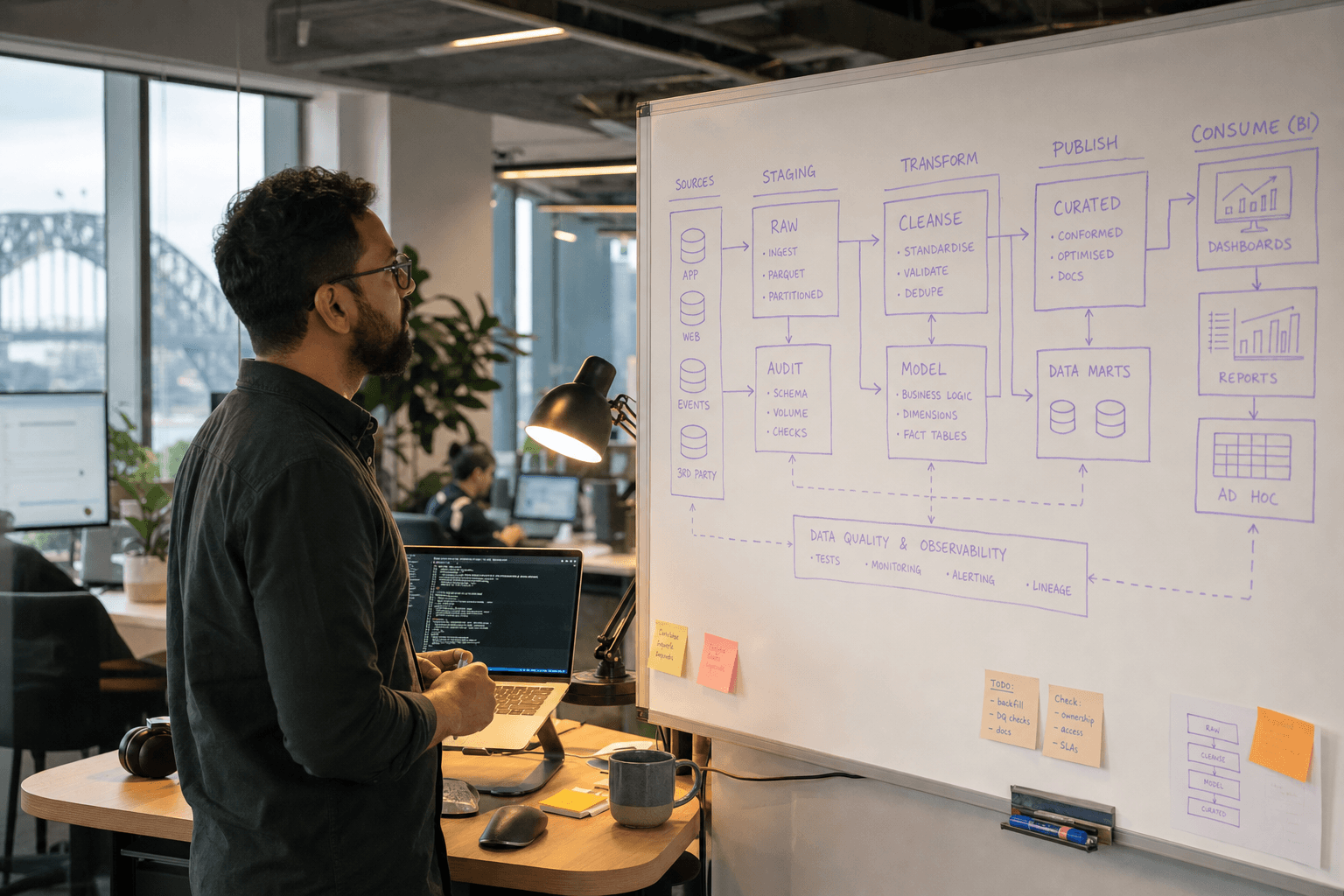
dbt for Mid-Market: Data Transformation Without Enterprise Costs
dbt brings enterprise-grade data transformation capabilities to mid-market Australian companies without enterprise costs. Learn how to implement modern data pipelines using SQL and software engineering best practices.

Data Quality for AI: Why Garbage In Still Means Garbage Out
Poor data quality is the fastest way to turn a promising AI project into an expensive failure. Learn how to assess if your data is AI-ready and implement a practical framework for data quality: profiling, validation, monitoring, and remediation.

Building Your First Data Pipeline: A Guide for Business Leaders
A data pipeline is an automated system that moves data from various sources, transforms it, and delivers it where your business needs it. Understanding data pipelines is crucial for business leaders because they form the foundation for reporting, analytics, and AI initiatives.

Data Warehouse vs Data Lake vs Lakehouse: Which One Do You Need?
Choosing the right data architecture — warehouse, lake, or lakehouse — can make or break your AI initiatives. Each approach serves different needs and impacts your ability to build AI-powered features.

Microservices vs Modular Monolith: Choosing the Right Architecture
Not every application needs microservices. For many mid-market companies, a modular monolith delivers clean architecture benefits without distributed systems complexity. Here's how to choose the right approach for your team in 2026.

Vector Database Guide: Pinecone vs Weaviate vs pgvector
Compare Pinecone, Weaviate, and pgvector for Australian AI applications. Practical guidance on choosing the right vector database for RAG systems, data sovereignty, and scaling requirements.

Cloud Migration Strategy for Australian Mid-Market Businesses
Cloud migration for Australian mid-market companies requires strategic alignment with business objectives, not just technical provider comparisons. Focus on building foundations that enable future growth while managing risk through phased implementation.

API-First Architecture: Why It Matters for AI Readiness
API-first architecture creates the foundation for seamless AI integration by making business data programmatically accessible. Learn practical patterns for retrofitting APIs onto legacy systems and designing interfaces that scale with AI demands.

Modernising .NET Legacy Applications: A Practical Migration Path
.NET Framework modernisation is critical for Australian enterprises, but the challenge is doing it without breaking production systems. The strangler fig pattern offers a safe, incremental approach to migrate legacy applications to modern .NET 8.