AI Localisation Architecture for APAC Market Expansion
Expanding into New Zealand and APAC takes more than a translation layer. This guide walks through the architectural decisions — retrieval, data structure, model selection, and locale-specific UX — that determine whether a multi-language AI rollout scales cleanly or needs a rebuild.
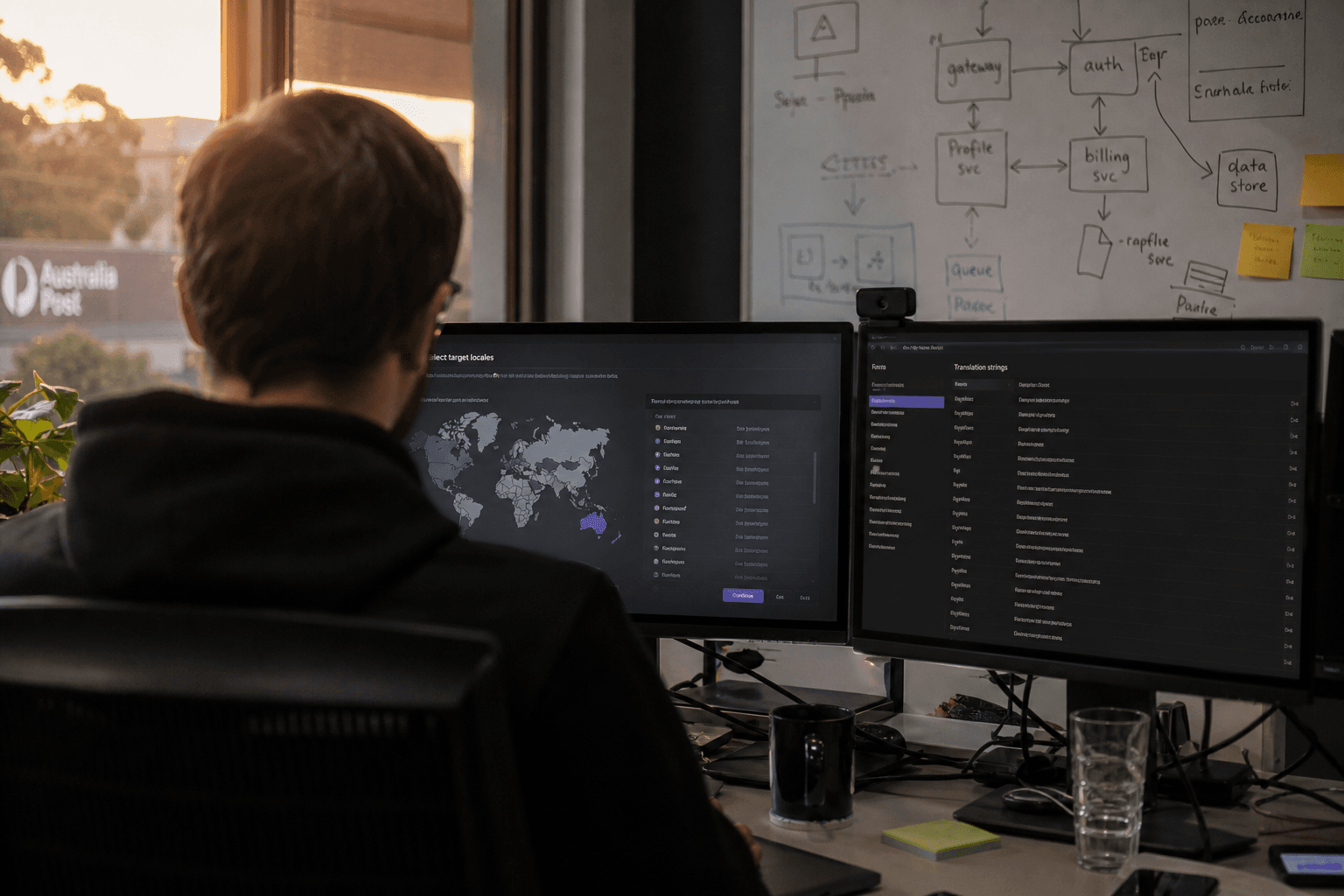
Expanding a SaaS or e-commerce product into New Zealand and broader APAC markets is often treated as a translation problem. It isn't. It's an architecture problem — one that touches your retrieval systems, your content pipelines, your model selection, and your UX in ways a simple string-translation layer can't solve. This guide sets out the architectural building blocks worth understanding before you commit engineering time to a multi-language rollout.
A note on scope: this is a synthesised architectural guide based on general AI infrastructure patterns, not a summary of a specific vendor benchmark or case study. Where we reference platform capabilities (retrieval-augmented generation, vector search, feature stores, model tuning), we're describing the class of tooling available on modern AI platforms — not quoting specific performance numbers, which we won't fabricate.
What is AI-powered localisation architecture?
AI-powered localisation architecture is the set of systems — translation and generation models, retrieval layers, content pipelines, and UX logic — that let a product serve accurate, culturally appropriate experiences in multiple languages and regions without maintaining a separate codebase per market. It sits above raw machine translation and below your product's UI layer, deciding what gets translated, generated, retrieved, or left untouched per locale.

The key distinction from traditional localisation tooling (translation management systems, string catalogues) is that AI-native architecture treats content as dynamic. Product descriptions, support responses, search results, and recommendations can be generated or adapted per locale in real time, rather than pre-translated and cached as static strings.
Why does expanding into New Zealand and APAC need more than translation?
New Zealand is often the easiest first step — English-first, culturally adjacent, similar regulatory environment — but it still surfaces gaps: date formats, currency, GST versus Australian GST rules, spelling conventions, and local payment methods. Broader APAC expansion (Southeast Asia, Japan, Korea, Greater China) multiplies this by adding genuine language translation, right-to-left or double-byte character handling, and materially different UX expectations.
Translation quality is necessary but not sufficient. A product that translates its interface correctly but keeps Australian idioms, AUD-only pricing logic, or assumptions about address formats will still feel foreign to users in Auckland, Singapore, or Tokyo. Architecture needs to separate language from locale — they are not the same axis, and treating them as one is the most common design mistake in early localisation efforts.
How should you architect a multi-language AI pipeline?
A robust pipeline separates four concerns: content retrieval, translation/generation, locale adaptation, and quality review. Each should be a distinct, swappable component rather than a single monolithic "translate everything" service, because your quality bar, latency tolerance, and review requirements differ wildly across content types (legal text versus product descriptions versus chat responses).

Retrieval-augmented generation (RAG) is a useful pattern here even outside its usual chatbot context: it is the practice of retrieving relevant, locale-specific reference content — glossaries, prior approved translations, regional style guides — and feeding it into a model's prompt so outputs stay consistent with what's already been approved for that market. Storing your approved translation memory as retrievable context, rather than relying purely on a model's general training, reduces drift and repeated review cycles.
A feature store or equivalent structured data layer becomes important once you're personalising by locale — serving different pricing tiers, currency formats, or recommendation logic per region requires locale to be a first-class attribute in your data infrastructure, not an afterthought bolted onto the UI. If your current data layer wasn't built with multi-region attributes in mind, this is often the first place technical debt surfaces during expansion. Our data-infrastructure work usually starts exactly here — establishing the locale and entitlement model before any AI feature sits on top of it.
Which translation approach should you use: machine translation, LLM-based generation, or hybrid?
The right choice depends on content volatility, risk tolerance, and volume — not on which approach is newest. Static, high-risk content (legal terms, compliance disclosures, pricing rules) generally warrants human-reviewed translation regardless of the tooling used to draft it. Dynamic, high-volume content (search results, product feeds, support chat) is where AI translation and generation earn their keep.
| Approach | Best for | Review burden | Notes |
|---|---|---|---|
| Traditional machine translation (MT) | High-volume, low-risk static content | Lower | Mature, predictable, but limited context-awareness |
| LLM-based translation/generation | Dynamic content, tone-sensitive copy, chat | Moderate | Better context handling; needs prompt and glossary grounding |
| Hybrid (MT/LLM draft + human review) | Legal, compliance, brand-critical content | Higher | Slower per item, but necessary where errors carry real cost |
| Human-only translation | Regulatory filings, contracts | Highest | No AI substitute where liability is direct |
Fine-tuning or lightweight model adaptation can improve consistency for domain-specific terminology (industry jargon, product names that shouldn't be translated), but it's a maintenance commitment — every model update or terminology change requires revalidation. Many teams get better return from strong retrieval grounding and glossary enforcement than from full fine-tuning, at least in the early stages of expansion.
How do you handle locale-specific UX beyond text?
Locale-specific UX is the set of interface and interaction decisions — layout, input formats, payment methods, imagery, and information density — that need to adapt per market independently of language. Text can be perfectly translated and the product can still feel wrong if these elements aren't addressed.
Practical examples worth planning for before launch: address and phone number formats (New Zealand postcodes and Australian postcodes are already different), date formats, decimal and thousands separators, right-to-left layout support if any target market requires it, and payment method availability (some APAC markets favour bank transfer or e-wallet options over cards). None of this is exotic — it's the kind of groundwork that's cheap to design for up front and expensive to retrofit into a monolith that assumed a single locale from day one. If your platform has grown organically without this separation, it's worth treating as an application-modernisation problem alongside the localisation work, not a separate initiative.
How should you evaluate and select models for APAC languages?
Model selection should be driven by measured output quality on your actual content, in your actual domain, for each target language — not by leaderboard rankings alone, since general-purpose benchmarks don't reflect how a model handles your product's specific terminology or tone. Build a small, representative evaluation set per target locale (product descriptions, support transcripts, UI strings) and score candidate models against it using both automated metrics and native-speaker review.
Model selection is the process of comparing candidate translation or generation models against defined quality, latency, and cost criteria for a specific use case, then choosing the one that best fits — rather than defaulting to whichever model is already integrated elsewhere in the stack. For APAC expansion specifically, pay attention to how models handle character sets (Japanese, Korean, Chinese), formality levels (several APAC languages have grammatically distinct formal/informal registers that matter commercially), and mixed-language input, which is common in real user queries across the region.
What does a sensible rollout sequence look like?
A staged rollout — starting with New Zealand, then expanding to English-fluent APAC markets, then true multi-language markets — lets you validate architecture decisions before the hardest translation problems arrive. New Zealand surfaces locale issues (currency, date formats, GST/tax logic) without the added complexity of translation quality assessment, making it a useful architectural proving ground.and Once the locale-separation architecture is solid, adding genuine translation layers for Southeast Asian or North Asian markets becomes an extension of the existing system rather than a rebuild.
This is also the point where AI product strategy decisions compound: which content gets AI-generated per market, which stays centrally authored and translated, and how you monitor quality drift over time as models and content both change. Getting this sequencing wrong is one of the more expensive mistakes we see — teams build a single-market AI feature, then discover the entire retrieval and prompt structure needs rework to support even one additional language.
Common pitfalls worth planning around
The most frequent issues aren't technical failures — they're architectural decisions made too early, before locale requirements were understood. Treating locale as a UI-only concern, hardcoding currency or date logic in application code rather than data models, and skipping native-speaker review on AI-generated content are the three we see most often. None require exotic fixes; they require designing the separation of concerns early, which is far cheaper than retrofitting it after launch.
If you're planning a multi-market AI rollout, it's worth reading more broadly on how AI product decisions get made before committing to a build — see our insights for related coverage on AI product strategy and engineering trade-offs.
Getting the architecture right before you build
Localisation architecture decisions made in the first few weeks of a project are the hardest to undo later. If you're exploring AI-powered localisation for a New Zealand or APAC expansion, we can help you think through the retrieval, data, and model-selection decisions before code gets written — our ai-product-strategy and ai-engineering teams work through exactly these trade-offs with product and engineering leaders. Get in touch to talk through your specific expansion plans.
Chris Kerr
Partner at Horizon Labs, an AI product consultancy and venture studio. A commercially focused product and technology leader with 20+ years building and scaling digital platforms, teams, and businesses across SaaS, travel, eCommerce, logistics and transport, and digital marketing — operating at the intersection of product, engineering, and data. Writes about platform strategy, AI transformation, modern data ecosystems, and the operational discipline that separates AI demos from AI products.