Edge AI for Industrial IoT: An Architecture Guide
Edge AI for industrial IoT means running inference locally on-site rather than in the cloud. This guide covers the latency, connectivity, and maintenance trade-offs that shape a sound architecture.
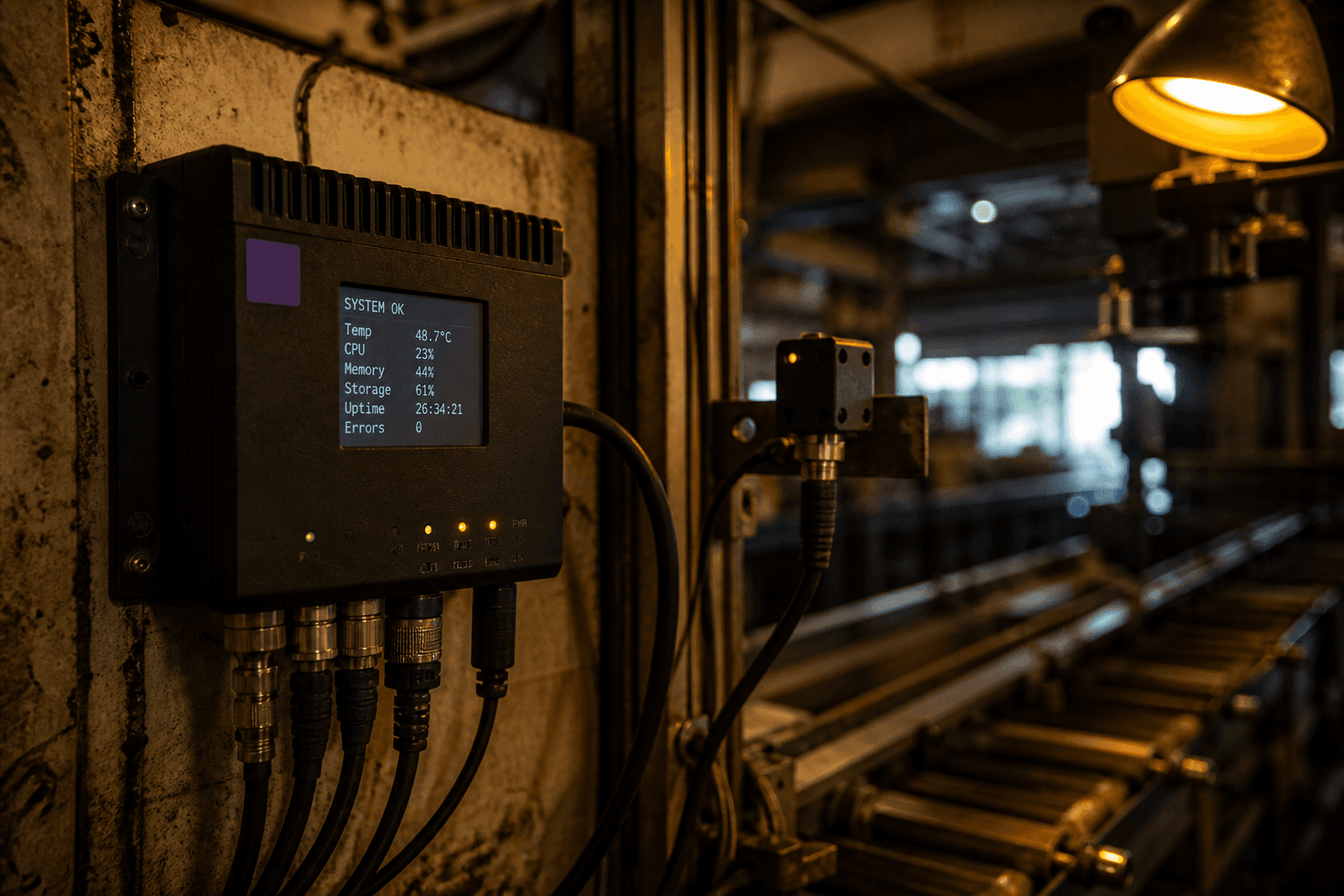
Edge AI for industrial IoT means running a trained machine learning model's inference step directly on local hardware — a PLC-connected gateway, an industrial PC on a production line, or an onboard compute unit in a logistics vehicle — instead of sending data to a cloud service and waiting for a response. The model can still be trained and updated centrally, but the decision at the point of use happens on-site, in milliseconds, without a round trip to a data centre. This architecture guide walks through the decisions that matter once inference moves from the cloud onto industrial hardware: latency budgets, connectivity constraints, and how you maintain a model fleet you can't walk up to.
What is edge AI for industrial IoT?
On-device inference is the execution of a model locally, using the device's own compute, for the prediction itself — not the training. Training typically still happens centrally, often in the cloud, where compute is cheap and data from many sites can be pooled. What changes at the edge is where the trained model actually makes its call: a defect-detection camera on a production line, or a predictive-maintenance sensor on a truck engine, evaluates the model on-site and acts on the result immediately, then reports back to the central system when it can.
This distinction matters because it reframes the engineering problem. You're not asking "can we run AI without the internet" — you're asking which decisions need to happen locally, which can be made centrally, and how the two halves of the system stay in sync.
Why does on-device inference matter on the factory floor and in the fleet?
Industrial environments have constraints that consumer mobile AI rarely faces: machinery that must react in milliseconds, sites with patchy or metered connectivity, and hardware that runs for years without a refresh cycle. A defect-detection camera on a production line, or a predictive-maintenance sensor on a truck engine, often needs an answer before the next frame or the next sensor reading arrives — not after a network call completes.
This is a genuinely different engineering problem to consumer AI. A phone app can tolerate the occasional failed API call and fall back gracefully; a safety interlock on a press brake, or a collision-avoidance signal in a fleet vehicle, generally cannot. The cost of a missed or late inference is operational, not just a poor user experience.
How does industrial edge AI differ from consumer mobile AI deployment?
Consumer mobile AI is designed around devices that are replaced every few years, connected to consistent broadband or cellular networks, and managed by the end user. Industrial edge deployments are different on almost every axis: hardware lifecycles measured in a decade or more, connectivity that may be intermittent or bandwidth-constrained — particularly across regional Australian sites and long-haul freight corridors — and fleets of devices that need to be updated and monitored centrally without anyone physically present.
That changes the engineering priorities. Model size and power draw matter more than marginal accuracy gains. Update mechanisms need to assume the device might be offline for days at a time. And diagnostics need to work without someone plugging in a laptop at the asset. Teams working through this kind of platform decision often find it overlaps with broader application modernisation work, since legacy SCADA and PLC integrations rarely anticipated model deployment as a requirement.
What are the latency trade-offs in an edge inference architecture?
Latency in industrial settings is rarely a single number — it's a budget that gets split between sensing, inference, and actuation, and the right split depends on what the system is controlling. A quality-control vision system inspecting parts on a conveyor has a tighter real-time budget than a fleet telematics model flagging a maintenance recommendation that a technician will review the next day.
The general pattern holds: the tighter the real-time requirement, the more inference needs to happen on or very near the device, with the cloud reserved for retraining, aggregation, and fleet-wide analytics rather than per-event decisions. Organisations building this kind of pipeline often start by mapping which decisions genuinely need sub-second local inference and which can tolerate a cloud round trip — that scoping exercise is where most architecture mistakes are made or avoided, and it's a question we work through directly with clients under ai product strategy.
What connectivity constraints shape edge AI design in Australia?
Connectivity is where industrial edge AI diverges most sharply from cloud-native AI platforms. Managed cloud ML services — including platforms with feature stores and vector search built for data-centre-scale serving — generally assume a reliable, high-bandwidth connection between the application and the model endpoint. Many manufacturing sites and logistics routes in Australia cannot assume that: regional facilities, port and rail corridors, and long-haul fleets regularly operate with limited, metered, or intermittent connectivity.

A sound architecture treats connectivity as a variable, not a constant. That typically means designing for graceful degradation — the device keeps making local decisions and buffering telemetry when the network is down, then syncs state and retrained models when connectivity returns — rather than an architecture that assumes an always-on link to a central service.
How do you maintain and update models deployed on distributed hardware?
Maintenance is the trade-off that gets underestimated most often. A model deployed to a handful of cloud endpoints is straightforward to monitor and roll back; a model deployed across hundreds of ruggedised gateways or vehicle units, some of which are offline for extended periods, is a different operational problem entirely — closer to fleet device management than conventional MLOps.
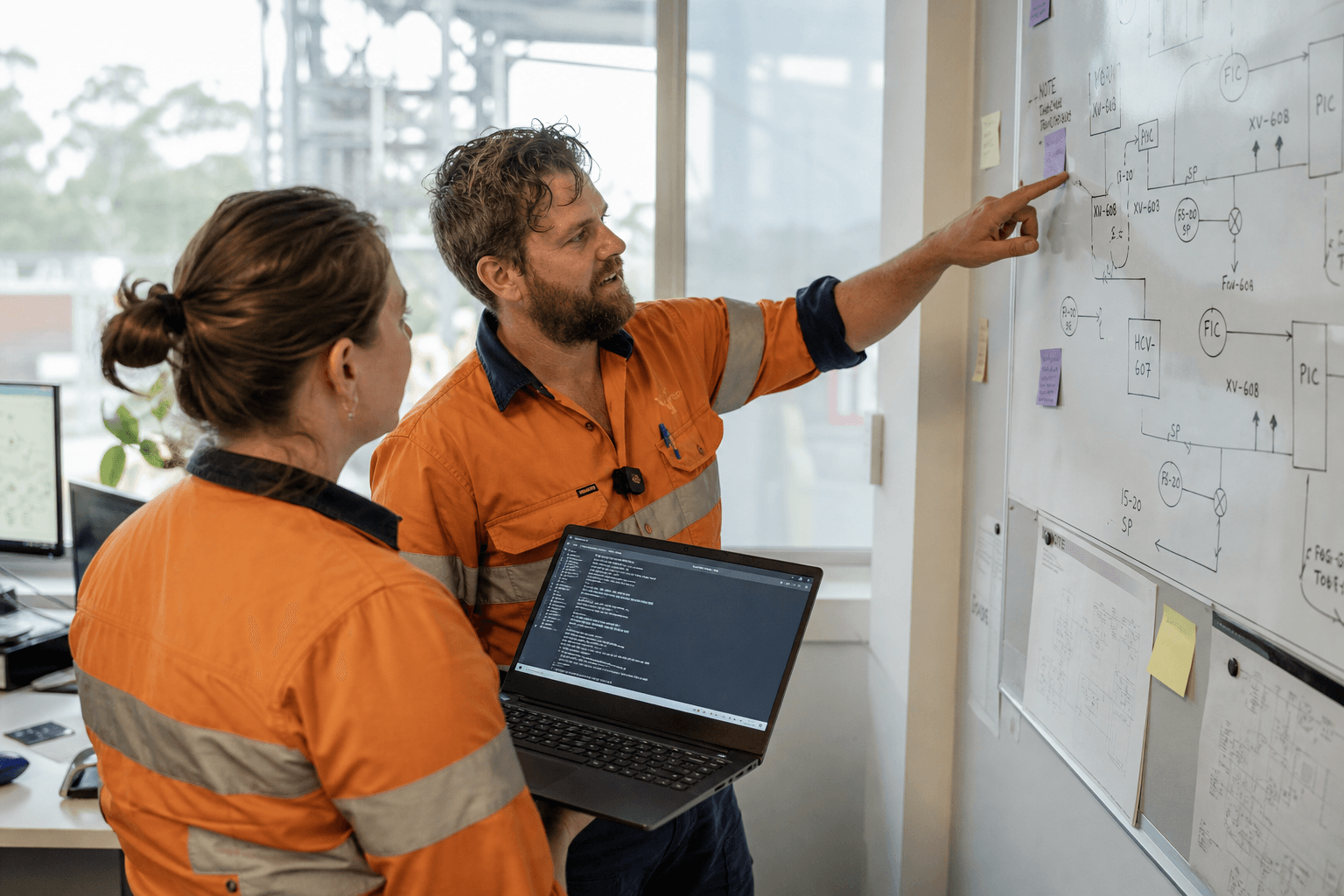
Practical architectures separate the concerns clearly: centralised training and model versioning sit in one system, while a separate deployment and monitoring layer handles staged rollouts, version pinning per device, and rollback if a new model underperforms on a subset of hardware. Devices should report health and drift signals opportunistically rather than on a fixed schedule, since connectivity windows are unpredictable. This is also where organisations typically discover gaps between their existing data infrastructure and what fleet-scale model operations actually require — pipelines built for batch analytics don't automatically support versioned model artefacts and edge telemetry at scale.
Getting this right is less about picking the newest edge runtime and more about disciplined ai engineering: defining clear interfaces between the on-device and cloud components, instrumenting for observability from day one, and building update mechanisms that assume failure as the normal case rather than the exception.
Where to start
Most industrial organisations don't need every decision pushed to the edge — they need a clear map of which decisions are latency-critical, which can tolerate a cloud round trip, and which hardware and connectivity constraints actually apply at each site. That scoping work, done honestly, is usually what separates an edge AI pilot that survives contact with a production floor from one that doesn't.
If you're weighing up where inference should live in your architecture, or want a second opinion on a design already in progress, get in touch — we're happy to talk through the trade-offs. You can also browse more insights on related AI and infrastructure topics.
Chris Kerr
Partner at Horizon Labs, an AI product consultancy and venture studio. A commercially focused product and technology leader with 20+ years building and scaling digital platforms, teams, and businesses across SaaS, travel, eCommerce, logistics and transport, and digital marketing — operating at the intersection of product, engineering, and data. Writes about platform strategy, AI transformation, modern data ecosystems, and the operational discipline that separates AI demos from AI products.