Choosing an Enterprise AI Platform: Bedrock vs Azure vs Vertex
Choosing an AI platform is a governance and architecture decision, not just a model choice. We compare AWS Bedrock, Azure AI Foundry, and Google Vertex AI on governance tooling, cost structure, and vendor lock-in — and are upfront about where public documentation runs thin.
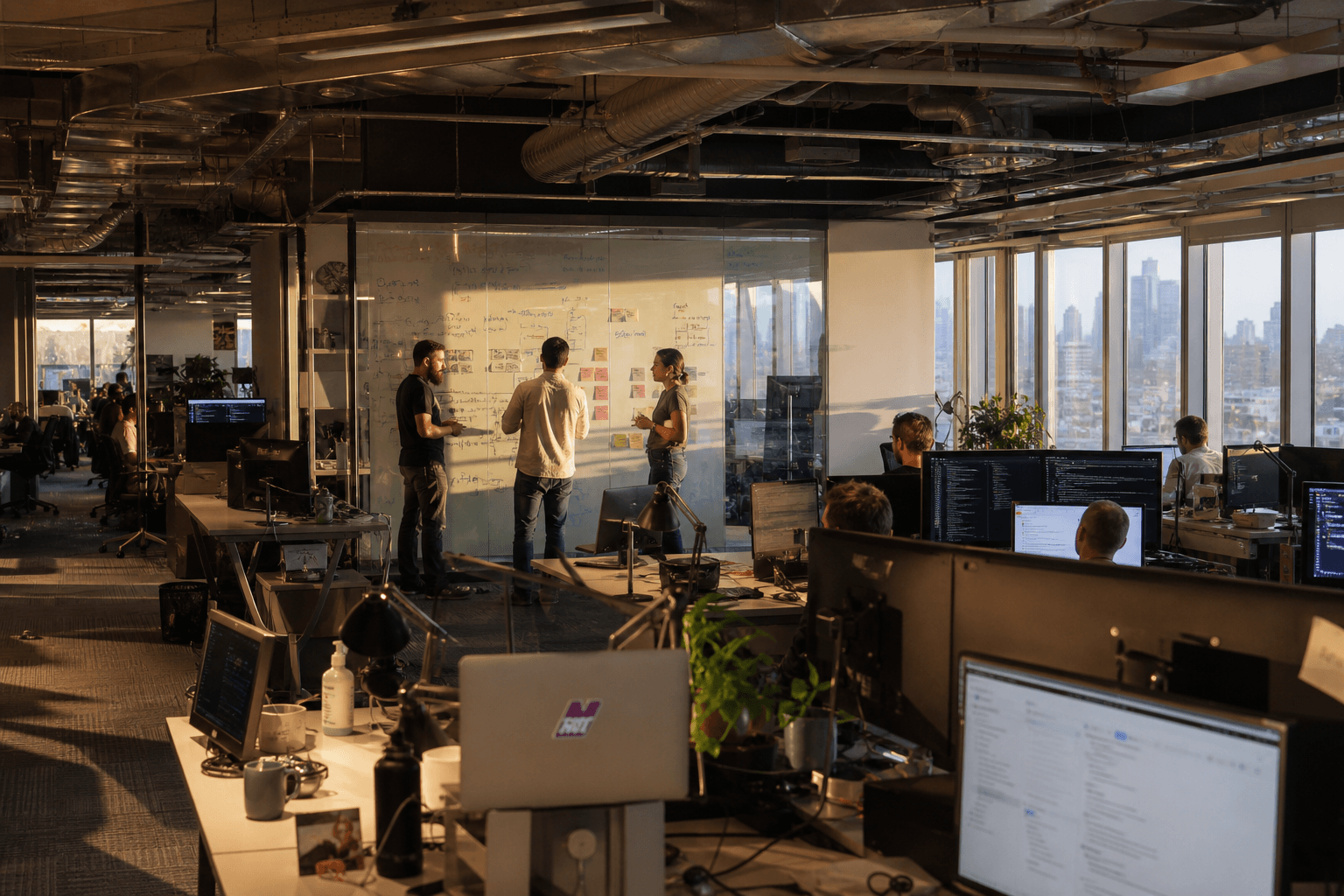
When engineering teams compare AWS Bedrock, Azure AI Foundry, and Google Vertex AI, the conversation usually starts in the wrong place: which model is best. That's the easy part — most frontier models are now accessible from more than one cloud. The harder, more consequential question is which platform ecosystem you want to build your governance, operations, and application architecture on top of for the next several years.
This article looks at the three major managed AI platforms through that lens: governance tooling, cost structure, integration effort, and vendor lock-in. We want to be upfront about something: our research base gives us deep, verified documentation on Google Vertex AI's platform architecture. Our visibility into the current internals of AWS Bedrock and Azure AI Foundry is comparatively shallow — AWS's own public documentation set we reviewed covers account and landing-zone governance tooling (Control Tower, Organizations, Security Hub), not Bedrock's model-serving or agent layer specifically, and we hold no dedicated documentation on Azure AI Foundry at all. Where we can't verify a claim, we say so rather than guess.
What is an AI platform ecosystem?
An AI platform ecosystem is the full set of managed services a cloud vendor provides around foundation models — not just model access, but the orchestration, retrieval, evaluation, governance, and operational tooling needed to run AI in production. Choosing one means choosing a long-term integration surface, not just an API endpoint.
For engineering leaders, this distinction matters because the switching cost of a platform ecosystem is much higher than the switching cost of a model. Swapping a model behind a stable API is often a config change. Re-platforming your RAG pipelines, agent orchestration, and governance policies from one vendor's managed services to another's is a multi-quarter engineering project.
Google Vertex AI: what's actually built into the platform
Google Vertex AI — recently rebranded in parts of its documentation as the Gemini Enterprise Agent Platform — is the most comprehensively documented of the three in our research, and it's unusually agent-native for a hyperscaler platform. Rather than treating agents as a thin wrapper around a chat model, Vertex AI ships a dedicated agent runtime called Reasoning Engines, with query, streaming (streamQuery), async (asyncQuery, cancelAsyncQuery), and bidirectional WebSocket invocation, plus persistent stateful Sessions for multi-turn agent memory. Google positions this as managed infrastructure comparable in role to open-source agent frameworks like LangGraph or LangChain's agent runtime — meaning teams evaluating Vertex are implicitly choosing a managed alternative to building that orchestration layer themselves.

Retrieval-augmented generation is similarly native rather than bolted on. Vertex exposes dedicated ragCorpora and ragFiles resources with a fuller lifecycle than a simple vector-search wrapper: retrieveContexts, augmentPrompt, corroborateContent, askContexts, and asyncRetrieveContexts. The presence of a corroboration step suggests some fact-checking and synthetic-data generation is designed into the managed service, rather than left entirely to application-layer code.
Governance in Vertex AI is surfaced as a distinct concern called Semantic Governance, paired with a separate provisionable policy engine, alongside the MLOps tooling you'd expect from a mature platform: feature stores, vector search, tuning jobs with checkpoint and rebase support, Tensorboard integration, model evaluation, and prompt caching. The developer surface is organised around Studio, Agents, Models, Notebooks, and Pricing, with a REST API at v1/v1beta1 and an "express mode" for simplified access to generateContent, streamGenerateContent, and countTokens.
What about AWS Bedrock and Azure AI Foundry?
This is where we need to be careful rather than confident. AWS Bedrock is a managed service for accessing multiple foundation models (Anthropic, Meta, Amazon's own Titan/Nova family, and others) through a unified API, with provisioned throughput options and integrations into AWS's broader data and security stack. Azure AI Foundry is Microsoft's unified studio for building, evaluating, and deploying AI applications across OpenAI and other partner models, integrated with Microsoft's identity and compliance tooling. Both of these are publicly known, generally described positions — we are not able to verify their current feature depth, agent runtime maturity, or RAG tooling against the same level of documentation we have for Vertex AI, so we won't construct a feature-by-feature scorecard that implies parity of research depth across all three.
What we can say with confidence is that AWS's governance strength lies elsewhere in its stack: Control Tower, Organizations, and Security Hub provide account vending, landing-zone guardrails, and compliance automation at the cloud-account level. That's valuable multi-account governance, but it's a different layer of the problem to Bedrock's model governance, and the two shouldn't be conflated when you're evaluating AI-specific policy controls.
Governance tooling: three different philosophies
The table below is a directional, qualitative comparison based on each vendor's publicly stated platform architecture — not independent benchmarking, and not a substitute for a proof-of-concept against your own workload.

| Dimension | Google Vertex AI | AWS Bedrock | Azure AI Foundry |
|---|---|---|---|
| Agent runtime | Native (Reasoning Engines, stateful Sessions) | Available via Agents for Bedrock; depth not independently verified here | Available via Foundry agent tooling; depth not independently verified here |
| RAG tooling | Native, multi-step lifecycle (retrieve, augment, corroborate) | Available via Knowledge Bases; architecture detail not verified here | Available via Foundry; architecture detail not verified here |
| AI-specific governance | Distinct "Semantic Governance" policy layer | Model-level guardrails exist; broader cloud governance is strong (Control Tower, Organizations) | Integrated with Microsoft Purview and Entra identity, per public positioning |
| Cloud-account governance | Standard GCP IAM/Org Policy | Mature multi-account tooling (landing zones, guardrails) | Azure Policy and management groups |
Cost structure and integration effort
All three platforms generally price around consumption — tokens processed, compute provisioned, and storage used — but the practical cost of a platform decision is rarely just the unit price. It's the integration effort: how much custom orchestration, retrieval, and governance code you have to write versus how much comes managed. A platform with native agent and RAG lifecycles, like Vertex AI's, can reduce the amount of bespoke infrastructure your team maintains — but only if your workload fits its opinionated architecture. A platform that asks you to assemble more of the stack yourself can offer more flexibility at the cost of more engineering time spent on plumbing rather than product.
This is a judgement call specific to your existing cloud footprint, team skills, and data residency requirements — it's not something a generic comparison table can resolve for you. Teams already standardised on one hyperscaler for compute and identity will usually find the matching AI platform cheaper to integrate in practice, even where unit pricing looks similar on paper.
Vendor lock-in: what to actually weigh up
Vendor lock-in in AI platforms shows up less in the model layer and more in the orchestration and governance layer. Agent runtimes, RAG corpora formats, prompt caching mechanisms, and policy engines are rarely portable between vendors without a rewrite. Before committing, it's worth mapping which parts of your intended architecture are genuinely managed-service-dependent (hard to migrate) versus which are thin wrappers you could re-point at another vendor's API with moderate effort.
How should an engineering team approach this decision?
Start with your workload, not the vendor marketing. If you need a managed agent runtime with built-in state and streaming, Vertex AI's architecture is purpose-built for that today. If your organisation is already deep in AWS's account and compliance tooling, the operational gravity of staying inside that ecosystem is real, even if Bedrock's model-layer feature set needs direct evaluation against your requirements. The same applies to Azure shops already using Entra ID and Purview for governance.
We'd recommend running a short architecture review or proof-of-concept against your actual retrieval and agent requirements before locking in a platform — not relying on vendor comparison pages (including this one) as the final word. Our ai-product-strategy work often starts exactly here: mapping what a client's workload actually needs against what each platform genuinely offers today, rather than what its roadmap promises. From there, our ai-engineering team builds the integration layer, and our data-infrastructure work makes sure the retrieval and pipeline foundations underneath any of these platforms are solid before you commit to one.
If your platform decision is tangled up with a broader legacy modernisation effort, it's also worth reading about application-modernisation patterns that let you decouple AI platform choice from your core application architecture, reducing the lock-in risk either way.
For more on related platform and architecture decisions, browse our insights.
Get in touch
If you're weighing up AWS Bedrock, Azure AI Foundry, or Google Vertex AI for a production AI initiative, we can help run an architecture review grounded in your actual workload and governance requirements — not a generic vendor comparison.
Chris Kerr
Partner at Horizon Labs, an AI product consultancy and venture studio. A commercially focused product and technology leader with 20+ years building and scaling digital platforms, teams, and businesses across SaaS, travel, eCommerce, logistics and transport, and digital marketing — operating at the intersection of product, engineering, and data. Writes about platform strategy, AI transformation, modern data ecosystems, and the operational discipline that separates AI demos from AI products.