AI Product Strategy: A Consulting Framework for Australian Businesses
AI product strategy is the structured process of deciding where AI creates real value in your product, what it takes to build it, and how you measure success. This article walks through the four-stage consulting framework Horizon Labs uses — from readiness assessment through implementation planning — to help Australian businesses move from intent to execution.

AI Product Strategy: A Consulting Framework for Australian Businesses
AI product strategy is the structured process of deciding where AI creates genuine value in your product, what it will take to build it, and how you measure whether it worked. For most Australian businesses, the challenge is not motivation — it is knowing where to start and how to avoid expensive detours. This article walks through the framework we use at Horizon Labs to take organisations from "we should probably do something with AI" to a concrete, sequenced roadmap they can actually execute.
What Is AI Product Strategy and Why Does It Matter?
AI product strategy is the discipline of defining which AI capabilities to build, in what order, on what foundations, and toward what business outcomes. Without it, AI initiatives tend to stall in pilot limbo — proof-of-concepts that never reach production, or features bolted onto products without solving a real problem.
For growing Australian businesses, this matters because the cost of a poorly sequenced AI programme is high. Engineering time is finite, data infrastructure takes time to build, and organisational trust in AI is fragile. A clear strategy reduces wasted spend and builds the internal confidence that sustains long-term adoption.
The framework we describe here covers four stages: assessment, opportunity mapping, roadmap development, and implementation planning. Each stage produces a concrete output, not just a slide deck.
Stage 1: AI Readiness Assessment
Before any roadmap can be meaningful, you need an honest picture of where you are starting from. An AI readiness assessment examines four dimensions:

Data Readiness
AI models are only as good as the data they are trained or grounded in. This assessment looks at whether your data is accessible, consistent, and sufficient in volume and coverage. Common findings at this stage include data siloed across systems with no integration layer, inconsistent schemas across environments, and business-critical data that exists only in PDFs or spreadsheets.
If your data infrastructure is not ready, the honest answer is to build it before committing to AI features. Our data infrastructure consulting work typically precedes AI engineering by one to two stages for companies in this position.
Technical Readiness
This covers your existing stack: cloud maturity, API architecture, deployment pipelines, and observability. AI features need somewhere reliable to live. A monolithic application with no deployment automation will struggle to absorb an LLM-powered feature without significant scaffolding.
If application architecture is the constraint, application modernisation work may need to run in parallel or slightly ahead of the AI programme.
Organisational Readiness
Do you have the internal capability to maintain what gets built? Are there change management constraints — compliance teams, governance processes, or risk appetite — that will shape what can be deployed? This is particularly relevant for Australian businesses in financial services, healthtech, and insurance, where responsible AI obligations intersect with APRA and AHPRA regulatory frameworks.
Problem Clarity
Finally, is there genuine agreement on what problem AI is meant to solve? Vague briefs like "we want to use AI in our product" are a starting point, not a specification. This stage surfaces the real business problems and maps them to the people experiencing them — both internal users and customers.
Stage 2: AI Opportunity Mapping
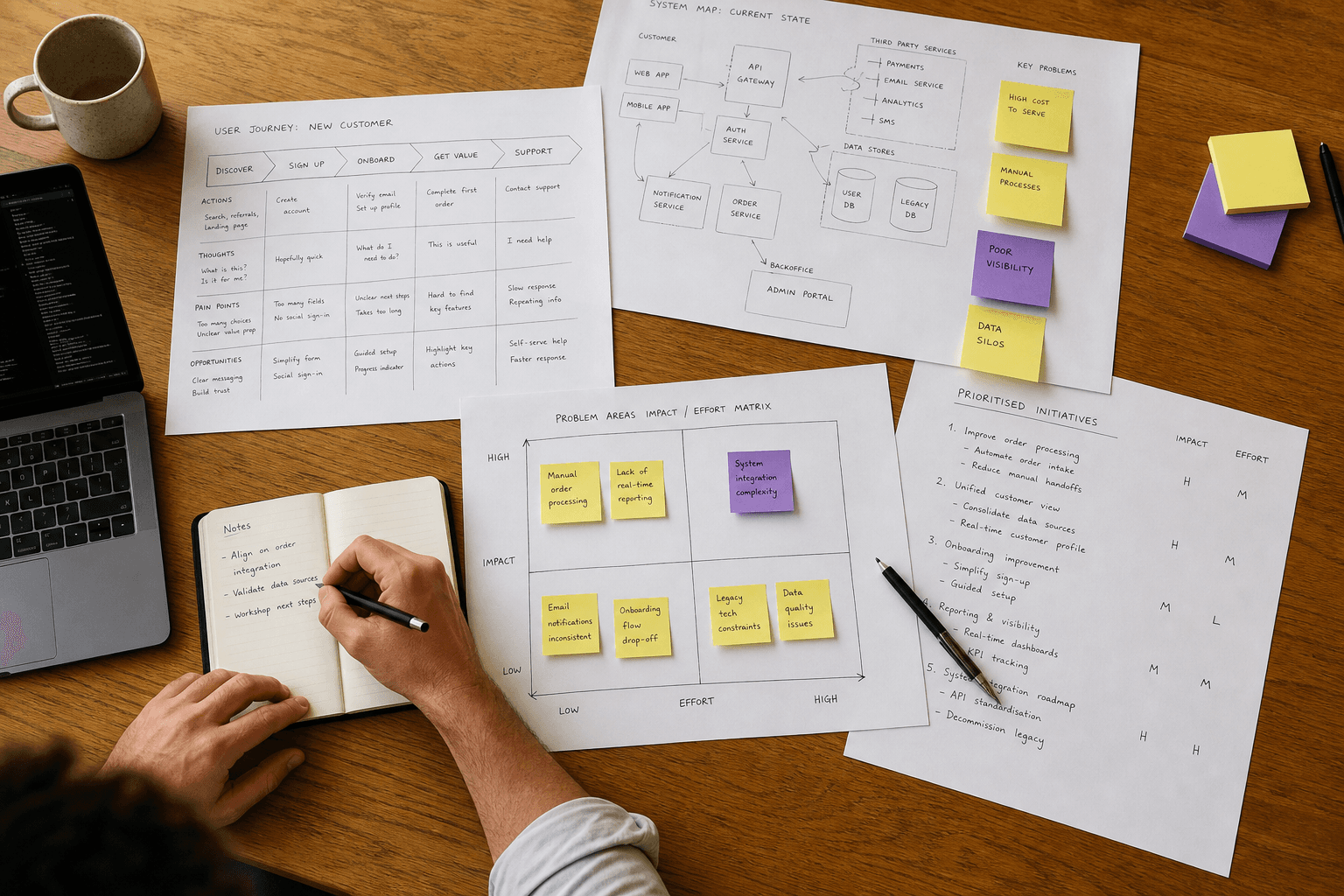
Once the readiness picture is clear, the next step is structured opportunity identification. This is not a brainstorm. It is a systematic process of examining your product and operations for problems that AI is actually well-suited to address.
What Problems Is AI Good At?
AI tends to create value in a specific class of problems:
- Classification and routing: Categorising inbound requests, triaging tickets, flagging anomalies
- Generation and synthesis: Drafting content, summarising documents, generating reports from structured data
- Prediction: Forecasting demand, estimating churn risk, scoring leads
- Search and retrieval: Semantic search over documents, knowledge base Q&A, product discovery
- Automation of judgment-heavy tasks: Tasks where a human currently applies pattern recognition repeatedly at scale
For each candidate problem, we assess three things: the quality of available data, the cost of errors (what happens when the model is wrong), and whether the benefit justifies the engineering and operational overhead.
Prioritisation Matrix
Opportunities are scored across two axes — business impact and implementation feasibility — and placed into a simple priority grid:
| Quadrant | Impact | Feasibility | Recommendation |
|---|---|---|---|
| Quick wins | High | High | Build first |
| Strategic bets | High | Lower | Invest with planning |
| Low-hanging fruit | Lower | High | Build if capacity allows |
| Deprioritise | Lower | Lower | Defer or drop |
This is a qualitative framework. The scores reflect your specific context, not invented benchmarks. The output is a ranked shortlist of AI opportunities, each with a plain-language problem statement and a first-pass view of what it would take to build.
Stage 3: AI Product Strategy Roadmap Development
An AI product strategy roadmap translates prioritised opportunities into a sequenced, time-bounded plan. It answers: what gets built, in what order, with what dependencies, and toward what measurable outcomes.
Sequencing Principles
Good AI roadmaps are sequenced around dependencies, not aspiration. The sequencing logic we apply:
- Foundation before features: Data pipelines, model infrastructure, and observability tooling before customer-facing AI features
- Internal before external: Deploy AI for internal users first, where the cost of errors is lower and feedback loops are tighter
- Narrow before broad: A focused AI feature that works well beats a broad one that works inconsistently
- Instrumentation from day one: Every AI feature should have measurement built in at the design stage, not added later
Roadmap Horizons
We typically structure AI roadmaps across three horizons:
Horizon 1 (0-3 months): Foundation and first proof of value. This might be a retrieval-augmented generation (RAG) system over your existing documentation, or an internal classification tool. Scope is tightly constrained. The goal is a production deployment, not a demo.
Horizon 2 (3-9 months): Core AI product features. Broader capability built on the infrastructure and learnings from Horizon 1. This is where the strategic bets from the opportunity matrix get properly resourced.
Horizon 3 (9-18 months): Compound capability. AI features that depend on accumulated data, user feedback loops, or more sophisticated model infrastructure. These are only achievable once the earlier foundations are in place.
Tooling and Architecture Decisions
The roadmap also captures key architecture decisions: which model providers or open-source models to evaluate, whether fine-tuning is warranted or retrieval-augmented generation is sufficient, where the system boundary sits, and how the team will monitor model behaviour in production.
These decisions have long-term consequences. We treat them as strategic, not purely technical, choices. Our AI product strategy engagements always include explicit vendor and architecture guidance, because these decisions shape the total cost of ownership for years.
Stage 4: Implementation Planning
Strategy without an implementation plan is a document. The final stage translates the roadmap into something an engineering team can execute.
Build vs Buy vs Partner
For each initiative on the roadmap, there is a make-or-buy decision. The options are rarely binary:
| Approach | When It Fits | Consideration |
|---|---|---|
| Use foundation model APIs (e.g. OpenAI, Anthropic, Gemini) | Speed to market, general capability tasks | Ongoing API cost, data privacy, vendor dependency |
| Open-source models (e.g. Llama, Mistral) | Data sovereignty, cost at scale, customisation | Inference infrastructure, ongoing model management |
| Third-party AI platforms | Domain-specific use cases (e.g. document processing, speech) | Integration complexity, contract terms |
| Custom-trained models | Highly specialised tasks with proprietary data | Cost, time, MLOps maturity required |
For most growing Australian businesses, foundation model APIs with good retrieval infrastructure are the right starting point. Custom training is rarely warranted until data volume, task specificity, and operational maturity justify the investment.
Responsible AI and Governance
Implementation planning includes a governance layer. For Australian businesses, this means considering the Australian Government's Voluntary AI Safety Standard and, for regulated industries, specific obligations under APRA CPG 234 (technology risk) and relevant consumer data legislation.
Practical governance considerations at the implementation stage:
- Human oversight: Which decisions require a human in the loop, and how is that enforced in the product?
- Explainability: Can the system explain its outputs to users or auditors when required?
- Bias and fairness review: Has the training data or retrieval corpus been reviewed for systematic bias?
- Data retention and privacy: Where does user input go, and for how long? What are the implications under the Australian Privacy Act 1988?
These are not afterthoughts. They are engineering requirements, and they belong in the implementation plan from the start.
Team and Capability Planning
The implementation plan also addresses who does the work. Options include embedding an external team (which is what we do), hiring, or some combination. The honest question here is whether your organisation needs to build permanent internal AI/ML capability, or whether a partnership model covers your needs.
For many businesses at the 50-500 employee scale, a lean internal product team supported by an experienced external engineering partner is the most effective model. It avoids the recruiting challenges of building an AI team from scratch, and ensures the codebase is built to a standard the internal team can maintain. Our AI engineering work is explicitly structured around this handoff.
Common Failure Modes in AI Product Strategy
A few patterns we see repeatedly that are worth naming:
Starting with the technology, not the problem. "We want to build an AI agent" is not a product strategy. It is a solution in search of a problem. The framework above works backward from business value, not forward from technology.
Underestimating data work. In most AI projects, the majority of the engineering effort is in data preparation, integration, and quality — not in the model itself. Plans that do not account for this consistently run late and over budget.
Skipping observability. AI systems behave differently from traditional software. They degrade gradually, fail in unexpected ways, and are sensitive to data distribution shifts. Monitoring and evaluation infrastructure is not optional.
Treating the pilot as the product. A proof-of-concept running in a notebook or a sandboxed environment is not a production AI feature. The gap between the two is significant. Production AI is hard — and the implementation plan needs to reflect that.
How Australian Businesses Should Think About Timing
There is no universally right time to start an AI programme — but there are conditions that make it more or less likely to succeed. In our experience, the businesses that get the most out of AI investment are those that:
- Have a stable core product with clear user problems
- Have data infrastructure that is at least partially in place
- Have engineering leadership with the bandwidth to prioritise it properly
- Have tolerance for iteration — the first version of an AI feature is rarely the right version
If those conditions are not yet met, the most valuable use of the budget may be building the foundation rather than rushing to ship an AI feature.
For more on related topics, you can explore our insights on AI engineering, data infrastructure, and application modernisation.
Start With a Structured AI Strategy Conversation
If you are exploring AI product strategy for your business and want a structured starting point rather than an open-ended engagement, we offer a focused assessment to help you understand your readiness, identify the highest-value opportunities, and build a roadmap your team can execute. It is scoped, time-bounded, and designed to give you something useful whether or not you work with us beyond that point.
If that sounds like what you need, get in touch and tell us where you are starting from.
Chris Kerr
Partner at Horizon Labs, an AI product consultancy and venture studio. A commercially focused product and technology leader with 20+ years building and scaling digital platforms, teams, and businesses across SaaS, travel, eCommerce, logistics and transport, and digital marketing — operating at the intersection of product, engineering, and data. Writes about platform strategy, AI transformation, modern data ecosystems, and the operational discipline that separates AI demos from AI products.