Application Modernisation in Australia: The Complete 2025 Guide
A practical guide to application modernisation for Australian engineering leaders — covering patterns like strangler fig and re-architecture, architecture maturity trade-offs, and Australian-specific context including the Essential Eight and Hosting Certification Framework.

Application modernisation is the process of updating legacy software systems — outdated architectures, unsupported platforms, or brittle monoliths — so they can support current business needs, integrate with modern tools, and scale reliably. For Australian engineering leaders, 2025 brings a specific mix of pressures: ageing systems reaching end-of-life, board-level AI mandates that need modern data foundations, and compliance frameworks that shape how and where you can run modernised workloads.
This guide covers the main modernisation patterns, how to think about architecture maturity, and the Australian-specific context — security frameworks, hosting requirements, and government digital transformation mandates — that should inform your approach.
What is application modernisation?
Application modernisation is the practice of transforming legacy applications — in architecture, infrastructure, or both — to improve maintainability, scalability, and compatibility with modern tooling, without necessarily rewriting the system from scratch. It ranges from infrastructure-only changes (moving a system to the cloud as-is) through to full architectural re-design. The right approach depends on the age and risk profile of the system, the business case for change, and how much you can afford to disrupt while the system is in flight.
Why does application modernisation matter for Australian businesses right now?
Modernisation matters because legacy systems increasingly block two things growing Australian companies need: reliable scaling and AI adoption. A monolith that is hard to change safely also makes it hard to introduce the data infrastructure and integration points that AI engineering work depends on. Many mid-market Australian companies — roughly 50 to 2,000 employees — are underserved here: large consultancies and global systems integrators typically price modernisation programmes well into six figures with procurement-heavy, slow-moving engagement models, which is a mismatch for a scale-up needing to ship changes in weeks, not quarters.
What are the main application modernisation patterns?
There are four patterns most Australian engineering teams choose between, and the right one depends on risk tolerance, timeline, and how tightly coupled the legacy system already is.
Lift-and-shift moves an application to new infrastructure (typically cloud) with minimal code changes. It's the fastest way to exit unsupported infrastructure or a data centre lease, but it carries forward existing architectural debt — you get infrastructure relief, not a fix to underlying design problems.
Re-platform makes targeted changes during the move — swapping a database engine, containerising a service, or adopting managed cloud services — to gain some operational benefit without a full re-architecture. It sits between lift-and-shift and a rewrite in both cost and risk.
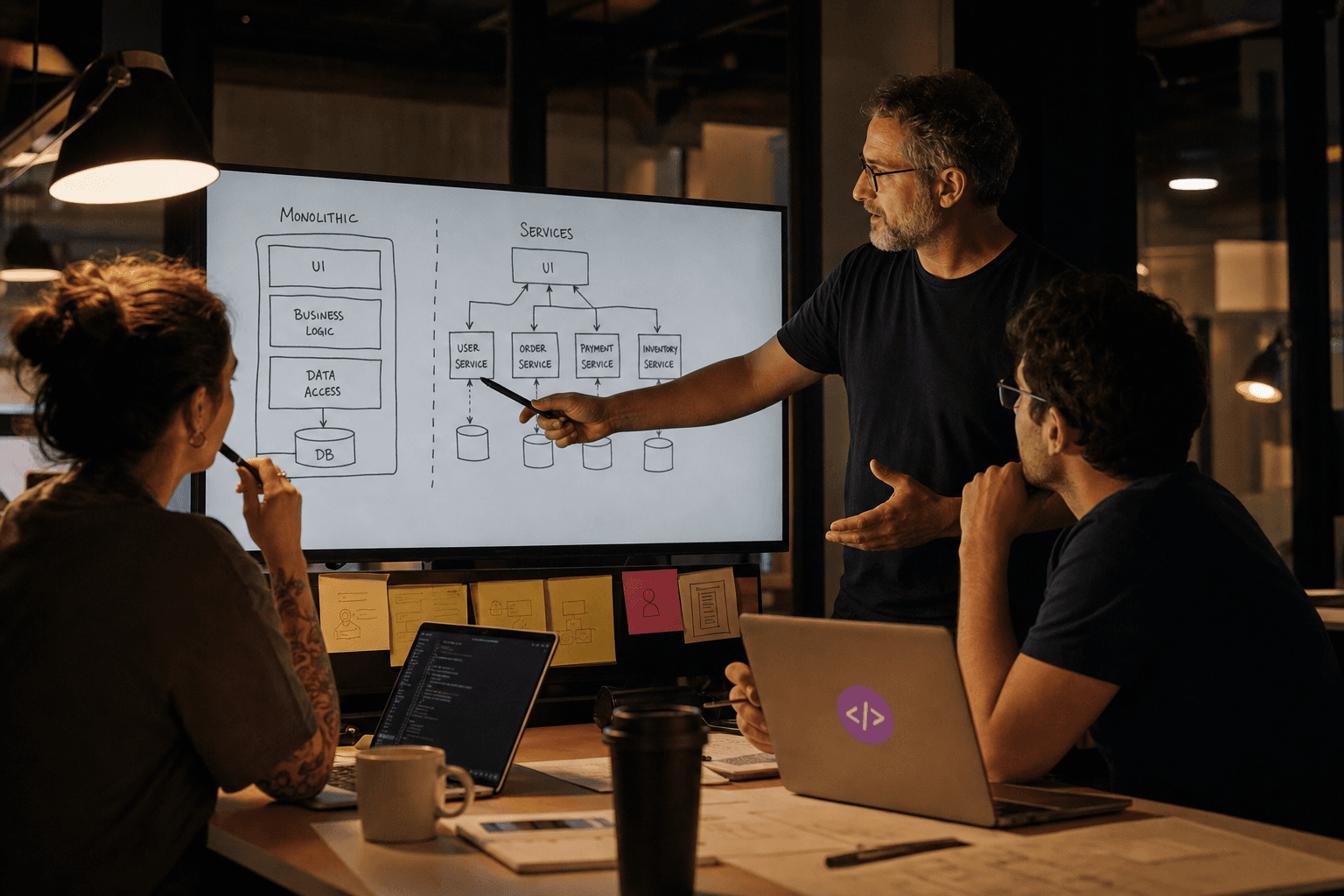
Re-architect restructures the application's internal design, often decomposing a monolith into services, while preserving business logic and behaviour. This is where most of the durable benefit lives, but it's also the highest-effort and highest-risk pattern if attempted as a single, large cutover.
Strangler fig is an incremental re-architecture pattern where new functionality is built alongside the legacy system, and traffic is gradually redirected until the old system can be retired piece by piece. It avoids a risky big-bang rewrite and lets teams keep shipping features throughout the migration. We cover this in more depth in RAG vs fine-tuning adjacent architectural thinking and specifically in application modernisation: the strangler fig pattern for legacy systems.
How do legacy monoliths compare to microservices and cloud-native architectures?
Architecture maturity is not a race to microservices — it's a match between system complexity and organisational capability. The table below compares the four common stages qualitatively; treat it as a discussion aid, not a scoring rubric.
| Architecture | Deployment flexibility | Operational complexity | Typical team fit |
|---|---|---|---|
| Legacy monolith | Low | Low (single deploy unit) | Small teams, stable feature set |
| Modular monolith | Medium | Low-Medium | Growing teams needing clearer boundaries without distributed-systems overhead |
| Microservices | High | High | Multiple teams, independent scaling needs, mature DevOps practice |
| Cloud-native (managed services, containers, serverless where appropriate) | High | Medium-High (shifted to platform) | Teams prioritising elasticity and reduced infrastructure ownership |
A modular monolith is often the pragmatic middle ground for Australian mid-market companies: it delivers much of the maintainability benefit of service decomposition without the operational overhead of running dozens of independently deployed services with a small platform team.
How does the ASD Essential Eight affect modernisation projects?
The Essential Eight is the Australian Signals Directorate's baseline set of mitigation strategies for cyber security, covering areas such as application control, patching, and restricting administrative privileges. Any modernisation project — particularly one touching infrastructure or introducing new services — is an opportunity to lift Essential Eight maturity, because it's far cheaper to bake controls like patching cadence and privileged access management into a new architecture than to retrofit them later. Organisations handling personal information as part of a modernised system also need to consider Australian Privacy Principles and Notifiable Data Breaches obligations under the Office of the Australian Information Commissioner's framework.

What is the Hosting Certification Framework and when does it apply?
The Hosting Certification Framework is a Digital Transformation Agency scheme that certifies hosting providers for use by Australian Government entities based on data sovereignty, security, and operational criteria. If your modernisation programme involves selling into, or operating as a supplier to, Australian government agencies, hosting decisions may need to reference this certification list — it's worth checking early rather than discovering a constraint after an architecture is already locked in.
How are state government digital transformation mandates shaping modernisation timelines?
Several Australian state governments run active digital transformation strategies that push agencies and, by extension, their suppliers and partners toward cloud adoption, API-first design, and improved citizen-facing services. If you sell into or partner with state government bodies, it's worth tracking your relevant state's digital strategy directly, since requirements and timelines vary by jurisdiction and are updated periodically — treat published state strategy documents as the authoritative source rather than second-hand summaries.
How long does an application modernisation project typically take?
Timelines vary widely with scope, but most Australian modernisation engagements follow a similar shape: a short assessment phase, followed by incremental delivery rather than one large cutover. An initial architecture review or readiness assessment typically runs a few weeks. A strangler-fig style migration of a meaningful legacy system is usually measured in months, delivered as a sequence of smaller releases rather than a single go-live, which keeps the business shipping value throughout rather than freezing feature work for a big-bang rewrite.
Where should you start?
Start with an honest assessment of what's actually blocking you — is it infrastructure age, architectural coupling, team velocity, or all three? A focused technical architecture review is usually the fastest way to get a clear, prioritised plan rather than guessing at scope upfront. You can read more about our approach on the application modernisation capability page, and if data quality or pipelines are part of the blocker, our data infrastructure work is often a natural companion. For more on related architecture and AI adoption topics, browse our insights.
If you're exploring application modernisation for your organisation, we can help — starting with a scoped review rather than a lengthy proposal.
Chris Kerr
Partner at Horizon Labs, an AI product consultancy and venture studio. A commercially focused product and technology leader with 20+ years building and scaling digital platforms, teams, and businesses across SaaS, travel, eCommerce, logistics and transport, and digital marketing — operating at the intersection of product, engineering, and data. Writes about platform strategy, AI transformation, modern data ecosystems, and the operational discipline that separates AI demos from AI products.