AI for Australian Manufacturing: 5 Use Cases That Work
Australian manufacturers are deploying production AI across five use cases today: predictive maintenance, computer vision quality inspection, document AI for compliance, demand forecasting, and procurement automation. This practitioner overview covers what makes each use case work in production — and where each one fails — for CTOs and engineering leaders evaluating where to start.
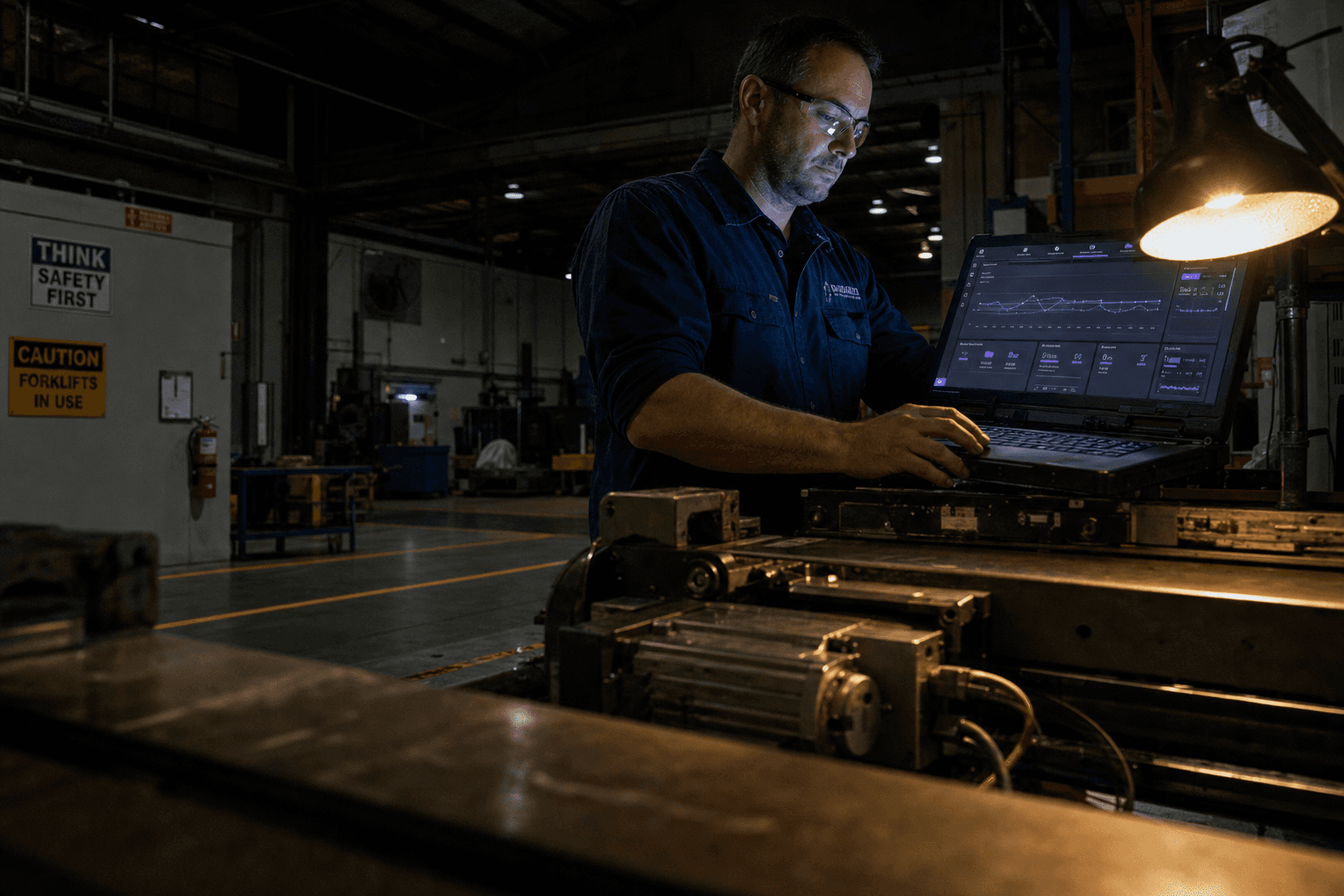
Australian manufacturers are under real pressure — rising input costs, workforce constraints, and global competitors who have been investing in automation and AI for years. The good news is that production-grade AI is no longer confined to automotive giants or tier-one aerospace suppliers. Mid-market manufacturers across Victoria, Queensland, and Western Australia are deploying AI in production today, not in pilot.
This post covers five use cases where AI is genuinely working in manufacturing environments — not as proofs-of-concept, but as systems running shift after shift, generating measurable outcomes. We have written it for CTOs and engineering leaders who want the practitioner view, not the vendor pitch.
1. Predictive Maintenance: From Scheduled Servicing to Condition-Based Intervention
Predictive maintenance is one of the most mature AI applications in manufacturing and, for many facilities, the highest-ROI starting point. The core idea is straightforward: rather than servicing equipment on a fixed calendar or waiting for failure, you use sensor data — vibration, temperature, pressure, current draw — to predict when a machine is likely to fail and intervene just before it does.
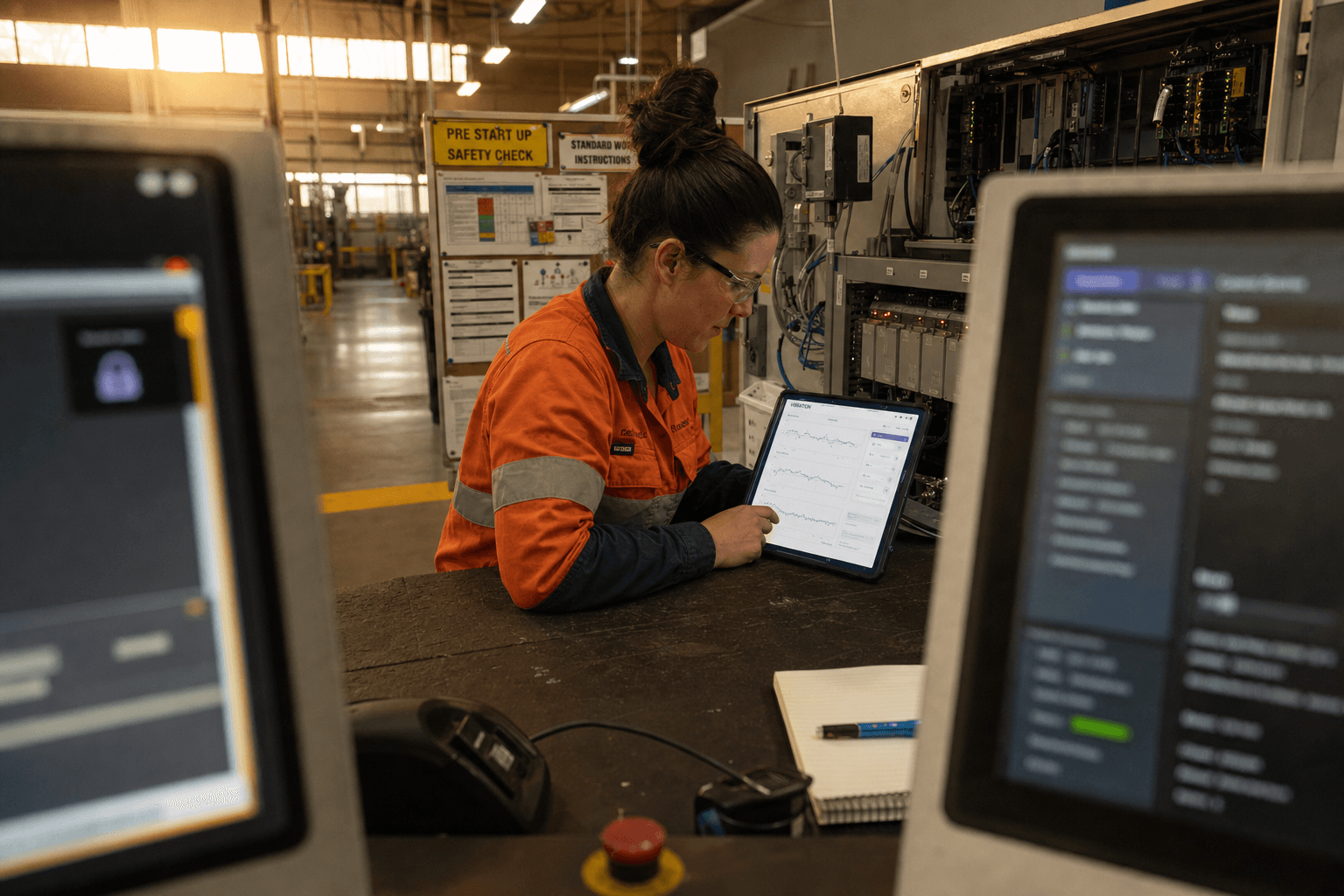
Modern predictive maintenance systems combine IoT sensor streams with time-series machine learning models. The model learns what "normal" looks like for each asset and flags anomalies that precede failure. Mature implementations can provide prediction windows measured in tens of hours, giving maintenance teams time to schedule intervention without halting production.
Illustrative outcomes cited in industry discussions include unplanned downtime reductions of around 80% and prediction windows of 60-72 hours or more for well-instrumented assets. These figures vary considerably depending on asset type, data quality, and model maturity — treat them as directional rather than guaranteed.
What makes it work in production:
- Clean, high-frequency sensor data with reliable timestamps
- Asset-level baselines rather than fleet-wide averages
- Integration with your CMMS or ERP so work orders are raised automatically
- A feedback loop — maintenance technicians logging actual failure modes so the model improves
Where it fails: Facilities with sparse or intermittent sensor coverage, assets with highly variable operating profiles, or environments where data historians are not connected to modern infrastructure. The AI problem is often secondary to a data infrastructure problem — see our work on data infrastructure for how we approach the foundation layer first.
2. Computer Vision Quality Inspection at Line Speed
Computer vision quality inspection is the use of camera systems and image classification or object detection models to identify defects, dimensional non-conformance, or assembly errors — automatically, at production line speed, without fatiguing.
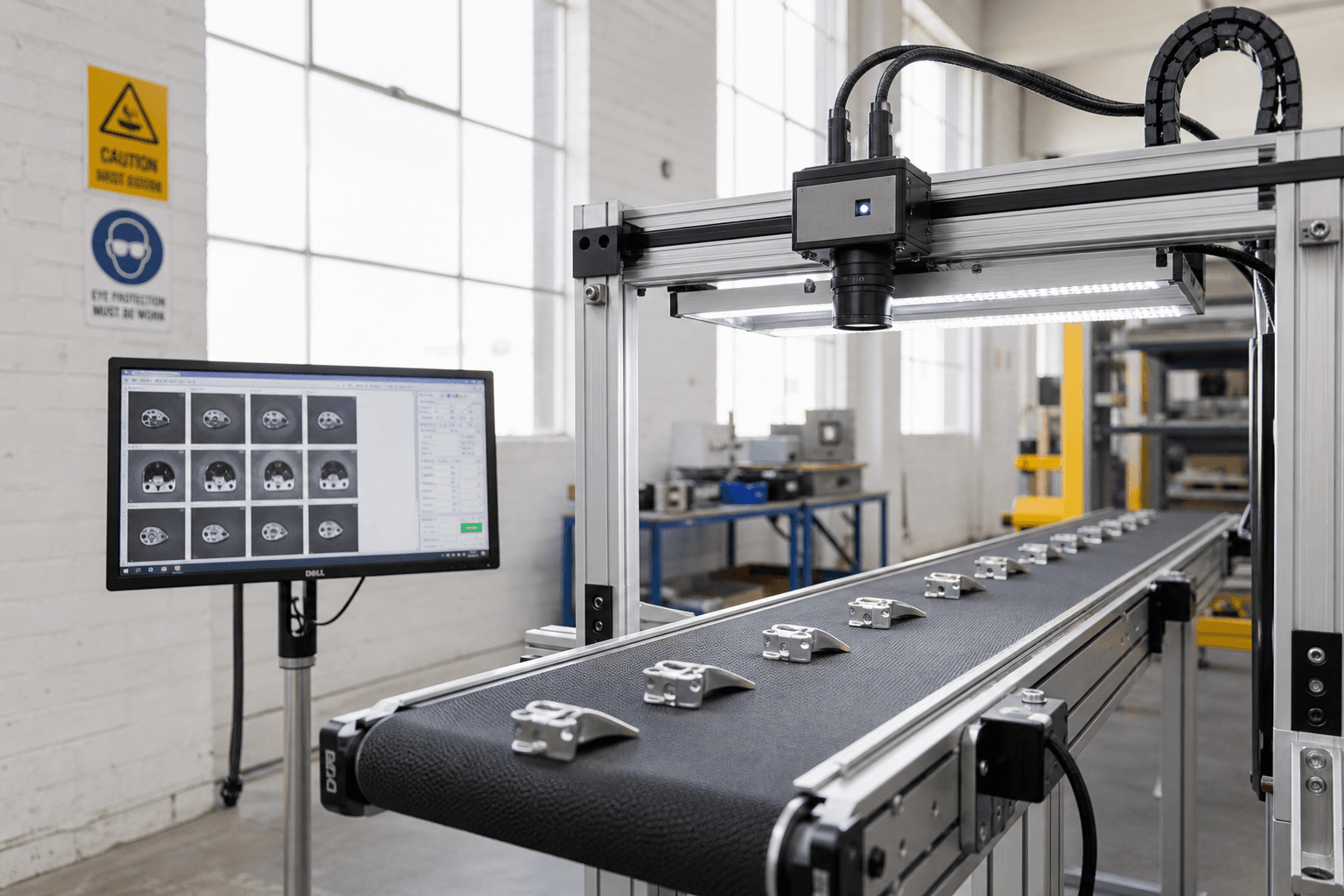
The business case is compelling: human visual inspection is inconsistent across shifts, slow relative to modern line speeds, and expensive at scale. A well-trained vision model running on edge hardware can inspect every unit rather than a statistical sample, flag defects in milliseconds, and log every result for traceability — something that matters enormously for ISO 9001 compliance and customer audit trails.
Common applications in Australian manufacturing include surface defect detection on metal and composite components, label and packaging verification in food and beverage, weld bead inspection, and assembly completeness checks.
What makes it work in production:
- Sufficient labelled examples of defect classes — this is often the bottleneck
- Consistent lighting and camera positioning (the model cannot compensate for a poorly engineered camera rig)
- Edge deployment so inspection latency does not depend on cloud round-trips
- Clear escalation logic — what happens when the model flags a unit versus rejects it automatically
Where it fails: Novel defect classes the model was not trained on, lighting variation across shifts, and situations where the acceptable quality boundary is inherently subjective or changes frequently. Active learning pipelines — where human reviewers label edge cases that are fed back into retraining — are essential for long-term reliability.
3. Document AI for Compliance and Safety Procedures
Document AI is the application of large language models and document understanding systems to extract, classify, retrieve, and reason over structured and unstructured documents. In manufacturing, this is especially valuable for compliance documentation, safety data sheets, work instructions, and audit evidence packages.
Australian manufacturers operate under a significant regulatory surface: Safe Work Australia standards, ISO management system requirements, industry-specific certifications, and increasingly, customer-mandated supply chain compliance requirements. Managing this documentation manually — finding the right version, confirming currency, linking procedures to equipment — is slow and error-prone.
Document AI systems can index your procedure library, answer technician questions in natural language ("What is the lock-out tag-out procedure for press line 3?"), flag documents approaching review dates, and automatically extract evidence for audit packs. Retrieval-augmented generation (RAG) architectures are well-suited here — the model retrieves relevant document chunks before generating an answer, which limits hallucination risk and grounds responses in your actual controlled documents.
What makes it work in production:
- A clean, version-controlled document repository as the source of truth
- Clear scope boundaries — the system answers questions about your documents, not general knowledge
- Human review for safety-critical outputs before action is taken
- Compliance with the Australian Privacy Principles if any documents contain personal information (workforce records, incident reports) — the Office of the Australian Information Commissioner provides guidance on AI and privacy obligations
Where it fails: Document libraries that are inconsistent, out of date, or stored across multiple unconnected systems. Garbage in, garbage out applies with particular force to RAG systems.
For teams thinking about where document AI fits in a broader AI product strategy, our AI product strategy capability covers how to sequence investments like this.
4. Demand Forecasting and Inventory Optimisation
Demand forecasting is the use of statistical and machine learning models to predict future product demand — and inventory optimisation is the translation of those forecasts into purchasing, production scheduling, and stock positioning decisions.
For Australian manufacturers, demand forecasting carries additional complexity: long import lead times for components (particularly from Asia-Pacific supply chains), seasonal demand variation, and a domestic market that is geographically dispersed. Getting inventory wrong in either direction is expensive — excess stock ties up working capital, while stockouts halt production or lose customer orders.
Modern forecasting systems move beyond simple time-series extrapolation. They incorporate external signals — commodity price indices, shipping lead time data, weather patterns for seasonal goods — alongside internal sales history. Ensemble models combining statistical baselines with gradient-boosted or neural forecasting components typically outperform single-method approaches on irregular demand patterns.
Inventory optimisation then takes the probabilistic forecast and computes reorder points, safety stock levels, and production batch sizes that balance service level targets against holding costs.
What makes it work in production:
- Reliable historical demand data — ideally at SKU level, with promotions and anomalies flagged
- Integration with your ERP so forecasts drive actual purchasing signals rather than sitting in a separate spreadsheet
- A defined process for human override — experienced planners have context the model does not
- Regular model retraining as demand patterns shift
Where it fails: Product lines with very short history, highly engineered-to-order products with no demand pattern, or businesses where a single customer dominates demand and their ordering behaviour is driven by relationship rather than observable signals.
5. AI Agents for Invoice and Procurement Automation
AI agents for procurement automation are systems that combine language models, document understanding, and workflow logic to handle repetitive procurement tasks — reading and validating invoices, matching purchase orders, flagging discrepancies, routing approvals, and generating purchase orders from reorder signals.
Manufacturing procurement teams deal with high invoice volumes, multiple supplier formats, and approval chains that slow down payments and create cash flow friction. Organisations processing large invoice volumes — in the range of thousands per month — report that a significant share of those invoices involve no exceptions and require no human judgement. Automating the routine cases frees procurement staff for supplier relationship management, contract negotiation, and exception resolution.
Illustrative throughput figures cited in practitioner discussions suggest that well-implemented systems can handle thousands of invoices per month in an automated or near-automated fashion, with human review reserved for exceptions. The actual volume and exception rate depend heavily on supplier diversity, ERP integration quality, and the consistency of incoming document formats.
What makes it work in production:
- Integration with your ERP and accounts payable system — this is non-negotiable
- A clear exception taxonomy — the agent needs to know what it can approve autonomously versus what requires escalation
- Supplier onboarding to preferred document formats where possible
- Audit logging of every automated decision for compliance and dispute resolution
Where it fails: High supplier fragmentation with many one-off vendors sending idiosyncratic document formats, ERP systems that lack modern APIs, and organisations without defined approval authority limits. The agent is only as reliable as the rules it is given — ambiguous approval policies produce ambiguous automation.
For teams ready to build procurement or operational AI agents, our AI engineering capability covers the full path from architecture through production deployment.
Choosing Where to Start
Not every manufacturer should start with the same use case. A rough prioritisation framework:
| Use Case | Data Prerequisite | Integration Complexity | Time to Production Value |
|---|---|---|---|
| Predictive Maintenance | High (sensor coverage) | Medium | Medium |
| Computer Vision QA | Medium (labelled images) | Low-Medium | Medium |
| Document AI (Compliance) | Low-Medium (document library) | Low | Low-Medium |
| Demand Forecasting | High (clean ERP history) | High | Medium-High |
| Invoice / Procurement Agents | Medium (ERP API access) | High | Medium |
The table uses qualitative descriptors deliberately — the actual timeline and complexity depend on your existing infrastructure. If your data infrastructure is fragmented, that is the constraint to solve first, not the AI model.
A Note on Australian Regulatory Context
Any AI system deployed in an Australian manufacturing environment that processes personal information — workforce safety records, incident data, supplier contact details — must comply with the Australian Privacy Principles under the Privacy Act 1988 and operate under the oversight of the Office of the Australian Information Commissioner (OAIC). This is not a reason to avoid AI; it is a reason to design data flows carefully from the start.
More broadly, Australia's emerging AI governance framework and Safe Work Australia's guidance on technology in the workplace are worth reviewing before deploying autonomous decision-making systems in safety-critical contexts.
Where to Go From Here
If you are exploring AI adoption in your manufacturing operation, the most useful first step is an honest assessment of your data infrastructure and integration landscape — before committing to any specific use case. The AI problem is rarely the hard part. The data plumbing usually is.
We work with Australian manufacturers and industrial technology businesses at exactly this stage — helping technical leaders build the foundation and then ship production AI that runs reliably, shift after shift. If that is the conversation you need, get in touch and tell us about your environment.
Chris Kerr
Partner at Horizon Labs, an AI product consultancy and venture studio. A commercially focused product and technology leader with 20+ years building and scaling digital platforms, teams, and businesses across SaaS, travel, eCommerce, logistics and transport, and digital marketing — operating at the intersection of product, engineering, and data. Writes about platform strategy, AI transformation, modern data ecosystems, and the operational discipline that separates AI demos from AI products.