Application Modernisation Cost Guide for Australia
Application modernisation costs in Australia vary significantly depending on your architecture, chosen approach, and cloud provider. This guide breaks down realistic cost ranges for common modernisation paths — from rehosting to full re-architecture — so you can plan and budget with confidence.

Application Modernisation Cost Guide for Australia
Application modernisation is the process of updating legacy systems — their architecture, codebase, infrastructure, or all three — to meet current reliability, scalability, and maintainability standards. For Australian businesses running on ageing software stacks, understanding what modernisation actually costs is the first practical step toward making a defensible investment decision.
This guide covers the main modernisation approaches, realistic cost ranges for Australian engagements, what drives cost up or down, and how to structure vendor selection. We have not invented numbers here — where we give ranges, they reflect the kinds of engagements our team sees across mid-market Australian organisations.
What Is Application Modernisation?
Application modernisation is the practice of transforming legacy software — whether a monolithic on-premises system, an ageing SaaS platform, or a patchwork of integrated tools — into a more maintainable, scalable, and extensible architecture. It is not simply a rewrite. Modernisation exists on a spectrum from lifting and shifting infrastructure to cloud, through to decomposing a monolith into domain-driven services, replacing vendor platforms, or rebuilding on a modern stack with AI capabilities embedded.
The right approach depends on your business goals, your tolerance for disruption, and how much technical debt you are actually carrying.
The Six Modernisation Approaches (and What Each Costs)
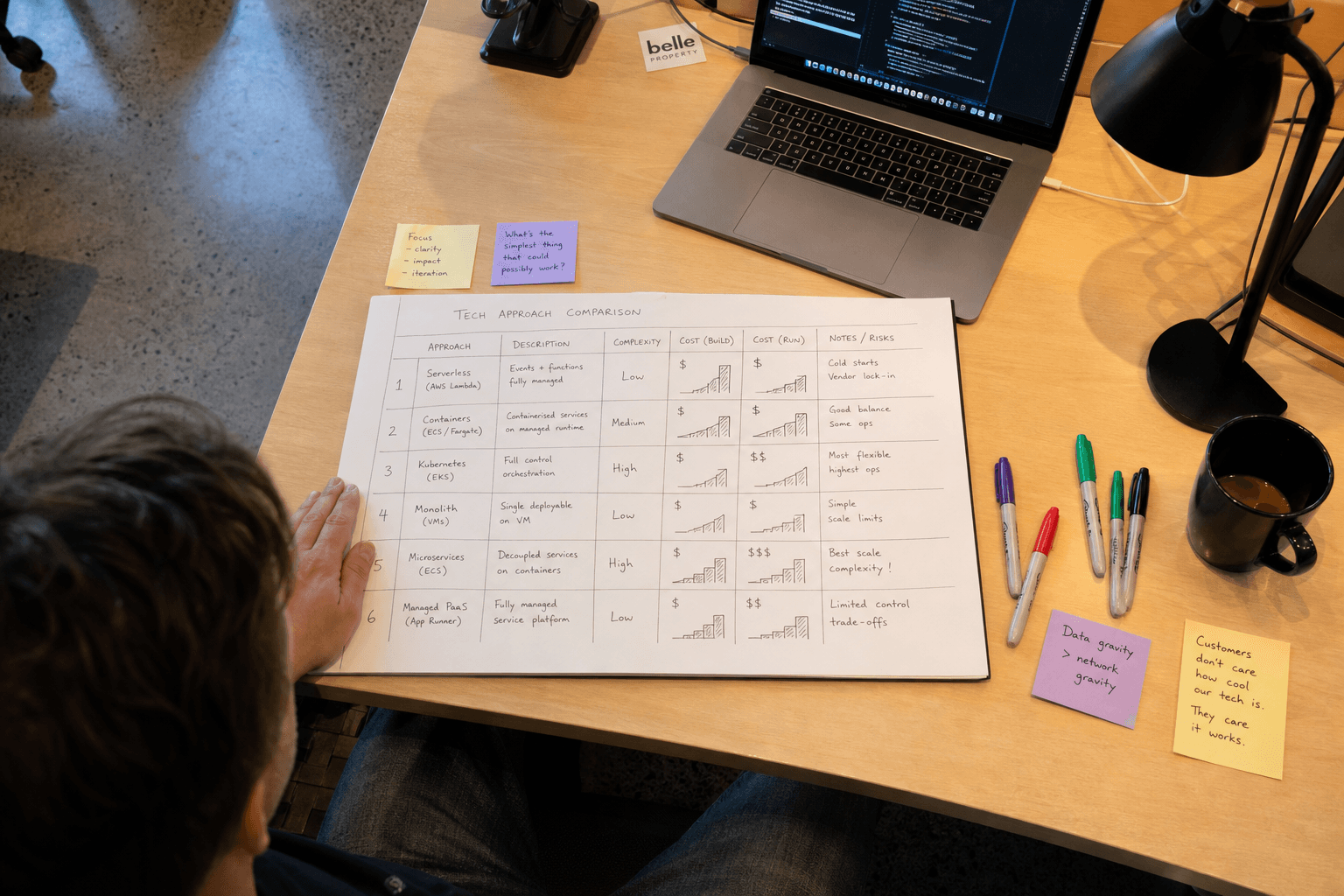
The most widely referenced framework for modernisation options is Gartner's "6 Rs" — Rehost, Replatform, Repurchase, Refactor, Re-architect, and Retire. Each sits at a different point on the cost and complexity curve.
| Approach | What It Means | Relative Cost | Relative Risk | Typical Duration |
|---|---|---|---|---|
| Rehost (Lift & Shift) | Move application to cloud with minimal changes | Lower | Lower | 4–16 weeks |
| Replatform | Move with targeted optimisations (e.g. managed DB) | Moderate | Moderate | 8–24 weeks |
| Repurchase | Replace with SaaS alternative | Moderate–Higher | Moderate | 8–20 weeks |
| Refactor / Re-architect | Restructure code or architecture without full rewrite | Higher | Higher | 16–52 weeks |
| Rebuild | Rewrite application from scratch on modern stack | Highest | Highest | 26–78 weeks |
| Retire | Decommission unused systems | Lowest | Lowest | 2–8 weeks |
For most mid-market Australian organisations, the realistic work sits in replatform, refactor, or a hybrid — not a full rebuild. Full rewrites are rarely the right call unless the existing codebase is genuinely unmaintainable and the business domain is well-understood.
How Much Does Application Modernisation Cost in Australia?
Application modernisation engagements in Australia typically range from around $50,000 for a scoped assessment and initial migration of a bounded system, through to $1M+ for enterprise-scale re-architecture programmes spanning multiple years. The most common mid-market engagement — replatforming or partially re-architecting a core business application — lands between $150,000 and $600,000 AUD.

These ranges are wide because cost is driven by factors specific to your environment. Here is a breakdown of what actually moves the number:
What Drives Modernisation Cost Up
- Undocumented legacy code. If nobody fully understands what the system does, discovery and reverse-engineering add significant time before any new code is written.
- Deep integrations. Applications tightly coupled to third-party systems, ERPs, or custom APIs require careful interface design at every boundary.
- Data migration complexity. Migrating years of production data — especially if schema changes are involved — is consistently one of the most underestimated cost drivers.
- Regulatory requirements. Australian industries with data sovereignty obligations (health, finance, government-adjacent) add architectural constraints around where data can live and how it must be handled.
- Parallel running. Many organisations run old and new systems simultaneously during transition, which means engineering effort for two environments.
- Low internal documentation. Teams that have high turnover or inherited systems from acquisitions often have almost no surviving design documentation.
What Keeps Cost Lower
- Well-scoped initial engagement. Starting with a bounded subsystem — rather than the whole platform — lets you learn and build confidence before committing to the full programme.
- Modern-adjacent existing stack. If your application already runs on cloud infrastructure and uses a reasonably current language version, replatforming is far simpler.
- Strong internal team. When your engineering team can own delivery and the external team acts as specialists or accelerators, total cost is lower and capability stays internal.
- Clear business requirements. Organisations that know what they want the modernised system to do — and have that documented — avoid expensive scope churn mid-engagement.
Cloud Migration Costs in Australia
Cloud migration is often a component of application modernisation, and Australian organisations generally work with AWS, Microsoft Azure, or Google Cloud — all of which have local regions (Sydney, Melbourne in some configurations) that satisfy Australian data residency requirements.
Cloud migration cost has two parts: the one-time migration effort and the ongoing infrastructure spend.
Migration effort (one-time): For a mid-sized application with a conventional three-tier architecture (web, application, database layers), a rehosting engagement typically runs 6–16 weeks of consulting and engineering effort. Replatforming to managed services — replacing self-managed databases with RDS or Cloud SQL, for instance — adds 30–60% to that effort but typically reduces ongoing operational cost and maintenance burden.
Ongoing cloud infrastructure spend: This depends heavily on workload size, but Australian mid-market organisations running production applications typically see monthly cloud infrastructure costs ranging from a few thousand dollars for smaller workloads to tens of thousands for high-throughput or data-intensive platforms. Cloud providers publish their Australian region pricing publicly — use their native calculators (AWS Pricing Calculator, Azure Pricing Calculator, Google Cloud Pricing Calculator) for workload-specific estimates, and model both reserved and on-demand pricing.
Note that cloud spend is not a like-for-like replacement for on-premises costs. You trade capital expenditure for operational expenditure, shift maintenance burden, and gain elasticity — but cloud is not automatically cheaper at equivalent scale. A proper business case should model total cost of ownership over three to five years.
Re-Architecture: Monolith to Services
One of the most common application modernisation journeys for Australian software product companies and internal platform teams is decomposing a monolithic application into a service-oriented or domain-driven architecture.
This is not a weekend project. Treating it like one is one of the most reliable ways to create a distributed monolith — a system with all the complexity of microservices and none of the benefits.
A structured approach that works well in practice is the strangler fig pattern, where new functionality is built alongside the monolith and legacy components are replaced incrementally. This avoids big-bang rewrites and lets the business keep shipping features while modernisation is underway.
For a mid-market Australian company with a monolith in the range of 500,000 to 2,000,000 lines of code, a realistic re-architecture programme — done properly, with clear domain boundaries, proper API contracts, event-driven integration where appropriate, and a data migration strategy — typically spans 12 to 24 months. Costs vary significantly based on team composition (internal versus external ratio) and scope, but organisations should plan for this to be a meaningful capital investment, not a one-quarter sprint.
If you want to understand the technical path in more detail, our application modernisation capability page covers the patterns and practices we apply in practice.
Assessment Before Commitment: The Architecture Review
Before committing budget to a modernisation programme, the most financially prudent step is a structured technical assessment. This typically runs 2–4 weeks and costs $15,000–$40,000 AUD, depending on system complexity.
A good assessment delivers:
- An honest inventory of what you actually have (codebase, infrastructure, integrations, data)
- A prioritised view of risk and technical debt
- Two or three concrete modernisation path options with rough cost and duration estimates
- A recommended approach with rationale
- A clear definition of what success looks like
This investment pays for itself by reducing scope surprises during delivery. Organisations that skip the assessment phase often find the full programme costs significantly more than initial estimates — not because vendors were dishonest, but because neither party had a clear picture of the actual system.
AI Readiness as a Modernisation Driver
An increasingly common driver for application modernisation in Australian organisations is the intention to add AI capabilities to existing products or internal tools. This is a legitimate and commercially meaningful reason to modernise — but it is worth being clear-eyed about it.
Legacy monolithic applications are generally difficult to extend with AI features. The reasons are structural: tight coupling makes it hard to insert new inference calls without touching unrelated code; lack of API boundaries makes it hard to route AI-generated responses back into the right parts of the product; and poor data infrastructure means the models have little useful context to work with.
Modernising the application — even partially — creates the surface area you need to add AI where it actually creates value. If AI adoption is part of your roadmap, it is worth factoring that into which components you prioritise for modernisation first.
If this is the direction you are heading, it is worth reading how we think about AI product strategy alongside modernisation — because the sequencing of these decisions matters.
Vendor Selection: What to Consider
Choosing the right partner for an application modernisation engagement is a significant decision. A few things to look for in a vendor or consulting partner:
Technical hands-on capability. The team doing the work should be able to show production code, explain architectural decisions, and engage on the specifics of your stack. Strategy-only engagements that hand off to a separate delivery team introduce coordination risk.
Experience with Australian regulatory context. If your business operates in financial services, health, or any sector with specific data handling obligations, your partner should understand the Australian Privacy Act, the Notifiable Data Breaches scheme, and industry-specific requirements like APRA CPS 234 (for financial services entities). These are not abstract concerns — they shape architectural decisions.
Clear ownership model. You should own everything at the end of the engagement: code, infrastructure configuration, documentation, and runbooks. Partners who create dependency through proprietary tooling or undocumented systems are a risk.
Realistic scoping. Be cautious of fixed-price quotes for complex re-architecture programmes. Legitimate vendors will want to do a discovery phase before committing to a delivery estimate — the ones who give you a firm number on day one without understanding your system have either not thought it through or are planning to renegotiate mid-flight.
Reference clients you can actually speak to. Ask for references in your industry or of similar technical complexity. Speak to them directly, not via a vendor-managed introduction email.
Building the Business Case
Application modernisation is a capital investment, and like any capital investment it needs a business case that a CFO or board can interrogate. A few components worth including:
- Current cost of the status quo: This includes maintenance cost, incident response time, the drag on feature delivery, and recruitment difficulty caused by an unattractive stack.
- Risk cost: What is the exposure if the legacy system fails? What does downtime cost per hour? What is the regulatory risk if a breach occurs in an unpatched system?
- Opportunity cost: What features or products cannot be built on the current architecture? What does the delay cost competitively?
- Investment required: Total modernisation cost including assessment, delivery, internal team time, training, and transition costs.
- Ongoing cost change: Model the difference in cloud infrastructure, maintenance, and engineering velocity post-modernisation.
Avoid building a business case on invented ROI numbers. A credible business case uses real costs from your own operations and qualified estimates — not benchmarks from vendor marketing materials.
Summary: Key Cost Factors at a Glance
| Factor | Lower Cost Scenario | Higher Cost Scenario |
|---|---|---|
| System documentation | Well-documented, known architecture | Undocumented, inherited codebase |
| Integration complexity | Few external dependencies | Deep ERP/API coupling |
| Data migration | Clean schema, small data volume | Years of production data, schema changes |
| Regulatory context | Standard commercial SaaS | Health, finance, data sovereignty requirements |
| Modernisation approach | Rehost or replatform | Full re-architecture or rebuild |
| Team composition | Strong internal team, external specialists | Fully external delivery |
| Scope management | Phased, bounded initial engagement | Whole-platform big-bang |
Next Steps
If you are exploring application modernisation for your business and want a clear-eyed view of what it would actually take and cost for your specific system, the right starting point is a structured technical assessment — not a proposal.
We work with Australian technology teams across SaaS, fintech, logistics, and professional services to assess legacy systems, define modernisation paths, and deliver production-ready outcomes. You can explore more on our application modernisation service page, or browse our insights for related technical reading.
If you are ready to start a conversation, get in touch and tell us about your system. We will give you an honest picture of what modernisation involves for your context — no obligation, no 200-page deck.
Chris Kerr
Partner at Horizon Labs, an AI product consultancy and venture studio. A commercially focused product and technology leader with 20+ years building and scaling digital platforms, teams, and businesses across SaaS, travel, eCommerce, logistics and transport, and digital marketing — operating at the intersection of product, engineering, and data. Writes about platform strategy, AI transformation, modern data ecosystems, and the operational discipline that separates AI demos from AI products.