MES Integration Architecture for AI-Powered Quality Control
A practical architecture guide for manufacturing technology leaders connecting MES and shop-floor PLCs to AI-powered visual quality inspection — covering data latency budgets, OT/IT network separation, and legacy protocol translation.
Manufacturing leaders investing in AI-powered visual quality inspection often discover that the hardest problems aren't in the model — they're in the architecture connecting shop-floor systems to the AI layer. Getting this wrong means inspection results that arrive too late to act on, or integrations that compromise plant network security. This guide covers the architectural decisions that matter most.
What is MES integration architecture?
MES integration architecture is the set of design decisions governing how a Manufacturing Execution System exchanges data with other systems — PLCs, SCADA, historians, ERP, and increasingly, AI inference services — including data flow direction, latency tolerance, protocol translation, and network segmentation. Good architecture treats these as first-class design constraints, not afterthoughts bolted on once a pilot has proven the AI model works in isolation.
Most AI visual inspection pilots succeed on a bench with a camera, a GPU, and a laptop. The hard part is wiring that same model into a live production line where the MES needs the inspection verdict in near real time, the PLC needs to act on it (reject, hold, re-route), and none of this can introduce a vulnerability into the operational technology (OT) network. This is an integration and systems problem as much as a machine learning problem.
Why does data latency matter for AI quality inspection?
Latency matters because an AI quality verdict that arrives after the part has already moved past the reject gate is operationally useless, regardless of model accuracy. The acceptable latency budget is set by line speed and actuator response time, not by what feels "fast enough" for a dashboard.
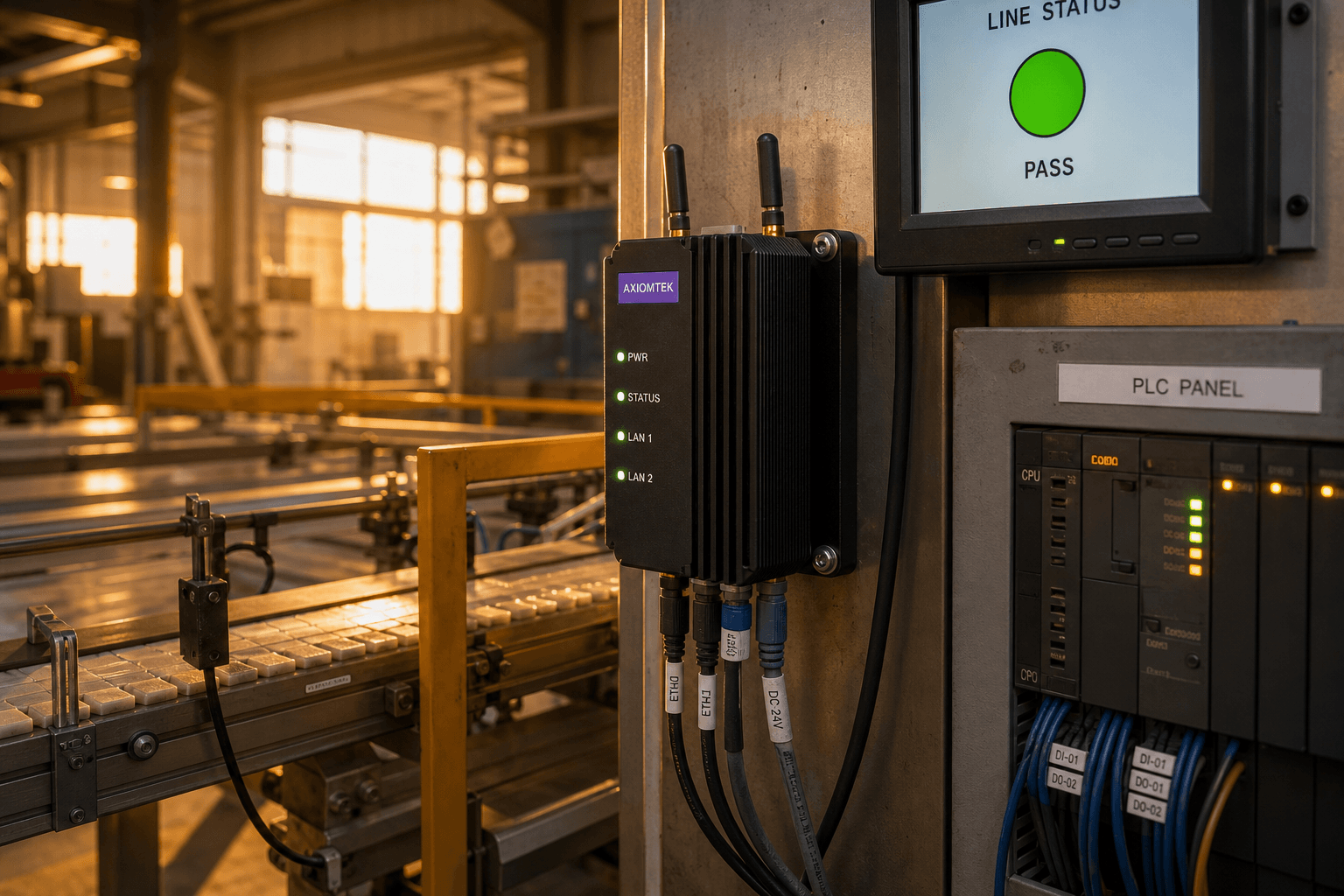
This changes the architecture conversation. A batch-oriented pipeline that writes inspection results to a data warehouse every few minutes is fine for trend analysis and yield reporting, but it cannot drive a reject-gate actuator. For in-line inspection tied to physical sorting, the inference and decision path typically needs to run at or near the edge — on-premises compute co-located with the line — with only aggregated results, images of flagged defects, and model performance metadata flowing upstream to the MES and any cloud-based analytics layer.
The practical implication is that most AI quality control deployments end up with two distinct data paths: a low-latency, deterministic path for the pass/fail or defect-classification decision that feeds the PLC in milliseconds to low-single-digit seconds, and a higher-latency, higher-volume path for storing images, model telemetry, and quality trends for later analysis. Conflating these into a single pipeline is a common source of project delay, because the SLA requirements of each path are fundamentally different.
How should OT and IT networks stay separated when adding AI?
OT/IT separation should be preserved by design, not weakened to accommodate AI workloads — the AI inference layer should sit in a demilitarised or segmented zone that can read sensor and image data from the OT network without exposing the OT network directly to IT or cloud systems. This follows the same segmentation logic manufacturers already apply to SCADA and PLC networks.
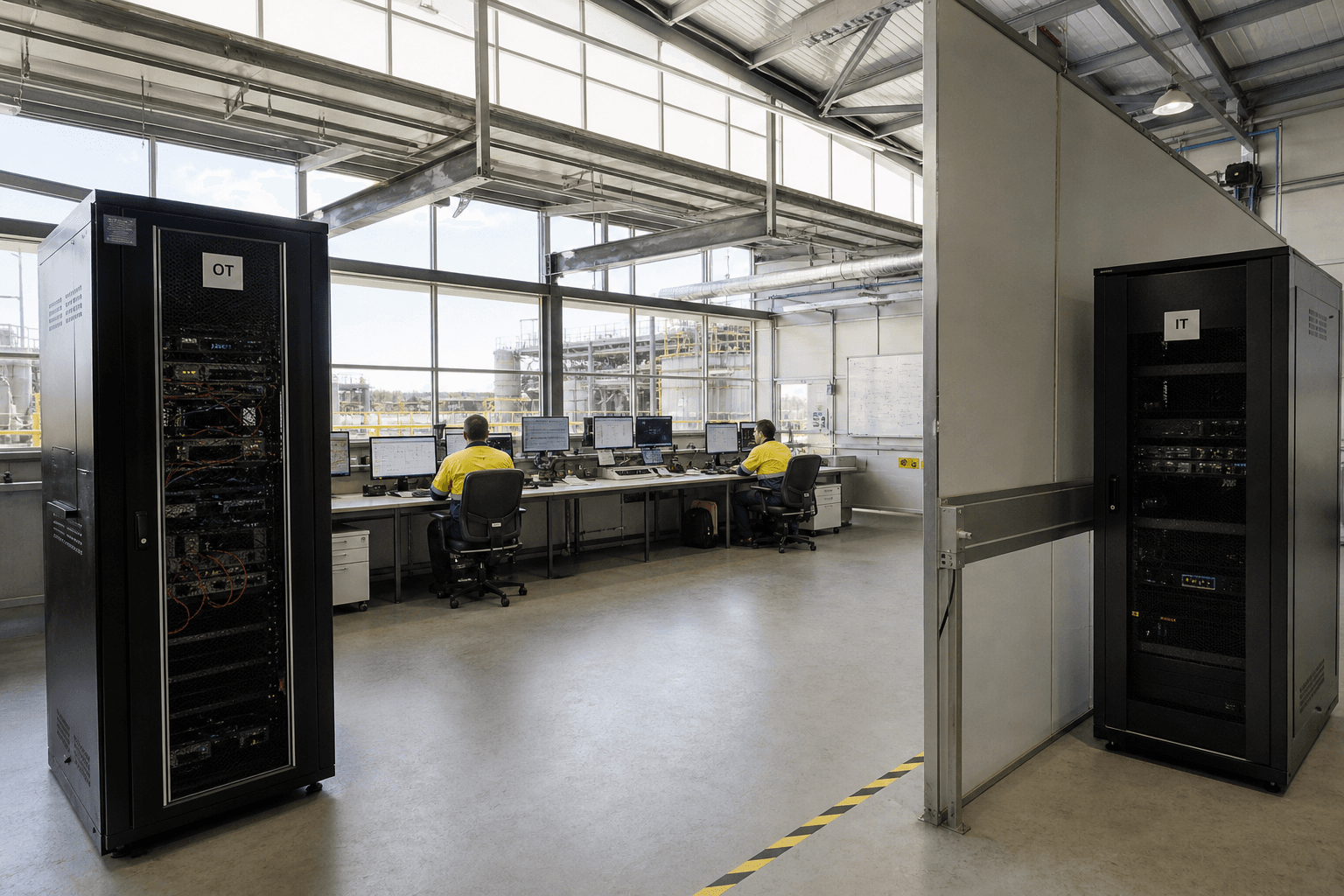
The widely referenced model here is the Purdue Enterprise Reference Architecture, which organises industrial control systems into layers — from field devices and controllers at the lowest levels up through supervisory control, the MES layer, and enterprise IT at the top — with firewalled zones between them. The Australian Cyber Security Centre's guidance on operational technology environments reinforces the same principle: OT networks should be logically and physically separated from corporate IT, with any data leaving the OT environment passing through a controlled, monitored boundary rather than an open connection (cyber.gov.au).
For AI quality inspection, this typically means: cameras and edge inference hardware live on or adjacent to the OT network segment; a one-way or tightly brokered data diode pattern pushes inspection results and flagged images up to the MES and IT-side analytics systems; and the AI model itself does not require inbound connectivity from IT or the internet to function on the line. Model updates and retraining are handled as a separate, scheduled, and audited process — not a live connection into the control network. Treating the AI component as just another OT-adjacent system, rather than a special case, keeps existing governance and audit processes intact.
How do you connect legacy PLCs to a modern AI inference layer?
Legacy PLCs are connected to AI inference systems through protocol translation at the edge, using an industrial gateway or edge server that speaks the PLC's native protocol on one side and a modern, structured interface on the other, rather than requiring the PLC itself to be replaced or reprogrammed.
Many shop floors still run PLCs communicating over older protocols — Modbus, Profibus, or vendor-specific variants — that were never designed to talk to machine learning services. Ripping and replacing this hardware is rarely justified when the goal is adding quality inspection. The more pragmatic pattern is an edge gateway that polls or subscribes to the relevant PLC tags (line speed, part presence, cycle triggers) and translates them into a protocol the AI and MES layers can consume, commonly OPC-UA, which has become the de facto standard for bridging legacy industrial equipment into modern IT-facing systems.
This gateway layer also absorbs a second practical problem: synchronisation. The AI inference result needs to be matched to the correct physical part on a moving line, which usually requires correlating a camera trigger event, a PLC cycle signal, and the model's output within a tight time window. Getting this part-to-result correlation wrong produces confident-looking quality data that is quietly misattributed to the wrong unit — a failure mode that is easy to miss in testing and costly to discover in production.
What does the end-to-end architecture look like?
A typical AI-powered quality control architecture has four layers: field-level sensing and PLC control, an edge gateway handling protocol translation and low-latency inference, the MES layer for shop-floor orchestration and traceability, and an IT/cloud layer for aggregated analytics, model lifecycle management, and reporting.
| Layer | Primary role | Typical latency tolerance | Network zone |
|---|---|---|---|
| Field (PLC, sensors, cameras) | Physical control and data capture | Milliseconds | OT |
| Edge gateway / inference | Protocol translation, real-time AI decision | Milliseconds to seconds | OT-adjacent / segmented |
| MES | Line orchestration, traceability, work-order context | Seconds to minutes | Segmented / DMZ |
| IT / cloud analytics | Trend analysis, model retraining, reporting | Minutes to hours | IT / cloud |
The design principle running through this table is that each layer should only receive the data it actually needs at the timescale it needs it, and no layer should require direct, unbrokered access to the one below it. This keeps the architecture both performant and auditable.
Where do manufacturers typically underestimate the effort?
Manufacturers most commonly underestimate the integration and data infrastructure work required to get clean, correlated, well-governed data flowing between PLCs, the MES, and the AI layer — not the difficulty of training an accurate defect-detection model. Pre-trained and fine-tunable vision models can often reach workable accuracy faster than the surrounding systems can reliably feed them data.
This mirrors a pattern we see across most AI adoption efforts, not just manufacturing: the model is rarely the bottleneck; the data plumbing, legacy connectivity, and governance around it are. Our piece on data infrastructure as the foundation for AI and the companion discussion of AI readiness both cover this in more general terms, and the same logic applies directly to shop-floor environments — the groundwork determines whether the AI component ever makes it past a pilot.
Building this without an in-house industrial AI team
For most manufacturing technology leaders, the practical question isn't whether AI quality inspection is technically feasible — it generally is — but whether the organisation has the combined OT networking, PLC integration, and AI engineering expertise to build it safely and maintainably. These are rarely found in the same team, which is why pilots often stall between a successful proof-of-concept and a production rollout.
Our AI engineering work focuses on exactly this handoff: taking a validated model and the surrounding integration architecture — edge gateways, protocol translation, MES connectivity, and monitoring — into a production system the client's own team can operate and extend. Where the broader question is which AI use cases are worth pursuing first on the shop floor, our AI product strategy work helps prioritise before architecture decisions get locked in. And where the underlying data pipelines between OT and IT systems need to be built or re-architected from the ground up, that falls under data infrastructure.
You can browse more architecture and strategy discussion on our insights page.
If you're exploring how to connect shop-floor systems to AI-powered quality control without compromising OT security or production uptime, we can help — starting with a conversation about your current PLC and MES landscape, not a sales pitch.
Chris Kerr
Partner at Horizon Labs, an AI product consultancy and venture studio. A commercially focused product and technology leader with 20+ years building and scaling digital platforms, teams, and businesses across SaaS, travel, eCommerce, logistics and transport, and digital marketing — operating at the intersection of product, engineering, and data. Writes about platform strategy, AI transformation, modern data ecosystems, and the operational discipline that separates AI demos from AI products.