Data Science Consulting in Melbourne: A Scoping Guide
Scoping your first data science engagement well matters more than picking the right vendor. This guide covers problem framing, data readiness checks, deliverable shapes, and pricing models for Melbourne-based mid-market companies.

If you're evaluating data science consulting in Melbourne for the first time, the biggest risk isn't picking the wrong vendor — it's scoping the wrong engagement. Most first projects fail not because the modelling was bad, but because the problem was never framed clearly, the data wasn't ready, or the deliverable was too broad to ship. This guide walks through how to scope a first engagement properly: problem framing, data readiness checks, deliverable shapes, and pricing models, with Melbourne and Victorian context built in.
What does "scoping" actually mean for a data science engagement?
Scoping is the process of defining exactly what problem you're solving, what data and access are required, what gets delivered, and how success is measured — before any contract is signed. A well-scoped engagement has a single primary question it answers ("can we predict customer churn 30 days out?") rather than an open-ended mandate ("help us use our data better"). The narrower the question, the easier it is to price, staff, and evaluate.
For a first engagement specifically, scope should favour a defined, shippable outcome over a broad discovery phase. Mid-market Australian companies — roughly 50 to 2,000 employees — typically want senior practitioners who write code and move fast, not a strategy report that sits in a shared drive. If your first engagement produces a working pipeline, model, or dashboard that your team can operate afterwards, you've scoped it correctly.
Start with problem framing, not a tech wishlist
Problem framing means translating a business question into a data science question with a measurable outcome, before discussing tools, models, or platforms. "We want AI" is not a scope. "We want to reduce manual invoice reconciliation time by flagging anomalies before they reach finance" is a scope. Start there.

A useful framing exercise is to write down three things: the decision this project should improve, who currently makes that decision, and what would change if the project succeeded. If you can't answer all three, you're not ready to scope a technical engagement yet — you're ready for a shorter ai-product-strategy conversation instead, which exists precisely to sit upstream of technical delivery.
Run a data readiness pre-check before you talk budget
Data readiness is the state of your data — its availability, quality, accessibility, and governance — relative to what a proposed engagement actually needs. Most delays and cost overruns in first engagements come from readiness gaps discovered mid-project, not from modelling difficulty. Check readiness before you scope pricing, not after.
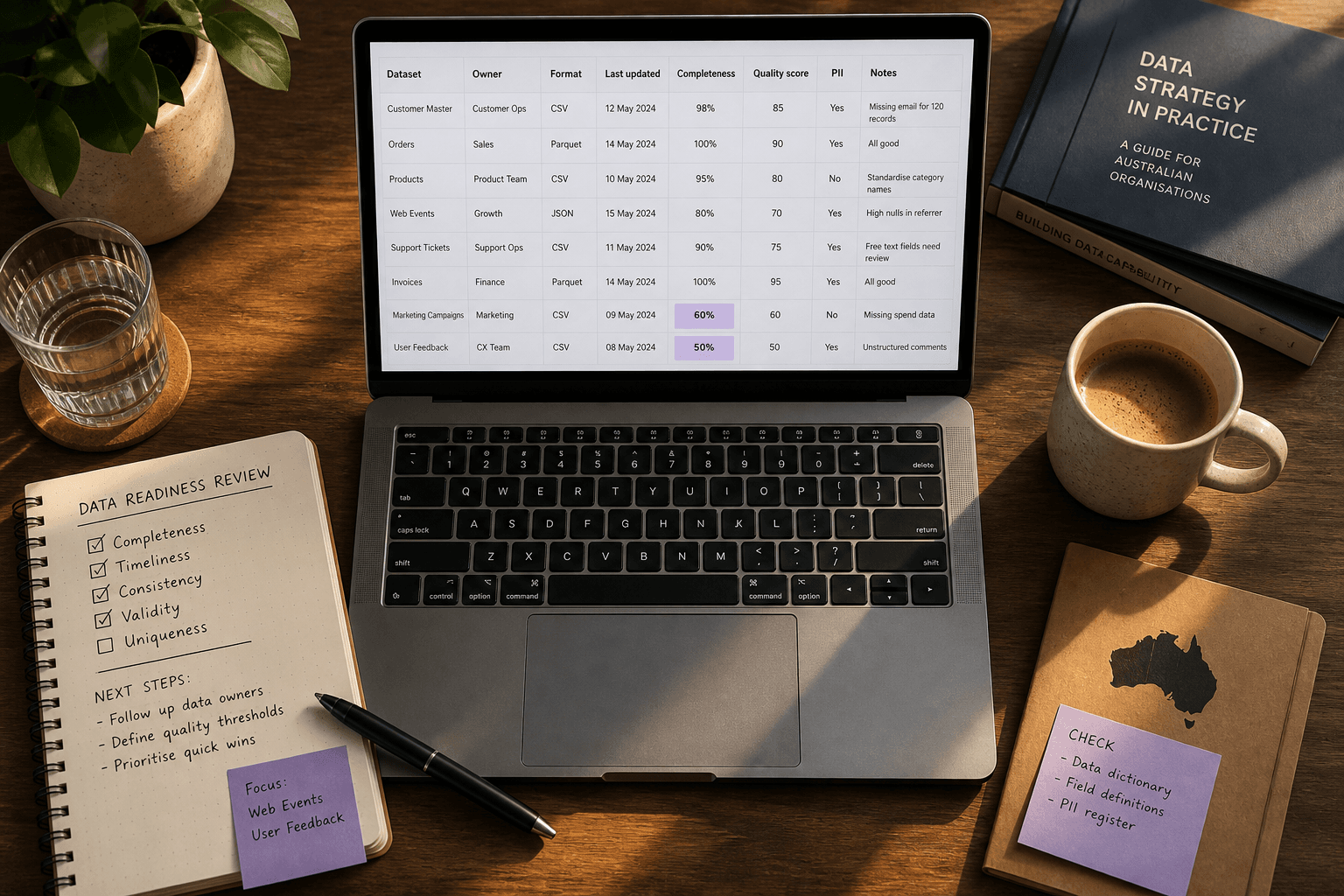
A practical pre-check covers four areas: whether the relevant data exists and is queryable (not locked in a legacy system or a spreadsheet on someone's desktop); whether it's clean enough to trust (missing values, duplicate records, inconsistent formats); whether you have legal authority to use it, particularly for personal information under the Privacy Act 1988 (Cth) and the Australian Privacy Principles; and whether someone on your team can grant technical access without a six-week IT ticket. Data quality frameworks such as ISO 8000 offer a useful reference point if you want to formalise this check internally. If your organisation doesn't yet have pipelines that move data reliably from source systems to somewhere usable, that's a sign your first engagement should focus on data-infrastructure before analytics or modelling.
What deliverable shapes look like for a first engagement
A deliverable shape is the concrete form a project's output takes — a report, a dashboard, a deployed model, or a production pipeline — and it should be decided before the engagement starts, not negotiated at the end. For a first engagement, favour deliverables that are small enough to ship in weeks, not quarters, and that your team can maintain afterwards without ongoing dependence on the consultancy.
Common first-engagement shapes include a readiness or architecture assessment that produces a written recommendation and roadmap; a proof-of-concept model or pipeline built against real (not synthetic) data to test feasibility; and a narrow production build — one pipeline, one model, one feature — with embedded senior practitioners rather than a large team. Avoid multi-phase transformation programmes as a first engagement; they're harder to scope accurately and defer the point at which you see working software.
Data science consulting Melbourne pricing models: what to expect
Pricing for data science consulting in Melbourne generally falls into three models: fixed-price for a defined deliverable, time-and-materials for exploratory or evolving scope, and retained/fractional arrangements for ongoing capability. Which model fits depends on how well-defined your problem and data readiness already are.
Fixed-price works best when the problem is narrow and the data is known to be usable — you're paying for a specific outcome. Time-and-materials suits situations where discovery is still happening, such as an initial readiness assessment. Retained or fractional models suit companies that need ongoing senior data or AI leadership without a full-time hire — this is a common bridge for organisations that have growing data needs but no dedicated data engineering team yet.
It's also worth understanding the top end of the market before you scope anything. Large consultancies typically require minimum engagements well into six figures, with formal tender processes for anything above roughly $500K AUD and senior day rates priced accordingly. That pricing and procurement model is built for enterprise budgets and timelines, not for a mid-market company that wants a working result in weeks. Knowing this helps you set expectations for what a right-sized first engagement should cost, and avoid over-scoping into a bracket you don't need.
How much does data science consulting in Melbourne cost?
Costs vary by deliverable shape and depth, but the table below gives a directional guide to how engagement types typically map to budget and duration for mid-market organisations.
| Engagement type | Typical duration | Typical deliverable | Indicative budget band (AUD) |
|---|---|---|---|
| Readiness / architecture assessment | 2–4 weeks | Written findings, roadmap, risk register | $15K–$40K |
| Proof-of-concept / pilot | 4–8 weeks | Working model or pipeline against real data | $30K–$100K |
| Narrow production build | 2–4 months | Deployed pipeline, model, or feature | $50K–$250K |
| Fractional / retained data & AI leadership | Ongoing, monthly | Advisory + hands-on delivery | $5K–$20K/month |
These are indicative bands, not quotes — actual pricing depends on data complexity, integration requirements, and how much of your existing stack the work needs to touch. Treat any proposal you receive as a starting point for negotiation, and press for a deliverable shape (not just a day count) before agreeing to a number.
Melbourne and Victorian context worth factoring in
Melbourne's mid-market technology sector spans fintech, healthtech, logistics, and professional services firms that typically have a modern front end but legacy backend systems or no dedicated data engineering function — a pattern common enough that it shapes how a first engagement should be scoped. If your organisation fits this profile, a first engagement often needs to address foundational data or platform issues before analytics or AI work can add value, which is why application-modernisation and data infrastructure work often precede — or run alongside — data science delivery.
Being Melbourne-headquartered doesn't need to limit your options: remote-first delivery means Victorian companies can work with practitioners based anywhere in Australia, and vice versa. What matters more than location is whether the team you engage will write production code and stay accountable to a shipped outcome, rather than handing off a strategy document and moving to the next client.
A simple scoping checklist for your first conversation
Before your first call with any data science consulting provider in Melbourne, write down: the business decision you want to improve, the data sources involved and their current state, who internally owns data access and governance, what "done" looks like for this specific engagement, and which budget band above roughly matches your ambition. Bring this checklist to the conversation and ask the provider to scope against it directly — a provider that can turn these five inputs into a specific deliverable and price range within a short discovery call is generally easier to hold accountable than one that proposes an open-ended programme.
If you want to go deeper on adjacent decisions — build versus buy, RAG versus fine-tuning for LLM features, or how to structure MLOps once a model is in production — our insights covers each of these in more detail, and pairs well with ai-engineering if your first engagement is likely to involve deploying a model rather than just analysing data.
If you're scoping your first data science engagement and want a second opinion on problem framing, data readiness, or deliverable shape before you commit budget, get in touch — we're happy to talk through what a right-sized first project looks like for your team.
Chris Kerr
Partner at Horizon Labs, an AI product consultancy and venture studio. A commercially focused product and technology leader with 20+ years building and scaling digital platforms, teams, and businesses across SaaS, travel, eCommerce, logistics and transport, and digital marketing — operating at the intersection of product, engineering, and data. Writes about platform strategy, AI transformation, modern data ecosystems, and the operational discipline that separates AI demos from AI products.