Fractional Head of Data: Leadership Without a Full-Time Hire
Growing organisations often need senior data leadership before they can justify — or fill — a full-time hire. This guide covers what a fractional Head of Data does, when it makes more sense than a permanent hire, and how it complements existing engineering teams.

Growing organisations often reach a point where data has outgrown ad hoc ownership. Dashboards multiply, pipelines break silently, and engineering leads get pulled into data decisions they were never meant to own. A fractional Head of Data is one way to bring senior data leadership into that gap without committing to a full-time executive hire before you're ready for one.
What is a fractional Head of Data?
A fractional Head of Data is an experienced data leader — often someone who has previously held a Head of Data, CDO, or senior data engineering leadership role — engaged part-time or on a defined-scope basis to set data strategy, establish governance, and guide a data team's technical direction. Unlike a full-time hire, the engagement is scoped to specific outcomes and hours, and can flex up or down as needs change.
This is a genuinely different role to a fractional CTO, even though the models are structurally similar. A fractional CTO owns engineering architecture, delivery, and technology roadmap across the whole product. A fractional Head of Data owns the data function specifically — infrastructure, quality, governance, analytics enablement, and increasingly, the foundations that make AI and machine learning initiatives viable.
Why do growing companies need this role before they need a full-time one?
Many organisations reach meaningful data volume and complexity well before they have the budget, hiring pipeline, or internal clarity to justify a full-time senior data executive. In the interim, decisions about data architecture, tooling, and governance often default to whoever is most vocal in the room — usually an engineering lead already stretched across other priorities.

This creates a specific and recognisable pattern: data assets exist, but there's no one accountable for turning them into a coherent, governed, AI-ready foundation. Analytics requests pile up. Machine learning pilots stall because no one owns data quality end to end. A fractional Head of Data exists to close that accountability gap during the period before — or instead of — a full-time hire.
What does a fractional Head of Data actually do?
A fractional Head of Data typically covers four areas: assessing the current state of your data infrastructure and practices, setting a prioritised roadmap, establishing governance and quality standards, and mentoring or upskilling the engineers and analysts already on your team. The specific mix depends on where your organisation is starting from.
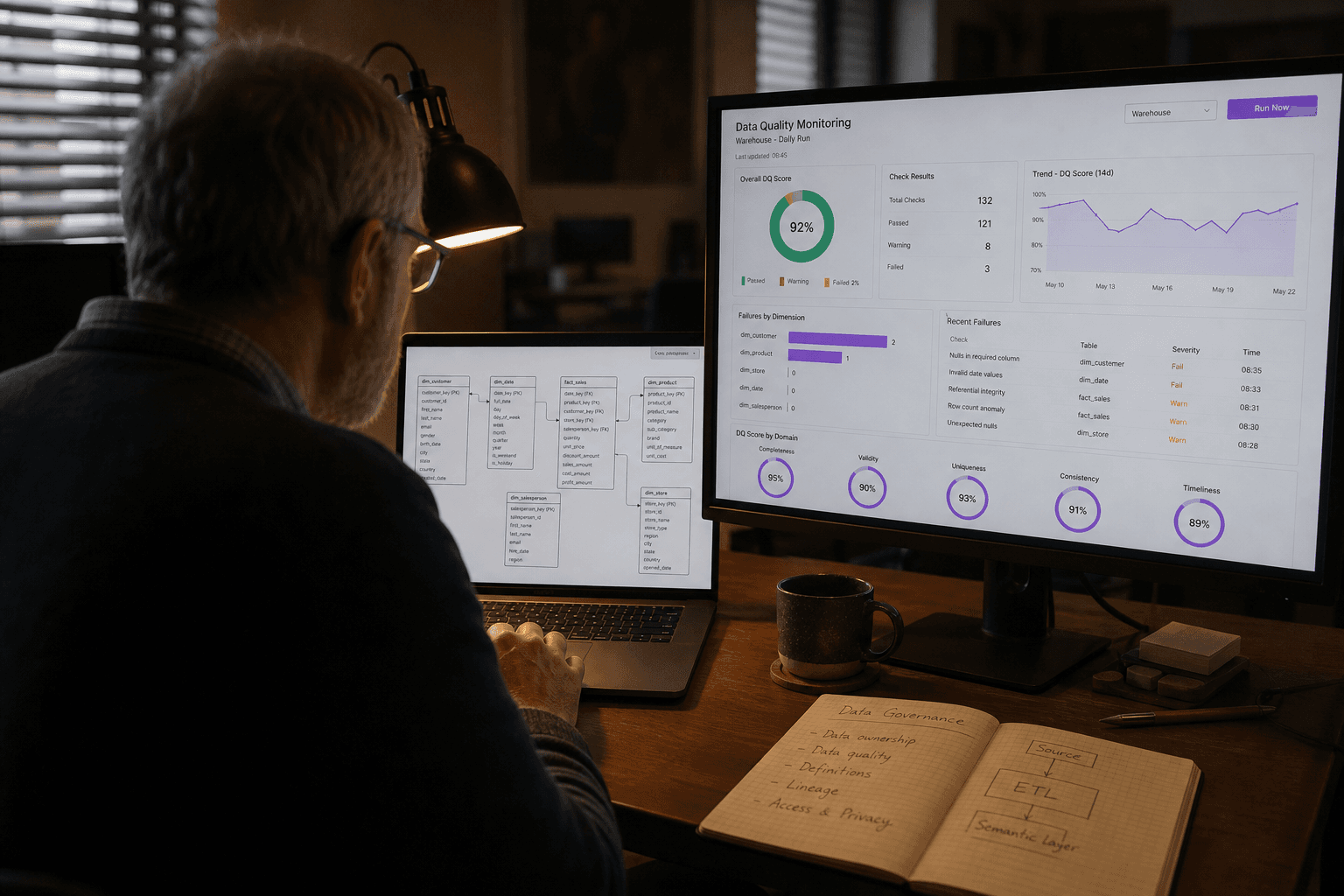
In practice, this often includes auditing existing pipelines and warehouse or lakehouse architecture, defining data ownership and access policies, selecting or rationalising tooling, setting up monitoring for data quality and pipeline reliability, and acting as the technical sponsor for data infrastructure investment decisions. Where an organisation is exploring machine learning or AI use cases, the fractional Head of Data is usually the person who determines whether the underlying data can actually support them — a question that has to be answered before any AI product strategy work can proceed with confidence.
When does a fractional Head of Data make sense versus a full-time hire?
A fractional engagement makes sense when data needs are real and growing but not yet large or stable enough to justify a permanent executive salary and the hiring cycle that comes with it. It also suits organisations that need senior judgement immediately — for a funding-round data room, a compliance deadline, or an AI initiative under board scrutiny — rather than in six months' time once recruitment concludes.
A full-time hire becomes the better option once the data function has enough scale, headcount, and ongoing complexity that a single leader's full attention is warranted, and once the organisation has enough clarity about the role to write a job description that will attract the right candidate. Many organisations use a fractional engagement specifically to reach that clarity — defining the mandate, proving out the roadmap, and building the case (and the team structure) that a future full-time leader will inherit.
| Situation | Fractional Head of Data | Full-time Head of Data / CDO |
|---|---|---|
| Data team size | Small to mid-sized, still forming | Established, multiple sub-teams |
| Urgency | Immediate need, hiring takes too long | Time available to recruit properly |
| Budget certainty | Data investment not yet fully committed | Sustained, multi-year data investment |
| Scope | Strategy, governance, roadmap, mentoring | Strategy plus full operational ownership |
| Best for | Bridging a gap or validating the mandate | Long-term, embedded leadership |
How does a fractional Head of Data work with an existing engineering team?
A fractional Head of Data does not replace engineers — it gives them a senior technical sponsor and decision-maker they currently lack. Engineering teams often have strong individual contributors who can build pipelines and models but have no one senior enough, or with enough bandwidth, to set direction, resolve architectural trade-offs, or push back on unrealistic scope.
The fractional leader typically works alongside your existing engineering leadership rather than above it in an organisational sense — clarifying where data engineering responsibilities sit relative to platform and application engineering, and making sure data infrastructure decisions are made with the same rigour as any other architectural decision. Where an organisation is also modernising legacy systems, this needs to be coordinated with application modernisation work so that data and platform architecture evolve together rather than in conflict.
What outcomes should you expect from a fractional Head of Data engagement?
Realistic outcomes are a documented data strategy and roadmap, clearer ownership and governance, improved data quality and reliability, and a team that is better equipped to support analytics and AI initiatives once the engagement scales down or transitions to a full-time hire. A fractional Head of Data is not a substitute for the engineering effort required to build pipelines and platforms — it's the leadership layer that ensures that effort is well directed.
Organisations should be cautious of expecting a fractional leader to single-handedly resolve years of accumulated technical debt or data quality issues within a short engagement. Production-grade data infrastructure takes sustained engineering investment; the fractional leader's role is to set direction and prioritise that investment, not to build it alone. This is the same honesty we bring to any AI Readiness Assessment — clarity about what's achievable in the timeframe matters more than an optimistic roadmap.
Where does this fit with CTO Advisory?
For organisations that need both technology and data leadership support, a fractional Head of Data can work in parallel with a broader CTO Advisory engagement, or exist as a standalone relationship focused purely on the data function. The right structure depends on whether your primary gap is in engineering leadership, data leadership, or both — and that's a conversation worth having before committing to either model.
If you're weighing up whether your organisation needs fractional data leadership, a full-time hire, or something in between, get in touch and we can talk through what fits your current stage. You can also browse our insights for more on building data and AI capability without overcommitting before you're ready.
Chris Kerr
Partner at Horizon Labs, an AI product consultancy and venture studio. A commercially focused product and technology leader with 20+ years building and scaling digital platforms, teams, and businesses across SaaS, travel, eCommerce, logistics and transport, and digital marketing — operating at the intersection of product, engineering, and data. Writes about platform strategy, AI transformation, modern data ecosystems, and the operational discipline that separates AI demos from AI products.