AI-Powered Workplace Safety Monitoring for Manufacturing
Computer vision and sensor-based AI can help detect PPE non-compliance and hazard conditions on shop floors and in warehouses — but it's a complement to Safe Work Australia's model WHS duties, not a replacement for them. Here's how the technology works and what it takes to deploy it responsibly.
What is AI-powered workplace safety monitoring?
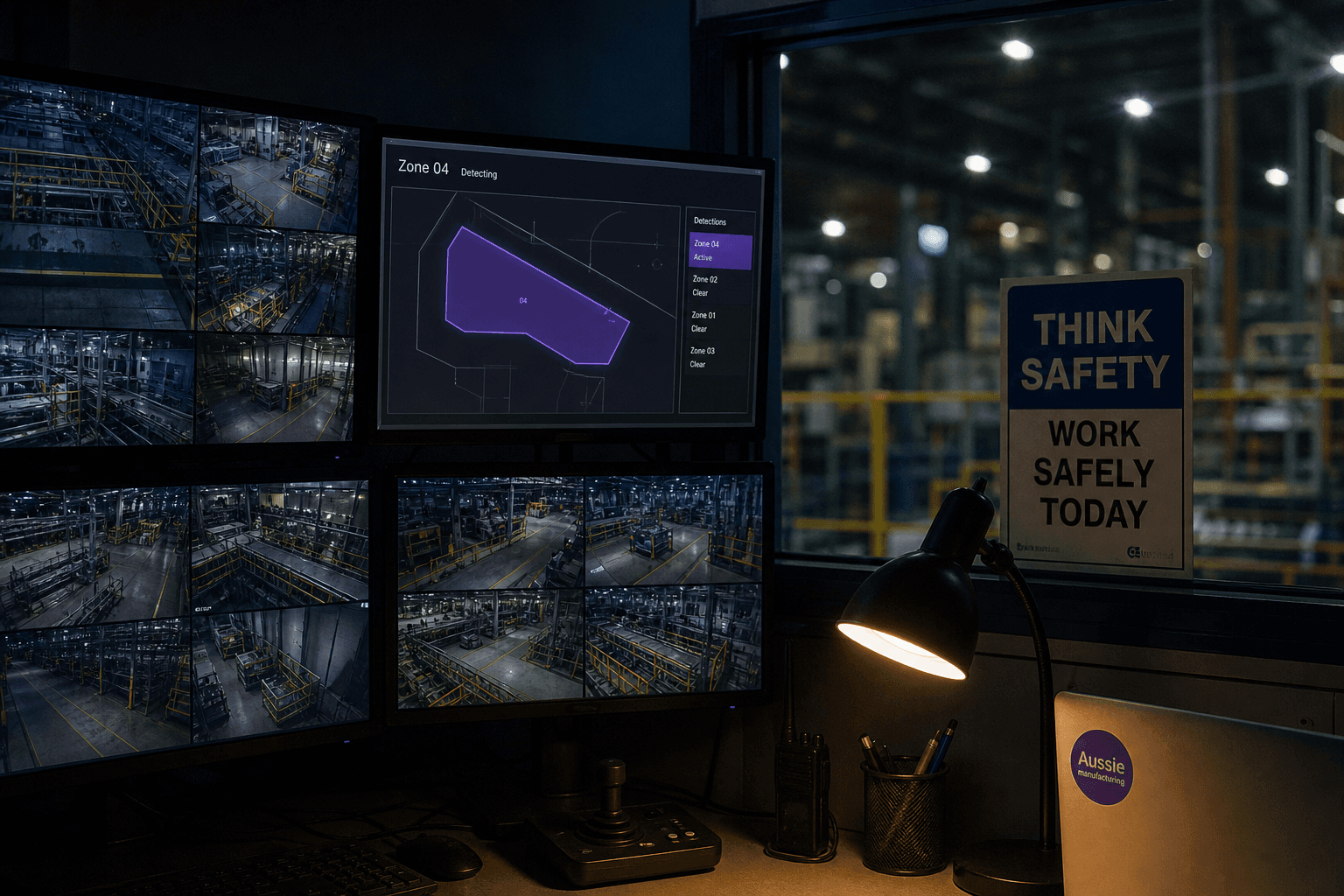
AI-powered workplace safety monitoring is the use of computer vision and sensor-based machine learning models to continuously observe physical work environments — shop floors, warehouses, loading docks — and flag conditions that create risk of harm, such as missing personal protective equipment (PPE), unsafe proximity to machinery, or obstructed walkways. Unlike manual audits, it operates continuously and surfaces issues in near real time, though it does not replace the human judgement and consultation processes that Australian work health and safety (WHS) law requires.
It's worth being upfront about where this technology sits today: it is a maturing category built on general-purpose computer vision and sensor platforms rather than a single off-the-shelf "safety AI" product. Most deployments are custom-engineered on top of foundation vision models and industrial sensor networks, tuned to a specific site's layout, hazards, and compliance requirements.
How does computer vision detect PPE non-compliance?
Computer vision systems use cameras already installed (or purpose-deployed) across a facility, paired with object detection models trained to recognise hard hats, hi-vis vests, safety glasses, gloves, and harnesses, then compare detected states against a site's required PPE zones. When a person enters a zone without the required item, the system can log the event and trigger an alert to a supervisor or safety dashboard rather than stopping work automatically.
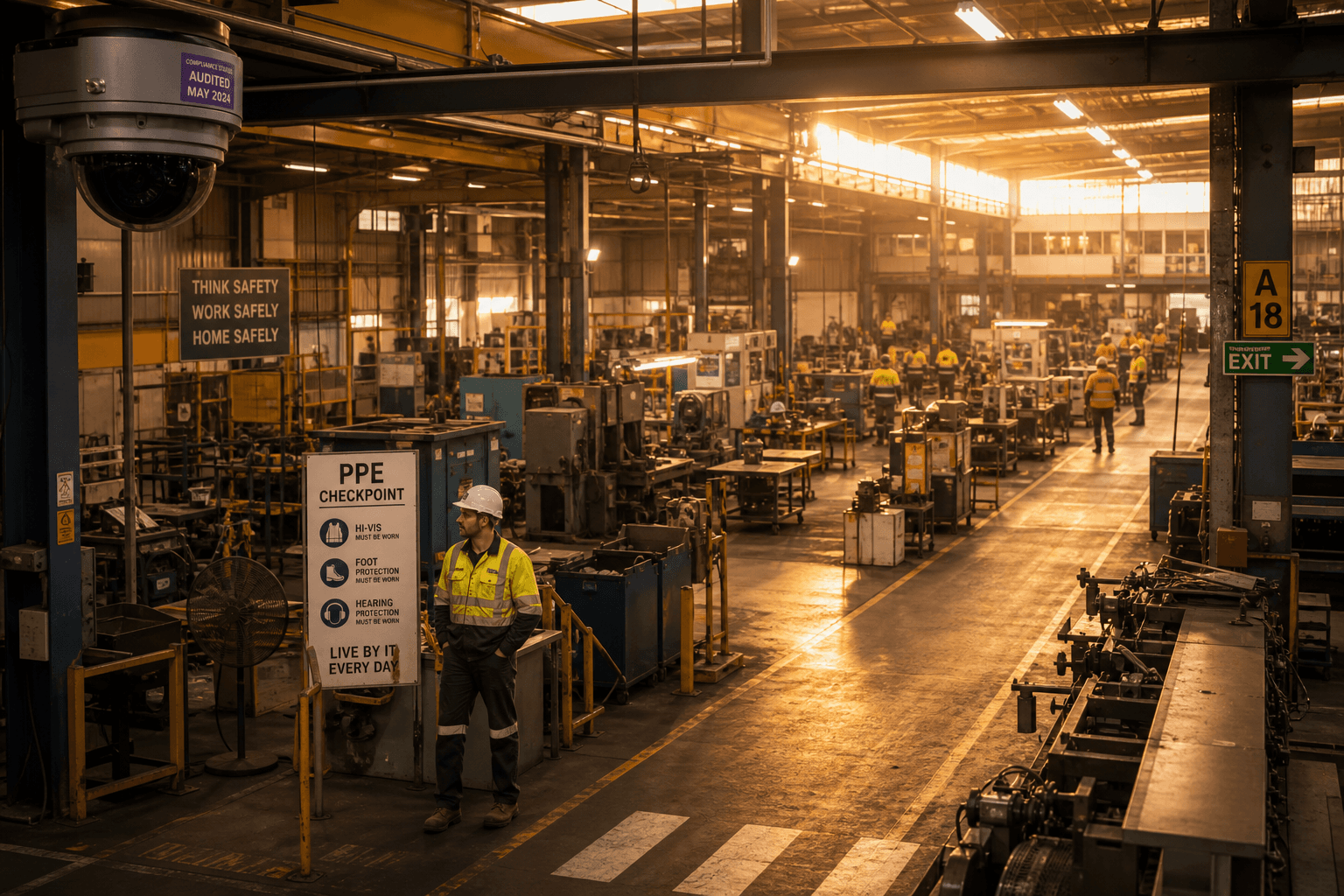
The practical challenge is accuracy in real conditions, not in a demo. Poor lighting, motion blur, partial occlusion by equipment, and visually similar uniforms all degrade detection quality. Models need to be validated against a site's actual camera placement and workforce before they're trusted for compliance reporting, and false positive rates need to be low enough that supervisors don't start ignoring alerts — a well-documented failure mode in alert-heavy systems generally.
How do sensor-based systems detect hazard conditions beyond PPE?
Sensor-based AI extends beyond cameras to include proximity sensors, RFID and ultra-wideband tags on workers and vehicles, environmental sensors (gas, temperature, noise), and machine telemetry, fused together to detect hazards like forklift-pedestrian proximity, blocked emergency egress, or equipment operating outside safe parameters. Fusing multiple sensor types typically produces more reliable hazard detection than any single modality, because it reduces reliance on line-of-sight camera coverage alone.
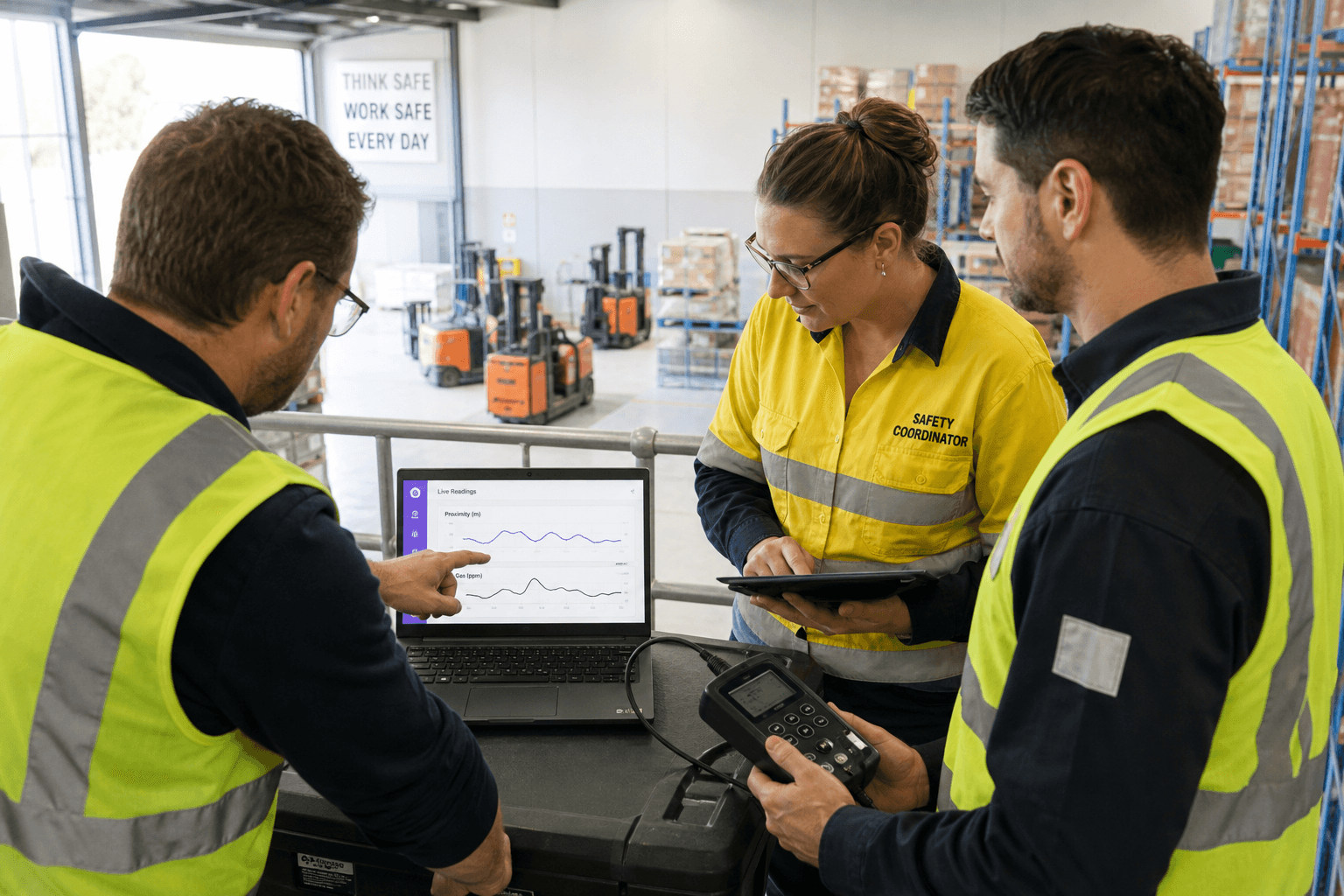
This is where the underlying AI/ML platform work matters more than the sensors themselves. Reliable hazard detection depends on consistent data pipelines, time-series alignment across sensor types, and a feature store that can serve low-latency signals to a monitoring or alerting layer — the same kind of infrastructure challenge we work through with clients in data-infrastructure engagements, regardless of the industry vertical.
How does this align with Safe Work Australia's model WHS laws?
Safe Work Australia's model Work Health and Safety (WHS) Act places a primary duty of care on a "person conducting a business or undertaking" (PCBU) to eliminate risks to health and safety so far as is reasonably practicable, and to minimise them where elimination isn't possible. AI monitoring can support this duty by improving visibility of PPE and hazard conditions, but it does not change the underlying legal obligation — the PCBU remains responsible for the systems of work, the consultation processes, and the corrective actions that follow an alert.
Model WHS laws and the associated Codes of Practice (including guidance on managing risks and on consultation, cooperation, and coordination) emphasise that workers must be consulted on health and safety matters that affect them. Introducing camera-based or wearable monitoring is one of those matters — it needs to go through the same consultation process as any other change to systems of work, not be deployed as a surveillance tool without worker input. Organisations evaluating this technology should treat it as an input to an existing WHS management system, not a replacement for one, and should check current guidance directly at safeworkaustralia.gov.au before finalising a deployment approach.
Computer vision vs wearables vs fixed sensors vs manual audits
| Approach | Coverage | Real-time capability | Typical constraint |
|---|---|---|---|
| Computer vision (fixed cameras) | High across monitored zones | High | Lighting, occlusion, blind spots |
| Wearable sensors (RFID/UWB tags) | Follows the worker | High | Compliance depends on workers wearing tags |
| Fixed environmental/proximity sensors | Zone-specific | High | Limited to instrumented areas |
| Manual safety audits | Point-in-time, human-judged | Low (periodic) | Labour-intensive, not continuous |
Most mature deployments combine two or more of these rather than relying on a single approach, because each has blind spots the others can partially cover.
What are the practical deployment constraints for growing operators?
For manufacturers and logistics operators without an existing AI or data engineering function, the constraints are rarely about the vision models themselves — they're about everything around the models. Camera and sensor coverage has to be planned against actual hazard zones, not retrofitted to wherever cameras already exist. Data from cameras, wearables, and WMS/MES systems needs a pipeline that can handle industrial-grade uptime requirements. And alerting needs a clear escalation path into existing safety management processes, or it becomes noise.
There's also a workforce trust dimension that's easy to underweight. Camera-based monitoring introduces legitimate privacy and surveillance concerns, and under model WHS consultation requirements, those concerns need to be worked through with the workforce — not around them. Getting this wrong can undermine the safety case entirely, regardless of how accurate the detection models are.
Before committing budget to a full build, it's generally worth running a scoped technical assessment — similar to how we approach ai-product-strategy engagements — to validate camera coverage, data availability, and integration points against the specific hazards a site actually faces, rather than assuming a generic PPE-detection model will transfer cleanly. Where the underlying systems (WMS, MES, legacy SCADA) are dated, that groundwork often overlaps with broader application-modernisation work, since safety data pipelines usually need to sit alongside, not inside, legacy operational systems.
Once a monitoring system is live, the harder engineering problem is operating it reliably over time — model drift as camera angles or workforce PPE change, alert fatigue if thresholds aren't tuned, and ongoing validation that the system is still detecting what it was trained to detect. This is the same production discipline we bring to any applied AI system through ai-engineering: the model shipping is the easy part; keeping it accurate and trusted in production is the ongoing work.
Where this leaves manufacturing and logistics leaders today
AI-powered safety monitoring is a genuinely useful complement to existing WHS management systems, not a replacement for the primary duty of care that sits with the PCBU under Australian model WHS laws. It works best as one input into a broader safety and data strategy, built on solid data infrastructure, validated against real site conditions, and introduced through proper worker consultation. Treat vendor claims of near-perfect detection with healthy scepticism, and plan for the ongoing validation work that production AI systems require.
For more on how we think about applying AI responsibly to operational problems, browse our insights.
If you're exploring AI-powered safety monitoring for a manufacturing or logistics site and want an honest read on what's technically achievable versus what needs more groundwork first, get in touch — we're happy to talk through the fit before any scope is defined.
Chris Kerr
Partner at Horizon Labs, an AI product consultancy and venture studio. A commercially focused product and technology leader with 20+ years building and scaling digital platforms, teams, and businesses across SaaS, travel, eCommerce, logistics and transport, and digital marketing — operating at the intersection of product, engineering, and data. Writes about platform strategy, AI transformation, modern data ecosystems, and the operational discipline that separates AI demos from AI products.