AI in Australian Manufacturing: 5 Use Cases in Production
Five AI use cases Australian manufacturers are running in production today — predictive maintenance, computer vision quality inspection, document AI for compliance, demand forecasting, and procurement automation. A practitioner's view of what the architecture looks like, what you need in place, and where each use case gets hard.
AI for Australian Manufacturing: 5 Use Cases That Actually Work in Production
Most conversations about AI in manufacturing start with the promise and skip the proof. This post does the opposite. These are five use cases that Australian manufacturers are running in production today — not pilots, not proofs of concept, but systems processing real data, making real decisions, and operating under real operational constraints.
This is not a strategy deck. It is a practitioner's view of what is working, what the architecture looks like, and what you need in place before you start.
1. Predictive Maintenance: Moving From Scheduled to Condition-Based
Predictive maintenance is the most mature AI use case in manufacturing, and for good reason — the economics are straightforward. Unplanned downtime is expensive. If a model can tell you a bearing is going to fail 72 hours before it does, you schedule the repair. Production continues. The emergency callout does not happen.
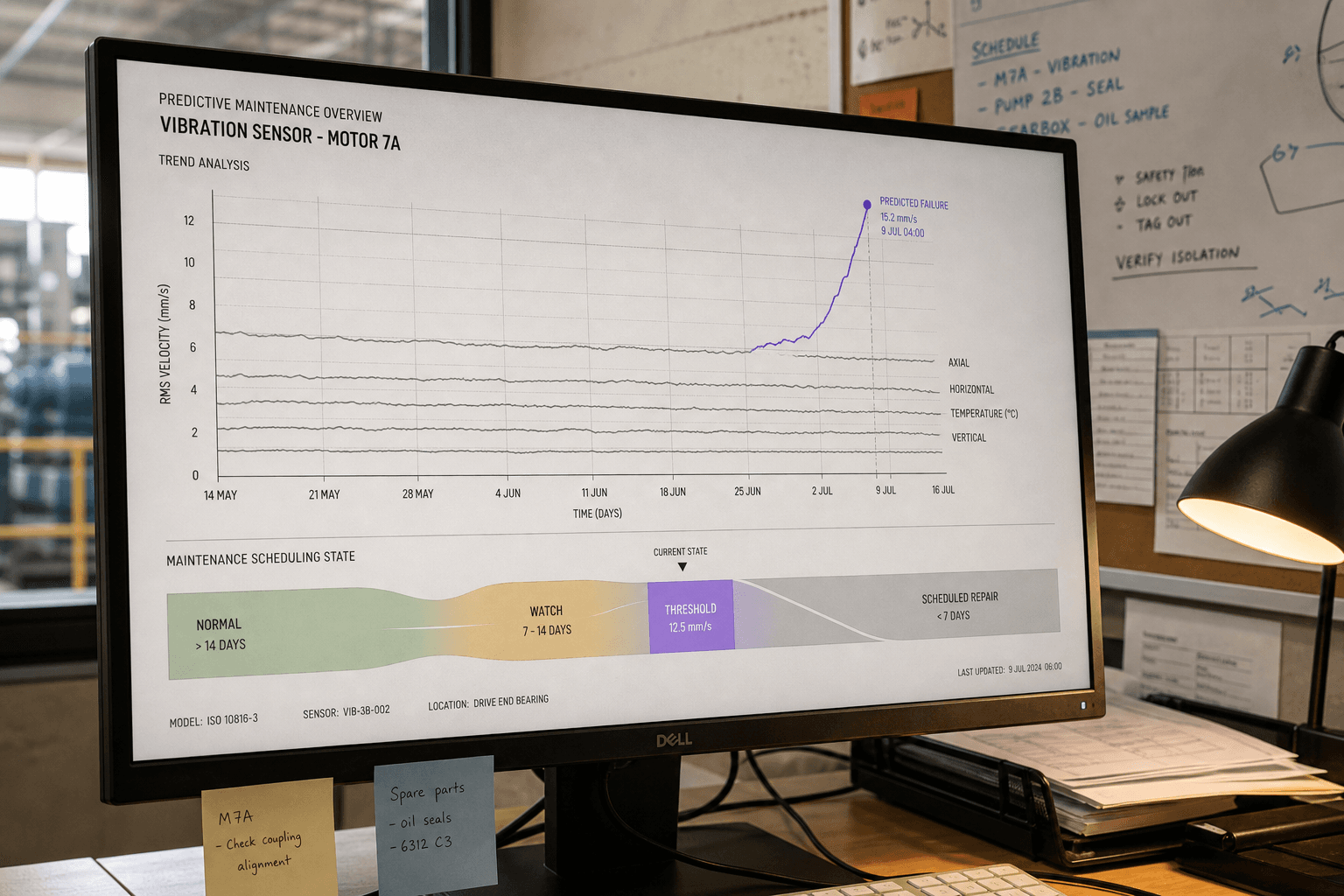
The architecture is not complicated in principle: sensor data from PLCs or SCADA systems feeds into a time-series pipeline, a model learns the degradation signatures of known failure modes, and alerts fire when the signature appears. In practice, the hard work is in the data infrastructure — cleaning sensor noise, handling missing readings, building the labelled failure history that the model needs to learn from.
Illustrative results from manufacturers who have moved beyond pilot: organisations running mature predictive maintenance programmes report downtime reduction in the range of 80% or more compared to scheduled-only maintenance, with failure prediction windows extending to 72 hours or longer for common failure modes. These figures reflect what is achievable with good sensor coverage and 12–18 months of labelled failure history — not what you should guarantee in your business case on day one.
What you need before you start:
- Sensor data with timestamps and equipment identifiers, accessible from outside the PLC
- At least 12 months of maintenance logs with failure dates and failure types
- A data pipeline that can ingest time-series data at the required frequency (often 1–10 second intervals)
- A maintenance team willing to act on model alerts — organisational adoption matters as much as model accuracy
Where it gets harder: Multi-site environments where the same equipment type operates under different load profiles. Models trained on one site often do not transfer without retraining. Build this assumption into your architecture from the start.
2. Computer Vision Quality Inspection at Line Speed
Computer vision for defect detection is now genuinely production-ready for a wide range of manufacturing contexts. The technology has matured to the point where a well-scoped inspection system can operate at line speed, run on edge hardware close to the line, and outperform manual inspection on consistency — particularly for high-volume, repetitive inspection tasks.
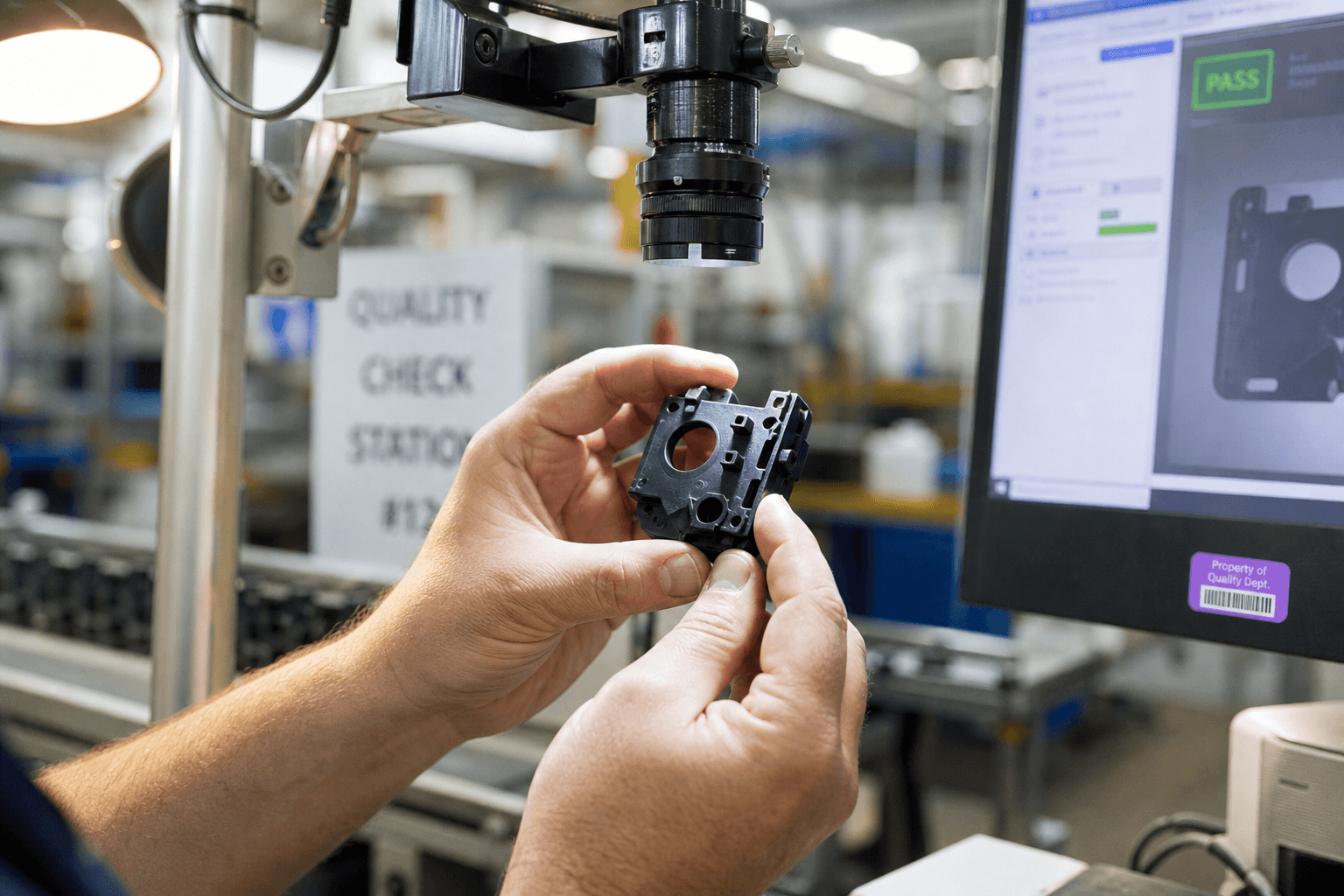
The use case is: cameras mounted at inspection points capture images of products or components, a vision model classifies each item (pass, fail, or review), and defects are flagged for rejection or human review. The system runs continuously, does not fatigue, and produces a complete inspection record.
Where Australian manufacturers are deploying this:
- Surface defect detection on sheet metal, glass, and food products
- Dimensional verification for machined components
- Label and packaging integrity checks
- Foreign object detection in food processing
Architecture considerations: Edge deployment is usually preferable to cloud inference for line-speed applications — latency requirements of under 100ms are common, and a cloud round-trip cannot reliably meet that. Industrial-grade cameras, controlled lighting, and physical mounting are not optional extras; they determine whether your training data is usable. Budget for this infrastructure alongside the model development.
The honest limitation: Vision models are trained on the defect types in your training data. Novel defect types — ones that were not present when the model was trained — will not be caught. You need a process for continuously adding new defect examples to the training set and retraining on a scheduled cadence. This is an ongoing operational commitment, not a one-time build.
For manufacturers considering computer vision alongside broader modernisation, it is worth reviewing how AI engineering fits into your existing line control architecture before scoping the project.
3. Document AI for Compliance and Safety Procedures
Australian manufacturing operates under a significant compliance burden: Safe Work Australia requirements, AS/NZS standards, ISO certifications, environmental reporting obligations, and industry-specific regulations that vary by sector. The documentation that supports this compliance — work instructions, material safety data sheets, quality procedures, audit records, non-conformance reports — is substantial and largely unstructured.
Document AI applies large language models and information extraction techniques to this document landscape. The practical applications that are working in production:
Procedure retrieval and summarisation: Operators query a system in natural language — "What is the lockout/tagout procedure for the press line?" — and receive the relevant extract from the current approved procedure, with a reference to the source document. This is retrieval-augmented generation (RAG) applied to a controlled document set. The model does not make up procedures; it retrieves them from your document library.
Non-conformance and incident report processing: Structured extraction from free-text incident reports — extracting equipment involved, injury type, corrective actions, and responsible parties — to populate a structured database for trend analysis and regulatory reporting.
Change management assistance: When a standard or regulation changes, document AI can identify which procedures reference the affected clause and flag them for review. This is a task that currently takes compliance teams weeks to do manually.
A critical guardrail: Document AI in a safety-critical environment requires human sign-off on outputs before they are acted upon. The system surfaces information and drafts; a qualified person confirms. Do not deploy retrieval systems for safety procedures without a clear human-in-the-loop workflow.
4. Demand Forecasting and Inventory Optimisation
Demand forecasting is one of the clearest cases where machine learning outperforms traditional statistical methods — not because the algorithms are magic, but because they can incorporate more variables than a spreadsheet model can handle: promotional calendars, weather, supplier lead times, economic indicators, and historical demand patterns simultaneously.
For Australian manufacturers, the specific challenges that make this valuable include:
- Long and variable ocean freight lead times from offshore suppliers
- Seasonal demand patterns that interact with Southern Hemisphere weather and the Australian retail calendar
- Concentration of demand in major east-coast markets with distribution complexity to WA and regional areas
What a production system looks like: Historical sales data, current inventory positions, and external signals (promotional plans, known demand events) feed into a forecasting model. The model produces SKU-level demand forecasts at weekly or monthly horizons. An optimisation layer translates those forecasts into reorder recommendations, taking into account lead times, holding costs, and service level targets.
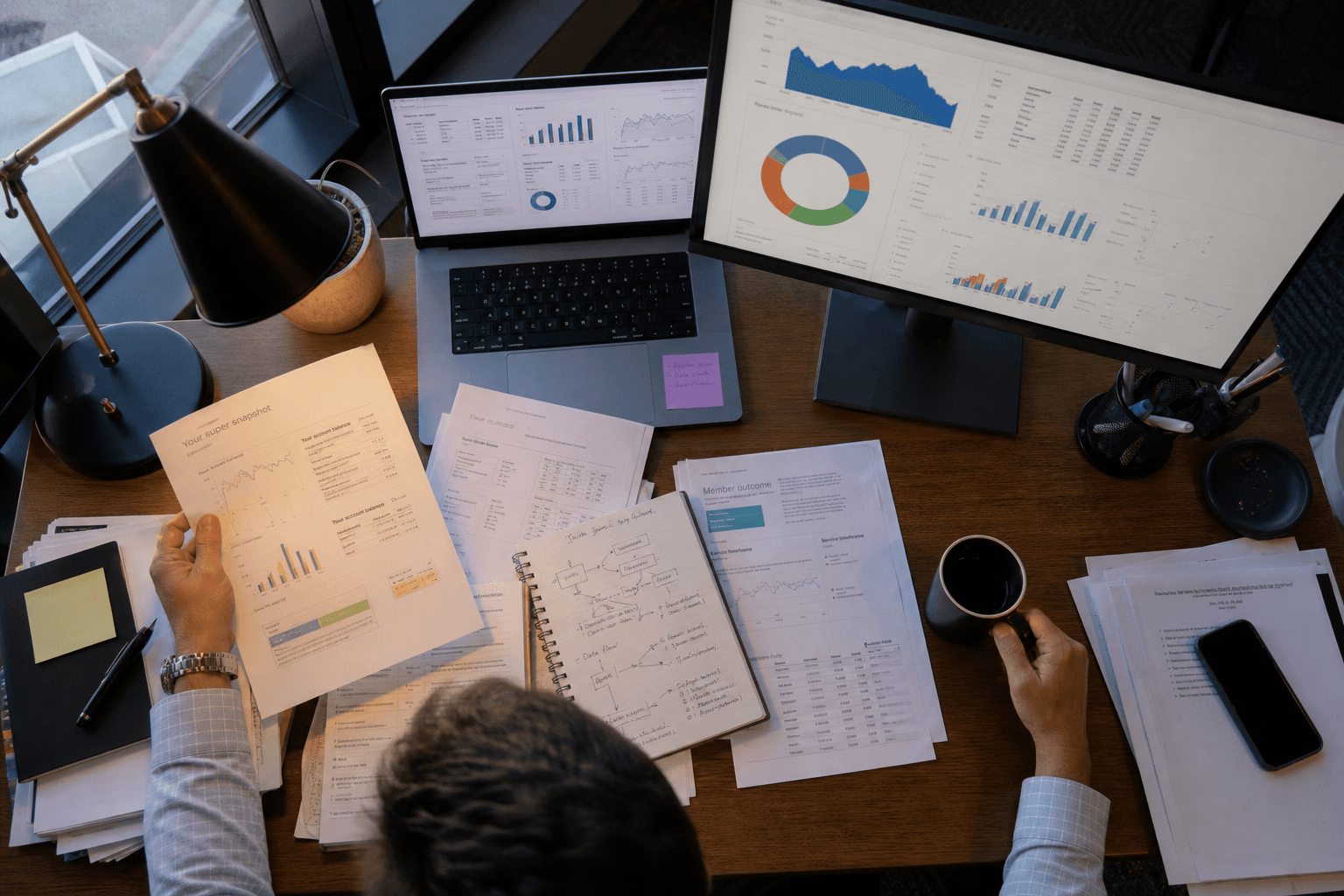
The data infrastructure requirement is non-trivial. If your inventory, sales, and supplier data live in separate systems that do not talk to each other, the forecasting model is the easy part. The data integration and quality work is the longer task. This is why data infrastructure is typically the first conversation — the model is only as good as the data feeding it.
What you should not expect: A forecasting model will not eliminate forecast error. Demand is genuinely uncertain, and a model that claims otherwise is overfit. The goal is to reduce error and reduce the cost of error — better fill rates, less excess inventory, fewer emergency replenishment orders.
5. AI Agents for Invoice and Procurement Automation
Manufacturing businesses with complex supply chains process large volumes of structured and semi-structured documents: purchase orders, supplier invoices, delivery receipts, and freight documents. At volume — organisations processing 2,000 or more invoices per month is a common threshold where automation becomes compelling — manual processing is slow, error-prone, and expensive.
AI agents in this context are not general-purpose reasoning systems. They are purpose-built automation pipelines that combine document extraction (pulling line items, quantities, prices, and supplier identifiers from invoice PDFs), matching logic (three-way matching against purchase orders and goods receipts), exception routing (flagging discrepancies for human review), and ERP integration (posting confirmed invoices automatically).
What makes this work in production:
- High-accuracy extraction from your actual supplier document formats, including the poorly-formatted ones
- A clear exception handling workflow — the system needs to know what it cannot process and route those cases reliably
- Audit trail requirements met — every automated decision logged with the extracted data that drove it
- Integration with your ERP (SAP, Oracle, Microsoft Dynamics, MYOB, and others) via API or file-based interface
The illustrative case: For an organisation processing 2,000+ invoices per month manually, a mature automation system can handle the majority of straight-through cases without human intervention, with exceptions routed to a smaller review queue. The reduction in processing time and error rate compounds over time as the system is tuned to your supplier document formats.
Where agents are not yet ready: Negotiation, supplier relationship management, and procurement decisions that require contextual judgment beyond document matching. The agent handles the processing workflow; it does not replace the procurement team.
For organisations exploring broader automation beyond invoice processing, our AI product strategy service helps scope which automation opportunities have the strongest business case before engineering begins.
What These Use Cases Have in Common
Looking across these five, a pattern emerges:
| Use Case | Core AI Technique | Primary Data Requirement | Common Blocker |
|---|---|---|---|
| Predictive Maintenance | Time-series anomaly detection | Sensor data + maintenance history | Data access from OT systems |
| Vision Quality Inspection | Computer vision / object detection | Labelled image dataset | Controlled lighting + camera setup |
| Document AI / Compliance | RAG + information extraction | Structured document library | Document governance / version control |
| Demand Forecasting | ML regression / ensemble models | Clean historical sales + inventory | Siloed ERP and inventory data |
| Invoice / Procurement Agents | Document extraction + workflow | Invoice PDFs + PO data | ERP integration complexity |
The common thread: none of these use cases fail because the AI is not good enough. They fail because the data is not ready, the integration is harder than expected, or the organisation is not set up to act on the outputs. The technology is the easier part.
Getting Started Without a 12-Month Roadmap
The organisations seeing the most traction are not the ones who built a comprehensive AI strategy before writing a line of code. They are the ones who picked one high-value, well-scoped use case, built the data foundation for it, shipped it to production, and learned from operating it.
A practical entry point is an AI readiness assessment focused on a specific use case — understanding the data you have, the integration points, and the realistic scope before committing to a full build. This avoids the common failure mode of scoping a project against ideal data that does not actually exist in production quality.
For more on how Australian technology leaders are approaching AI adoption, explore our insights — including our practitioner's guide to building the data foundation for AI.
Work With a Team That Ships Production AI
If you are evaluating AI use cases for your manufacturing operation and want a direct conversation about what is realistic for your environment, we would be glad to hear about your challenge. We work with Australian manufacturers on the full journey — from assessing readiness through to engineering and operating production systems — and we will tell you honestly if a use case is not ready to build yet.
Chris Kerr
Partner at Horizon Labs, an AI product consultancy and venture studio. A commercially focused product and technology leader with 20+ years building and scaling digital platforms, teams, and businesses across SaaS, travel, eCommerce, logistics and transport, and digital marketing — operating at the intersection of product, engineering, and data. Writes about platform strategy, AI transformation, modern data ecosystems, and the operational discipline that separates AI demos from AI products.