AI-Assisted Estimation for More Predictable Software Delivery
AI-assisted estimation tools can sharpen sprint planning by surfacing historical patterns and outliers in delivery data — but they cannot replace the judgement calls at the heart of estimating genuinely uncertain work. Here's a practical look at where these tools help, and where they don't.

Engineering leaders at growing Australian companies are under constant pressure to answer one question: when will this ship? AI-assisted estimation tools promise sharper answers, drawing on historical velocity, code complexity signals, and pattern matching across past sprints. Used well, they tighten forecasts. Used as a replacement for judgement, they create false confidence.
What is AI-assisted engineering estimation?
AI-assisted engineering estimation is the use of machine learning models and historical delivery data to generate effort or duration forecasts for software work, rather than relying solely on manual techniques like planning poker or expert judgement. These tools typically ingest ticket history, commit patterns, code churn, and team velocity to flag estimates that look optimistic or inconsistent with past delivery. They do not replace estimation — they augment the inputs a team uses to make the call.
Most tools on the market today sit on top of existing project trackers (Jira, Linear, Azure DevOps) and surface statistical outliers: a story sized similarly to past work that took three times longer, or a sprint commitment that exceeds what the team has historically delivered in that window. That is pattern recognition, not prediction of the future.
Why is delivery predictability so hard for scale-up engineering teams?
Delivery predictability breaks down for growing engineering teams because the variables compound: headcount changes faster than process matures, legacy systems carry undocumented complexity, and growth-stage priorities shift between sprints. Add a backend that was never built for the current scale, and even experienced teams struggle to size work with confidence.
This is compounded in Australian scale-ups by board and investor reporting cycles. Engineering leaders are frequently asked to commit to a roadmap months out, while the underlying codebase — often a monolith accumulated through early product-market-fit iterations — resists confident estimation. The gap between what the business wants to promise and what the team can reliably commit to is where most delivery predictability problems originate, not in the estimation technique itself.
How can AI tools actually improve sprint planning?
AI tools improve sprint planning primarily by surfacing historical patterns a team would otherwise rely on memory to recall: which types of stories consistently run over, which engineers' estimates skew optimistic, and which dependencies have caused slippage before. Surfacing this data in planning meetings grounds the conversation in evidence rather than optimism.

The practical applications fall into a few categories: anomaly detection on estimate sizing, automated breakdown suggestions for large tickets based on similar past work, and velocity forecasting that accounts for known team capacity changes (leave, onboarding, context switching). None of these automate the estimate itself — they inform the humans making it.
| Approach | What it does well | What it misses |
|---|---|---|
| Planning poker / expert judgement | Captures tacit knowledge, builds team buy-in | Scales poorly, inconsistent across teams |
| Historical velocity tracking | Simple, transparent, easy to audit | Assumes future work resembles past work |
| AI-assisted estimation tools | Flags outliers, surfaces patterns at scale | Cannot judge novel problems or ambiguous scope |
| Hybrid (AI-informed, human-decided) | Combines data signal with contextual judgement | Requires discipline to not defer to the tool |
What are the limits of automating estimation?
Estimation is fundamentally a judgement call about an uncertain future, and no model trained on past delivery data can fully account for genuinely novel problems, scope that has not been defined yet, or dependencies on people and systems outside the team's control. This is the core limitation that any AI-assisted estimation programme needs to be honest about from day one.
Software engineering has long recognised that estimate uncertainty is highest early in a project and narrows as scope clarifies — a pattern often described as the "cone of uncertainty." AI tools trained on historical data can tell you how your team has performed on similar-looking work before. They cannot tell you how your team will perform on work that has never been attempted, or how a third-party API outage, a key engineer's parental leave, or an unplanned production incident will reshape a sprint. Teams that treat AI-generated estimates as authoritative rather than advisory tend to see predictability get worse, not better, because the model's confidence masks genuine uncertainty.
What does a practical AI-assisted estimation workflow look like?
A practical workflow treats AI output as one input into a planning conversation the team still owns. The tool flags an estimate as an outlier relative to historical patterns; the team discusses whether that is because the work genuinely differs from past work, or because the estimate needs revisiting. The decision — and accountability for it — stays with the humans.
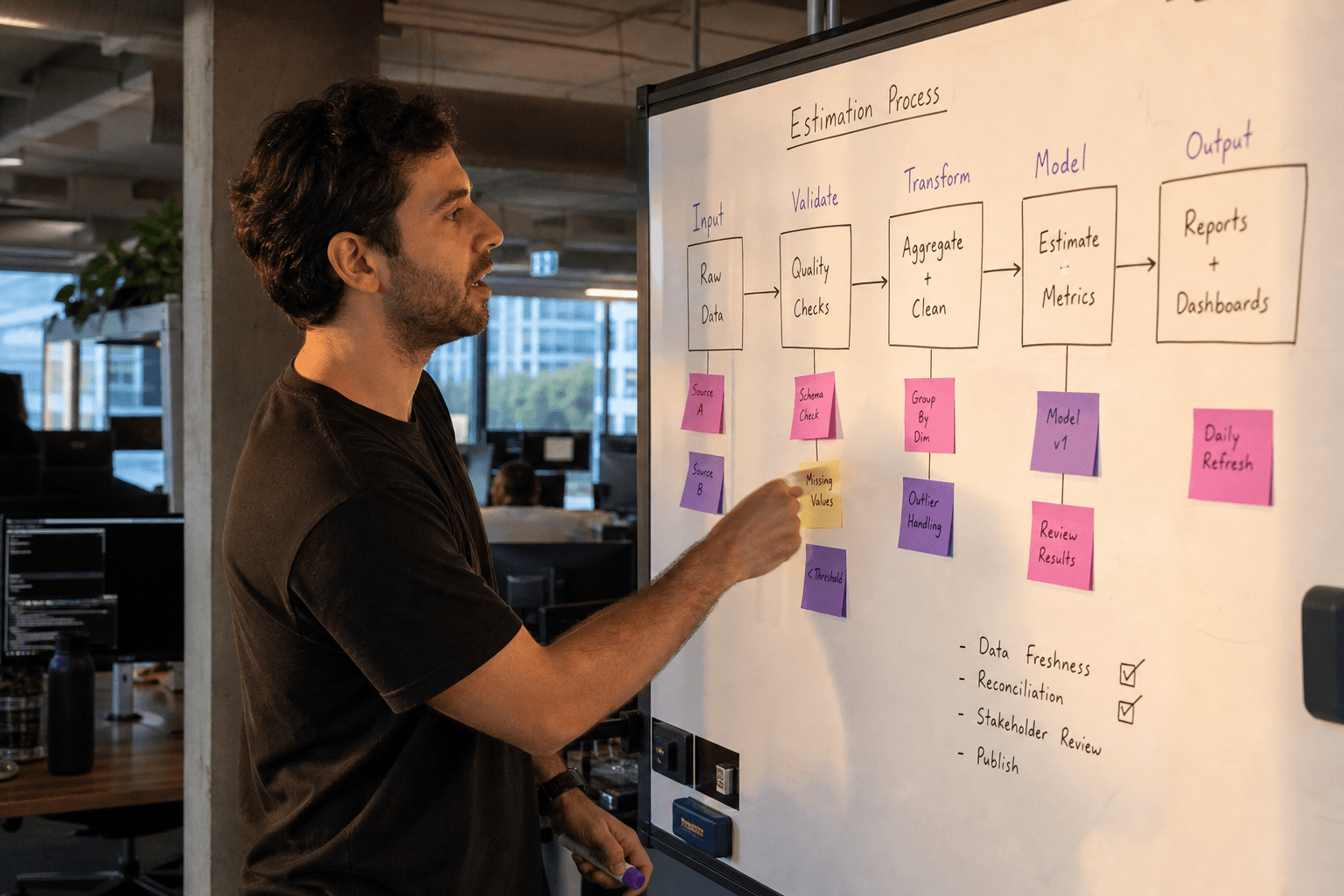
This matters more for teams carrying technical debt, where legacy code complexity is poorly reflected in any historical dataset. A team working through application modernisation on a decade-old monolith cannot expect an estimation model trained on recent, well-understood code to accurately size work in the parts of the system nobody has touched in years. In that context, pairing AI-assisted estimation with proper architectural discovery — understanding what you are actually estimating against — produces far more reliable forecasts than the tooling alone.
How does estimation tooling fit into a broader AI and data strategy?
AI-assisted estimation works best as part of a team's broader data and engineering maturity, not as a standalone tool bolted onto Jira. Teams need clean, structured delivery data — consistent ticket sizing conventions, reliable time tracking, and a shared definition of "done" — before any model can produce useful signal. This is, in effect, a smaller version of the same data infrastructure problem that shows up in product analytics and ML initiatives: the model is only as good as the pipeline feeding it.
For engineering leaders evaluating where AI genuinely adds value in their delivery process versus where it adds noise, it is worth treating this as a strategic question rather than a tooling purchase. That is the same lens we bring to AI product strategy work more broadly: start with the decision you are trying to improve, then work backwards to the right combination of data, tooling, and process — rather than adopting a tool because it promises automation of something that was never purely mechanical to begin with.
Where AI-assisted estimation sits alongside engineering delivery models
For scale-up teams facing genuinely novel or ambiguous delivery challenges — a legacy migration with unclear scope, or a first AI feature with no historical precedent — no estimation tool, AI-assisted or otherwise, substitutes for engineers who have solved similar problems before. This is one reason embedded delivery models exist alongside internal teams: they bring pattern-matched experience to problems that are, by definition, outside a team's own historical dataset. If you are weighing how to resource an unpredictable piece of delivery work, our AI engineering team can help scope what is genuinely estimable versus what needs discovery first.
AI-assisted estimation is a useful addition to a mature planning process, not a fix for an immature one. It will not turn an under-resourced team or an undocumented legacy system into a predictable delivery machine. Used honestly — as a source of evidence rather than a verdict — it helps teams have better conversations about risk, and that is usually what delivery predictability actually depends on.
If you're exploring how to improve delivery predictability on a legacy or AI-adjacent codebase, we can help. You can also browse our insights for more on application modernisation, AI engineering, and data infrastructure.
Chris Kerr
Partner at Horizon Labs, an AI product consultancy and venture studio. A commercially focused product and technology leader with 20+ years building and scaling digital platforms, teams, and businesses across SaaS, travel, eCommerce, logistics and transport, and digital marketing — operating at the intersection of product, engineering, and data. Writes about platform strategy, AI transformation, modern data ecosystems, and the operational discipline that separates AI demos from AI products.