Feature Flagging and Progressive Delivery for AI Rollouts
AI features fail differently to normal software — unpredictably, not consistently. Here's how growing engineering teams use feature flags, canary releases and staged rollouts to limit the blast radius when that happens.

Shipping an AI-powered feature is not the same as shipping a UI change. A model can behave well in testing and still produce unexpected, biased, or simply wrong outputs once it meets real production traffic. Feature flagging and progressive delivery give engineering teams a way to expose AI features gradually, watch how they behave under live conditions, and pull back quickly if something goes wrong — without a full redeploy.
What is progressive delivery for AI features?
Progressive delivery is the practice of releasing a feature to a small, controlled slice of users or traffic first, then expanding exposure in stages as confidence grows. For AI features, this matters more than for typical software because model behaviour can shift with input distribution, prompt variation, or edge cases that never showed up in a test set. A feature flag is a runtime switch that controls whether a given code path — in this case, a model call or AI-generated experience — is active for a given user, cohort, or percentage of traffic, without requiring a new deployment.
Together, flags and staged rollout turn an AI launch from a single binary event into a series of small, reversible decisions.
Why do AI features need different rollout treatment to standard software?
AI features carry failure modes that traditional code does not: hallucinated or fabricated outputs, latency spikes from model inference, drift as real-world data diverges from training data, and inconsistent behaviour across similar-looking inputs. A bug in conventional code tends to fail the same way every time, which makes it easy to catch in QA. A model can be correct 95% of the time and still fail unpredictably on inputs you did not anticipate — which is precisely the scenario progressive delivery is built to catch early, on a small blast radius, before it reaches your full user base.
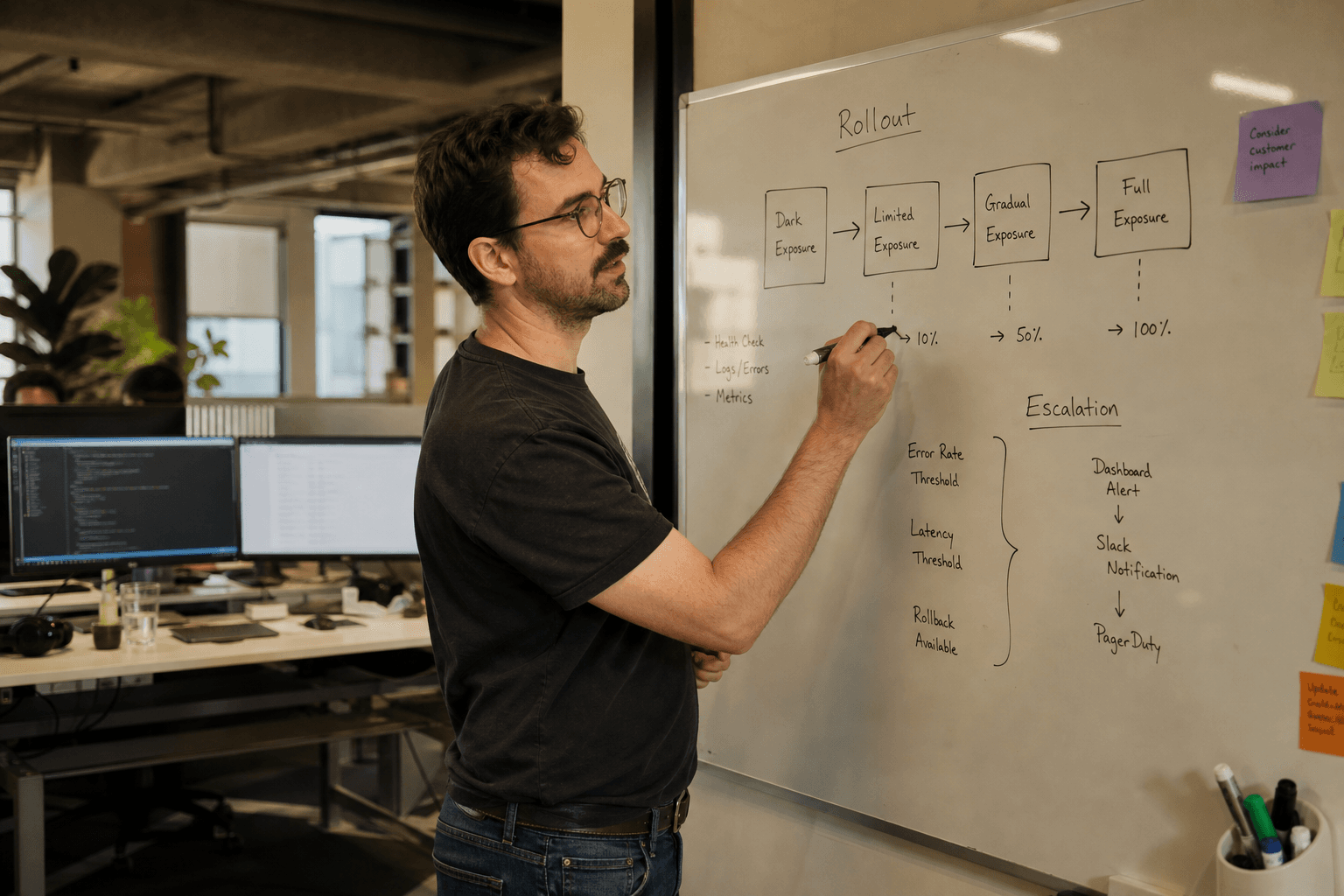
This is also why AI rollout planning belongs earlier in the process than many teams expect. Decisions about what "safe" looks like for a given feature — acceptable error rates, fallback behaviour, human-in-the-loop checkpoints — are product and architecture decisions, not just deployment mechanics. Teams that fold this into their AI product strategy from the outset avoid retrofitting safety controls after an incident.
What techniques do teams actually use?
Most organisations combine a handful of complementary techniques rather than relying on one pattern alone. A canary release is a rollout where a new feature is enabled for a small, representative subset of real users or traffic before wider release, with monitoring gating each expansion. A kill switch is a flag specifically designed to disable a feature instantly, without a deployment, if monitoring detects a problem. Shadow deployment runs the new model alongside the existing system on live traffic, but only logs its output for comparison — it never affects what the user sees.

| Technique | What it controls | Best suited for |
|---|---|---|
| Feature flag | Binary or percentage-based on/off per user, cohort, or environment | Decoupling release from deploy; instant rollback |
| Canary release | Gradual traffic expansion (e.g. internal users → 1% → 10% → 100%) | Catching unexpected model behaviour before full exposure |
| Shadow deployment | Running a model in parallel with no user-facing impact | Validating accuracy and latency before any real exposure |
| A/B / experiment gating | Comparing model variants against a control group | Measuring impact on business or quality metrics |
| Kill switch | Immediate disable, independent of deploy pipeline | Incident response when a model misbehaves in production |
None of these replace rigorous model evaluation before launch — they are the production-side safety net for the behaviour you cannot fully predict in offline testing.
How do you design a rollout plan for an AI feature?
A sound rollout plan starts with the smallest possible real-world exposure and defines, in advance, what would trigger a pause or rollback at each stage. Typical stages move from internal dogfooding, to a small percentage of opted-in or low-risk users, to a broader but still partial rollout, and finally to full availability — with monitoring and a clear rollback owner at every step. The plan should specify who can pull the kill switch, how fast that decision can be made, and what the fallback experience looks like when the AI feature is disabled — a simpler rules-based response, a cached result, or a clear message that the feature is temporarily unavailable.
This kind of staged release depends on infrastructure that can actually support flag evaluation, cohort targeting, and fast rollback at low latency — which often surfaces gaps in teams whose platforms were not built with this in mind. That's frequently where application modernisation work and progressive delivery efforts intersect: legacy monoliths and tightly coupled deployment pipelines make flag-based rollout far harder to implement safely.
What metrics should gate each rollout stage?
The right gating metrics combine model-quality signals with standard operational ones, and both need to be watched together, because a model can be operationally healthy while quietly degrading in quality. Model-quality signals include output accuracy on known-answer test cases, rates of fallback or "I don't know" responses, and manual review flags from spot-checking real outputs. Operational signals include latency, error rates, and cost per inference, since a model that is accurate but too slow or too expensive is still a failed rollout.
Getting this instrumentation in place is as much a data problem as a release-engineering one — you need pipelines that can capture, label, and surface model outputs in near real time, not just application logs. This is where solid data infrastructure and the engineering discipline behind production-grade AI engineering do the quiet, unglamorous work that makes progressive delivery trustworthy rather than theatrical.
Where does this fit alongside MLOps and governance tooling?
Platform-level governance tools — model evaluation pipelines, deployment monitoring, and policy engines offered by major AI platforms — are necessary but not sufficient on their own. They tell you whether a deployed model is behaving within policy at the project level; they do not, by themselves, control how gradually a feature reaches your users or give you an instant, application-level kill switch. Progressive delivery sits a layer above that governance tooling, controlling exposure at the product and traffic level, while platform monitoring tells you what's happening inside the model once traffic reaches it. Mature AI engineering practice uses both together rather than treating either as a substitute for the other.
Getting started
The teams that roll out AI features safely are rarely the ones with the most sophisticated models — they're the ones with the discipline to expose those models gradually, watch closely, and roll back without drama when something looks off. If your current deployment pipeline can't support a staged rollout or an instant kill switch for an AI feature, that's worth fixing before the next launch, not after an incident. For more on related engineering and strategy topics, browse our insights.
If you're planning an AI feature rollout and want a second opinion on your release architecture, get in touch — we can talk through what a safe, staged launch looks like for your stack.
Chris Kerr
Partner at Horizon Labs, an AI product consultancy and venture studio. A commercially focused product and technology leader with 20+ years building and scaling digital platforms, teams, and businesses across SaaS, travel, eCommerce, logistics and transport, and digital marketing — operating at the intersection of product, engineering, and data. Writes about platform strategy, AI transformation, modern data ecosystems, and the operational discipline that separates AI demos from AI products.