When to Replace Your Software Platform: 7 Signs It's Time
Platform replacement is one of the hardest decisions in technology leadership. This guide provides a framework for when to replace versus renovate your existing platform, with seven clear signs that indicate replacement makes more business sense than continued renovation.

When to Replace Your Software Platform: 7 Signs It's Time
Platform replacement is one of the hardest decisions in technology leadership. The sunk cost fallacy whispers "just one more upgrade" while technical debt screams for a fresh start. Making the wrong call costs millions in wasted effort, migration risks, and opportunity cost.
This guide provides a decision framework for when to replace versus renovate your existing platform, helping you navigate the complex trade-offs between continuity and transformation.
The Replace vs Renovate Decision Framework
Platform replacement decisions require balancing three critical factors: technical debt severity, business impact, and migration risk. The key is moving beyond emotional attachment to legacy systems and evaluating objective criteria.
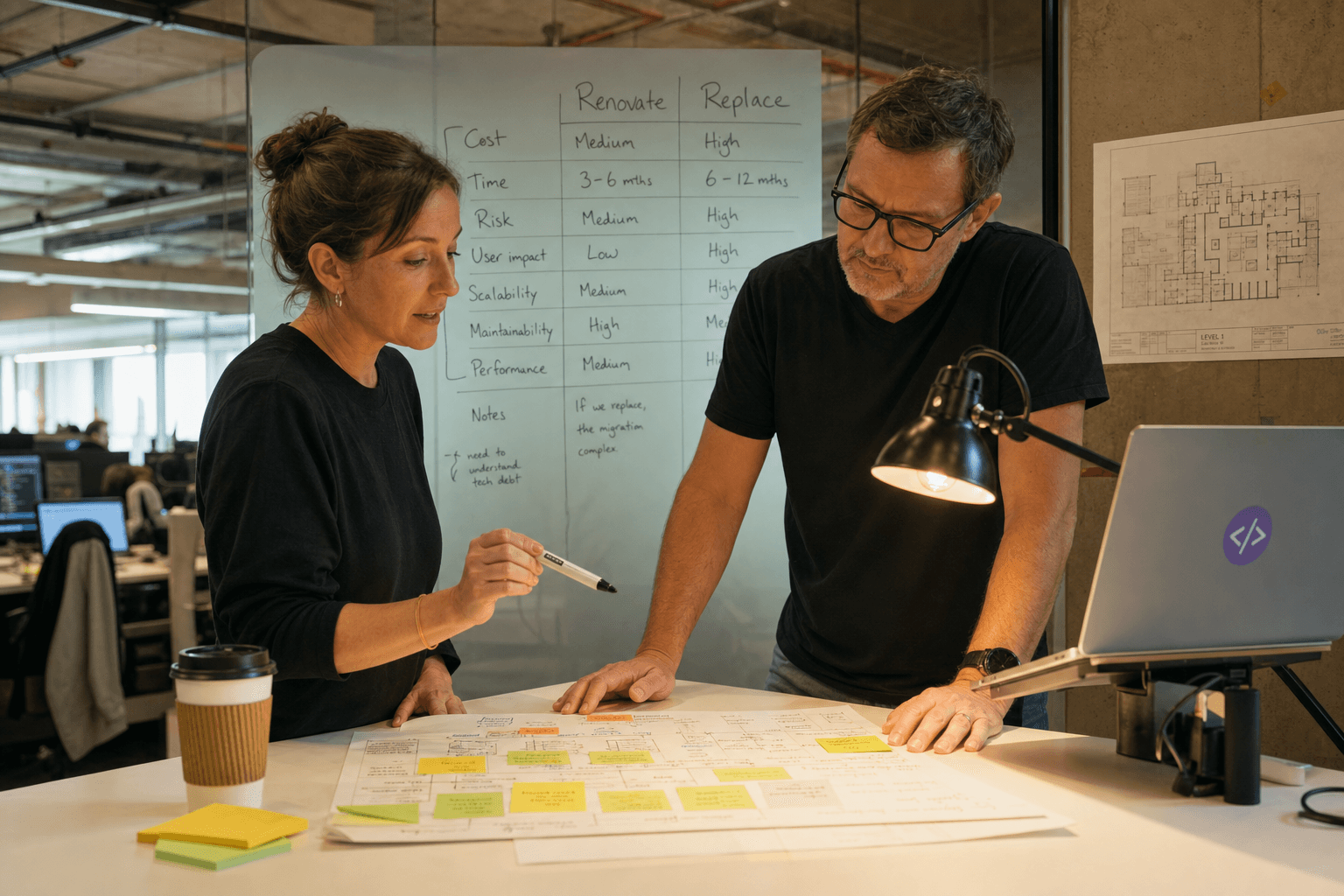
Start with a simple question: "If we were building this system today, would we build it the same way?" If the answer is no, you need to assess whether the gap can be bridged through incremental improvements or requires a fundamental rebuild.
Evaluating Technical Debt Severity
| Factor | Renovate | Replace |
|---|---|---|
| Architecture | Modular, extensible | Monolithic, tightly coupled |
| Technology stack | Supported, modern | End-of-life, unsupported |
| Development velocity | Steady feature delivery | Slowing or stalled |
| Maintenance cost | Predictable, manageable | Escalating, unpredictable |
7 Signs Your Platform Needs Replacement
1. Development Velocity Has Ground to a Halt

When simple feature requests take months instead of weeks, your platform has become a productivity anchor. This happens when technical debt accumulates faster than teams can address it, creating a negative feedback loop.
Signs include: developers spending more time working around limitations than building features, frequent production hotfixes, and new team members taking months to become productive. If your engineering team is spending over 70% of their time on maintenance rather than new development, replacement may be more cost-effective than continued renovation.
2. Technology Stack Reaches End-of-Life
Running on unsupported technology creates security vulnerabilities and limits hiring options. When your platform relies on frameworks, databases, or languages that vendors no longer support, you face a stark choice: migrate or accept increasing risk.
End-of-life technology means no security patches, no compatibility updates, and shrinking talent pools. The longer you wait, the more expensive and risky migration becomes. Plan platform replacement at least 18 months before support ends.
3. Scaling Costs Exceed Revenue Growth
Healthy platforms exhibit predictable scaling patterns where infrastructure costs grow slower than revenue. When your platform requires exponential resource increases for linear growth, fundamental architectural issues are likely at play.
Monolithic architectures often hit scaling walls where adding capacity becomes prohibitively expensive. If your infrastructure costs are growing faster than your customer base, investigate whether architectural limitations require platform replacement.
4. Security Architecture Cannot Meet Modern Standards
Legacy platforms often lack modern security foundations like encryption at rest, proper authentication flows, or audit logging. When security becomes a bolt-on afterthought rather than a foundational element, comprehensive replacement may be the only viable path.
Regulatory requirements in finance, healthcare, and data privacy are continuously evolving. If your platform cannot adapt to new compliance standards without fundamental architectural changes, replacement planning should begin immediately.
5. Integration Complexity Creates Business Bottlenecks
Modern business moves at API speed. If your platform requires custom development for every integration, lacks modern API standards, or cannot connect to essential business tools, it constrains growth opportunities.
Platforms that cannot easily integrate with CRM systems, marketing automation, analytics tools, or third-party services create operational friction that compounds over time. The inability to quickly connect new tools often signals architectural inflexibility that renovation cannot address.
6. Data Architecture Prevents Analytics and AI Adoption
Data trapped in proprietary formats or scattered across disconnected systems prevents organisations from leveraging analytics and AI. If your platform stores data in ways that make extraction, transformation, or analysis difficult, it becomes a barrier to competitive advantage.
Modern platforms need to support real-time analytics, machine learning integration, and flexible data export. Legacy systems with proprietary data models often require complete replacement to enable advanced analytics capabilities.
7. Talent Acquisition and Retention Becomes Impossible
Developers want to work with modern technology stacks that advance their careers. If your platform relies on outdated languages, frameworks, or architectural patterns that skilled developers avoid, you face an unsustainable talent challenge.
The inability to attract and retain engineering talent creates a vicious cycle: existing team members leave, knowledge walks out the door, and the platform becomes even harder to maintain. When recruitment consistently fails due to technology stack concerns, replacement planning becomes urgent.
Overcoming the Sunk Cost Fallacy
The sunk cost fallacy traps organisations in "just one more upgrade" thinking. Money already invested in legacy platforms feels too valuable to abandon, even when continued investment yields diminishing returns.
Reframe the decision around future value, not past investment. Ask: "What would it cost to achieve our business goals with the current platform versus a new one?" Include hidden costs like reduced developer productivity, security risks, and missed opportunities.
Sunk costs are irrelevant to future decisions. Focus on the total cost of ownership over the next 3-5 years, including opportunity costs from delayed features and competitive disadvantage.
Migration Planning and Risk Mitigation
Successful platform replacement requires careful planning and risk management. The strangler fig pattern offers a proven approach: gradually replace functionality while keeping the existing system operational.
Migration Strategy Framework
- Assess and audit: Document current functionality, data models, and integration points
- Design target architecture: Define the new platform's technical and business requirements
- Plan incremental migration: Identify which components to migrate first and in what order
- Establish data migration: Design data transformation and synchronisation approaches
- Test thoroughly: Build comprehensive testing strategies for each migration phase
- Plan rollback procedures: Ensure you can revert changes if issues arise
For more detailed guidance on migration approaches, see our insights on application modernisation strategies.
Building the Business Case for Platform Replacement
Executive stakeholders need clear business justification for platform replacement investments. Focus on quantifiable impacts: reduced development costs, faster time-to-market, improved security posture, and competitive positioning.
Present the decision as risk management, not just technology upgrade. Legacy platforms create business risks through security vulnerabilities, compliance challenges, talent retention issues, and competitive disadvantage.
Include opportunity costs in your analysis. What business initiatives cannot proceed with the current platform? What competitive advantages are you missing? These strategic considerations often outweigh pure cost comparisons.
When Renovation Makes More Sense
Platform replacement is not always the answer. Renovation through application modernisation can be effective when:
- The core architecture is sound but needs technology updates
- Business logic is complex and well-tested
- Migration risk exceeds the benefits of replacement
- Budget constraints require incremental improvement
- The platform serves a specific niche effectively
The key is honest assessment of whether renovation can achieve your business goals within acceptable timeframes and budgets.
Making the Decision
Platform replacement decisions require balancing technical reality, business needs, and resource constraints. Use objective criteria, avoid emotional attachment to legacy systems, and focus on future value creation rather than past investment.
If three or more of the seven signs apply to your platform, replacement likely offers better long-term value than continued renovation. The earlier you begin planning, the more control you have over timing and risk management.
Facing a platform replacement decision? Our application modernisation team helps organisations navigate these complex transitions, from initial assessment through successful migration. Get in touch to discuss your specific situation and explore your options.
Chris Kerr
Partner at Horizon Labs, an AI product consultancy and venture studio. A commercially focused product and technology leader with 20+ years building and scaling digital platforms, teams, and businesses across SaaS, travel, eCommerce, logistics and transport, and digital marketing — operating at the intersection of product, engineering, and data. Writes about platform strategy, AI transformation, modern data ecosystems, and the operational discipline that separates AI demos from AI products.