Vector Database Selection for Australian RAG Applications
Selecting the right vector database for RAG applications requires balancing performance, cost, and data sovereignty. Australian organisations must consider managed versus self-hosted options, local data residency requirements, and operational complexity.

Vector Database Selection for Australian RAG Applications
Vector databases power the backbone of modern RAG (Retrieval-Augmented Generation) systems, storing and retrieving high-dimensional embeddings that enable AI applications to access relevant context. For Australian organisations building AI-powered search and knowledge systems, the choice between managed services and self-hosted solutions involves critical trade-offs around performance, cost, operational complexity, and data sovereignty.
The vector database landscape offers options from fully managed cloud services to open-source extensions. Each approach brings distinct advantages and challenges that affect everything from query latency and scaling capabilities to compliance requirements and total cost of ownership.
RAG System Requirements for Vector Databases
Effective RAG applications demand vector databases optimised for high-dimensional similarity searches with consistent low latency. Essential capabilities include approximate nearest neighbour (ANN) search algorithms, metadata filtering for refined queries, and hybrid search combining vector similarity with traditional text search.
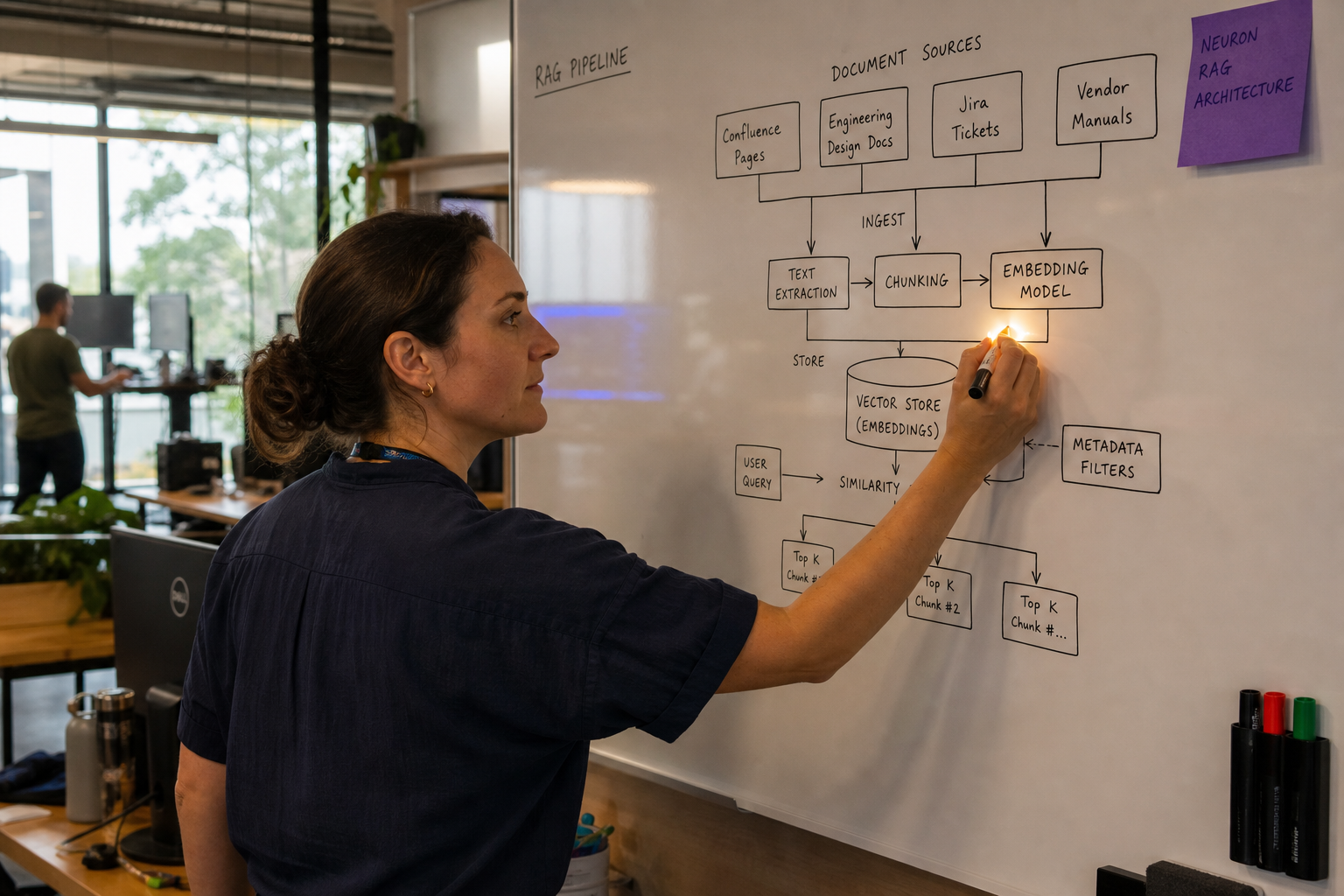
Production RAG systems require real-time updates as knowledge bases evolve, concurrent query handling for multiple users, and reliability that supports business-critical AI applications. The database must integrate seamlessly with embedding models while maintaining performance at scale.
Pinecone: Cloud-Native Vector Search
Managed Infrastructure Approach

Pinecone provides a fully managed vector database service designed specifically for machine learning workloads. The platform handles indexing, scaling, and infrastructure management automatically, using proprietary algorithms optimised for similarity search operations.
The service architecture separates compute from storage, enabling independent scaling of query performance and data capacity. This design allows organisations to optimise costs while maintaining performance as data volumes grow.
Operational Simplicity
Pinecone eliminates database administration overhead by managing index optimisation, backup procedures, and scaling decisions automatically. Development teams can focus on application logic rather than infrastructure management.
The platform includes integrated monitoring, alerting, and performance analytics. System updates and patches apply transparently without requiring downtime or manual intervention from client organisations.
Australian Deployment Considerations
Pinecone operates primarily from international infrastructure with limited options for Australian data residency. Organisations with regulatory requirements around data sovereignty must evaluate whether cross-border data transfer aligns with their compliance obligations under Australian privacy and data protection frameworks.
Weaviate: Flexible Vector Database Platform
Deployment Versatility
Weaviate offers both self-hosted open-source deployment and managed cloud services, providing flexibility for organisations with varying infrastructure preferences. The open-source version delivers complete control over data location, customisation options, and operational procedures.
Organisations can deploy Weaviate on-premises, in Australian cloud regions, or through managed services. This flexibility accommodates diverse data residency requirements and control preferences across different industry sectors.
Advanced Search Functionality
Weaviate supports sophisticated hybrid search capabilities combining vector similarity with traditional keyword search and graph-based queries. The platform integrates with multiple embedding providers and supports custom machine learning models.
Built-in vectorisation modules automatically generate embeddings from text, images, or other data types during ingestion, streamlining the data preparation process for RAG applications.
Management Complexity
Self-hosted Weaviate deployments require database administration expertise, including index tuning, scaling decisions, backup management, and security update procedures. Teams must establish monitoring systems and handle performance optimisation based on their specific use cases.
Weaviate Cloud Service reduces operational overhead while maintaining deployment flexibility compared to fully proprietary solutions, offering a middle ground for organisations seeking managed convenience with more control options.
pgvector: PostgreSQL Vector Extension
PostgreSQL Integration
pgvector extends PostgreSQL databases with vector similarity search capabilities, enabling organisations to add AI functionality to existing PostgreSQL deployments. This approach leverages established database expertise and infrastructure investments.
The extension supports both exact and approximate nearest neighbour searches with configurable algorithms. Integration with PostgreSQL allows vector data to coexist with relational data in unified database environments, simplifying architecture for applications requiring both data types.
Cost and Infrastructure Advantages
pgvector eliminates additional database licensing costs by extending existing PostgreSQL installations. Australian organisations can deploy pgvector in local cloud regions or on-premises infrastructure without vendor-specific infrastructure dependencies.
The extension integrates with existing PostgreSQL backup, monitoring, and administration tools, reducing learning curves for database teams already familiar with PostgreSQL operations.
Scale and Performance Characteristics
While pgvector handles moderate-scale vector workloads effectively, query performance at very large scales may not match purpose-built vector databases. Performance depends significantly on PostgreSQL configuration, hardware specifications, and index tuning strategies.
Organisations with existing PostgreSQL expertise may find pgvector sufficient for initial RAG implementations, with the option to migrate to specialised vector databases as requirements evolve.
Selection Criteria for Australian Organisations
Data Sovereignty Requirements
Australian organisations operating under privacy regulations or industry compliance frameworks must consider data residency requirements when selecting vector database solutions. Self-hosted options like Weaviate and pgvector provide greater control over data location compared to international managed services.
Organisations in regulated industries may require on-premises or Australian-hosted deployments to maintain compliance with data protection obligations and industry standards.
Operational Capability Assessment
Teams with established database administration expertise may benefit from self-hosted solutions offering greater customisation and control. Organisations lacking dedicated database resources might prefer managed services that reduce operational overhead.
The choice between managed and self-hosted deployments should align with existing technical capabilities and resource allocation for database operations and maintenance.
Performance and Scale Requirements
RAG applications with high query volumes or large vector datasets may require purpose-built vector databases optimised for similarity search operations. Applications with moderate scale requirements might find PostgreSQL extensions sufficient for their needs.
Performance requirements should be evaluated based on expected query volumes, response time requirements, and data growth projections over time.
Implementation Approach
Successful vector database selection requires evaluating specific use case requirements against available technical resources and compliance obligations. Organisations should conduct proof-of-concept implementations to validate performance characteristics under realistic workloads.
Consider starting with solutions that align with existing technical expertise and infrastructure, with migration paths to more specialised platforms as requirements evolve. This approach reduces initial implementation risks while maintaining flexibility for future scaling needs.
For organisations building RAG systems in Australia, the vector database choice affects long-term scalability, operational complexity, and compliance posture. Careful evaluation of these factors ensures the selected solution supports both immediate requirements and future AI application development.
To discuss vector database selection for your RAG implementation, get in touch with our AI engineering team. We help Australian organisations navigate these technical decisions and implement production-ready AI systems that align with local requirements and long-term objectives.
Sarah Mitchell
Principal AI Engineer at Horizon Labs. Specialises in production LLM systems — RAG architectures, fine-tuning pipelines, and the evaluation harnesses that prove a model still works six months after launch. Eight years in machine learning, the last four shipping AI into Australian financial services and healthcare. PhD-level depth, founder-level pragmatism.