The Real Cost of AI Implementation in Australia: Budget Guide
AI implementation costs in Australia range from $25,000 for simple chatbots to $500,000+ for complex systems. Here's transparent pricing across discovery, build, and operations phases, with real budget ranges by project type.
The Real Cost of AI Implementation in Australia: What to Budget and Why
AI implementation costs in Australia range from $25,000 for simple chatbots to $500,000+ for complex multi-agent systems, but most Australian businesses get cost estimates that are either wildly optimistic or completely opaque. Here's what AI projects actually cost, broken down by phase, with real numbers from the Australian market.
While every consulting firm talks about AI transformation, none publish transparent pricing. This leaves CTOs and technical founders flying blind when budgeting for AI initiatives. After delivering 50+ AI projects across Australia since 2018, here's what we've learned about actual implementation costs.
Why AI Project Costs Are Hard to Estimate
AI project costs vary dramatically because AI is fundamentally different from traditional software development. Traditional projects follow predictable patterns — wireframes lead to development, development leads to deployment. AI projects require experimentation, data quality assessment, and model iteration that can't be fully scoped upfront.
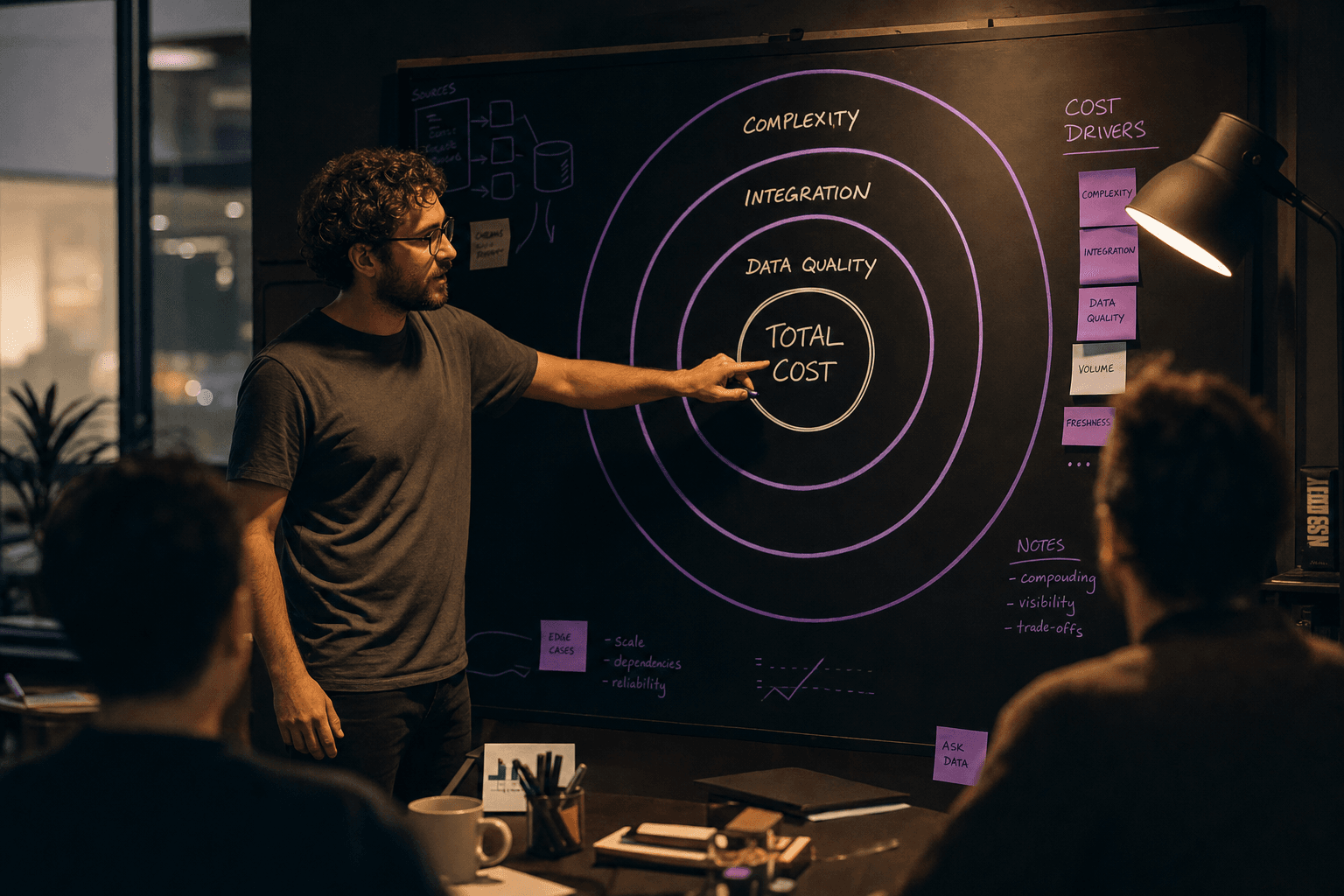
The three factors that drive 80% of cost variation are data quality (clean, labeled data vs messy enterprise data), technical complexity (simple RAG vs multi-modal agents), and integration requirements (standalone tool vs enterprise system integration). A seemingly simple "customer service chatbot" can cost $25,000 if you have clean FAQ data, or $150,000 if it needs to integrate with legacy CRM systems and handle complex product configurations.
Australian businesses also face unique cost drivers: data sovereignty requirements, integration with local systems (MYOB, Xero), and compliance with Australian privacy regulations add 15-25% to baseline costs.
The Three Cost Categories: Build, Infrastructure, Operations
Build Costs (One-Time)

Build costs cover discovery, development, and initial deployment. This is typically 60-70% of first-year total cost of ownership.
Discovery Phase ($8,000 - $35,000)
Discovery is technical due diligence — data assessment, feasibility analysis, and solution architecture. For RAG systems, this involves evaluating document quality and retrieval patterns. For predictive models, it's data exploration and feature engineering potential.
Simple projects (single use case, clean data): $8,000 - $15,000 Complex projects (multiple use cases, data quality issues): $20,000 - $35,000
Skipping discovery is the fastest way to double your build costs. We've rescued projects where businesses jumped straight to development and hit data quality walls six months in.
Development Phase ($15,000 - $400,000)
Development costs depend on AI complexity, integration requirements, and user experience needs.
| Project Type | Complexity | Typical Cost Range |
|---|---|---|
| RAG Chatbot (Simple) | Single knowledge base, basic UI | $15,000 - $40,000 |
| RAG System (Enterprise) | Multiple data sources, CRM integration | $60,000 - $120,000 |
| Predictive Analytics | Custom ML models, business intelligence | $80,000 - $180,000 |
| Multi-Agent System | Complex workflows, external APIs | $200,000 - $400,000 |
| Computer Vision | Custom models, edge deployment | $150,000 - $350,000 |
Key Development Cost Drivers:
- Data engineering: Cleaning and structuring enterprise data often costs more than the AI models themselves
- Integration complexity: Connecting to legacy systems can double development time
- Custom UI/UX: Consumer-grade interfaces cost 3-5x more than basic admin panels
- Compliance requirements: GDPR, Australian Privacy Principles, industry regulations
Infrastructure Costs (Monthly)
Infrastructure costs cover cloud compute, storage, and AI model hosting. These are predictable once you understand usage patterns.
Cloud Computing ($200 - $5,000+ monthly)
AI workloads require different infrastructure than traditional applications. Language models need GPU compute for inference, ML training requires burst capacity, and data pipelines need reliable storage.
- RAG Systems: $200 - $800/month (vector databases, embedding models, LLM inference)
- Custom ML Models: $400 - $2,000/month (training compute, model hosting, data pipelines)
- Computer Vision: $800 - $5,000+/month (GPU inference, image storage, processing queues)
Australian data sovereignty requirements often mean using local cloud regions (AWS ap-southeast-2, Azure Australia East), which can add 10-15% to baseline costs compared to US regions.
Third-Party AI Services ($100 - $3,000+ monthly)
Most production AI systems use managed services for core capabilities:
- OpenAI/Anthropic APIs: $0.01 - $0.06 per 1K tokens (typical usage: $200 - $2,000/month)
- AWS Bedrock/Azure OpenAI: Similar pricing with enterprise features
- Specialized APIs (speech, vision, translation): $100 - $1,000/month
Operations Costs (Ongoing)
Operations costs cover monitoring, maintenance, and continuous improvement. This is often underestimated but critical for production AI systems.
MLOps and Monitoring ($1,000 - $8,000 monthly)
AI systems require different operational practices than traditional software. Model performance degrades over time, data drift affects accuracy, and AI outputs need human oversight.
- Performance monitoring: Track accuracy, latency, cost per inference
- Data quality monitoring: Detect drift, outliers, and input quality issues
- Model retraining: Update models with new data (quarterly to monthly)
- Human oversight: Content moderation, quality assurance, edge case handling
For enterprise systems, budget $2,000 - $8,000/month for dedicated MLOps resources. Smaller systems can often be monitored as part of general DevOps practices.
Budget Ranges by Project Type
RAG Systems (Retrieval-Augmented Generation)
Simple RAG System: $25,000 - $60,000 first year
- Use case: Internal knowledge base, FAQ automation
- Build: $15,000 - $40,000
- Infrastructure: $200 - $500/month
- Operations: Minimal (can be handled by existing IT team)
Enterprise RAG System: $80,000 - $200,000 first year
- Use case: Customer service integration, complex document retrieval
- Build: $60,000 - $120,000
- Infrastructure: $800 - $2,000/month
- Operations: $2,000 - $5,000/month
Predictive Analytics and ML
Business Intelligence ML: $100,000 - $250,000 first year
- Use case: Demand forecasting, customer segmentation
- Build: $80,000 - $180,000
- Infrastructure: $400 - $1,500/month
- Operations: $2,000 - $6,000/month
Real-time Prediction Systems: $200,000 - $500,000 first year
- Use case: Dynamic pricing, fraud detection
- Build: $150,000 - $350,000
- Infrastructure: $1,000 - $3,000/month
- Operations: $4,000 - $10,000/month
Multi-Agent Systems
Complex Automation: $300,000 - $800,000 first year
- Use case: Autonomous customer workflows, intelligent process automation
- Build: $200,000 - $500,000
- Infrastructure: $1,500 - $4,000/month
- Operations: $5,000 - $15,000/month
Multi-agent systems represent the current frontier of enterprise AI. These systems coordinate multiple AI models to handle complex workflows, but require significant investment in both development and ongoing operations.
Australian Market Considerations
Data Sovereignty and Compliance
Australian businesses must consider data sovereignty requirements, which can add 15-25% to baseline costs. This includes:
- Using Australian cloud regions for sensitive data
- Compliance with Australian Privacy Principles (APPs)
- Industry-specific regulations (APRA for financial services, TGA for healthcare)
Skills and Resource Availability
Australia has a smaller pool of AI specialists compared to the US or UK, which affects both consulting rates and internal hiring costs. Expect to pay premium rates for experienced AI engineers and data scientists.
Integration with Australian Business Systems
Many AI projects need to integrate with local business software (MYOB, Xero, local CRM systems), which can add complexity and cost compared to US-focused solutions.
How to Budget for AI Implementation
Start with Discovery
Always budget for proper discovery. A $20,000 investment in upfront analysis can save $100,000+ in development costs by identifying data quality issues and technical constraints early.
Plan for Iteration
AI projects are inherently iterative. Budget 20-30% contingency for model refinement, unexpected data challenges, and scope adjustments based on initial results.
Consider Total Cost of Ownership
Focus on 3-year TCO rather than just build costs. A $50,000 RAG system with $2,000/month operations costs has a 3-year TCO of $122,000. Factor in scaling costs as usage grows.
Benchmark Against Business Value
The best AI projects pay for themselves within 12-18 months through efficiency gains, cost reduction, or revenue improvement. If you can't clearly articulate the business value that justifies the investment, reconsider the project scope.
Getting Started
Transparent pricing shouldn't be revolutionary in AI consulting, but it apparently is. Most firms either lowball initial estimates to win deals, then expand scope, or provide ranges so wide they're meaningless.
AI implementation requires upfront investment, but the returns compound quickly when done right. The key is honest scoping, proper discovery, and realistic budgeting for both build and operations.
If you're planning an AI initiative and want transparent cost estimates based on your specific requirements, explore our AI capabilities or start a conversation about your project. We'll give you real numbers, not sales pitches.
Aisha Reddy
Head of AI Strategy at Horizon Labs. Runs the AI Readiness Assessments and advises mid-market boards on where AI investment actually pays back. Former management consultant who got tired of slide decks; now ships AI that delivers measurable outcomes. Writes about strategy, governance, and how to evaluate AI consultancies without being sold to.