FinOps for Engineering Leaders: Controlling Cloud Spend
Cloud spend rarely spikes overnight — it creeps until the AWS or Azure bill becomes a board-level issue. Here's a practical framework for Australian engineering leaders to structure account governance, attribute spend, and decide between SaaS tooling and embedded support.

Cloud bills rarely spike overnight. They creep — a forgotten dev environment here, an over-provisioned database there — until a scale-up's AWS, Azure or GCP invoice becomes a board-level conversation. For engineering leaders who own that number, the fix isn't a single dashboard. It's a governance structure that makes cost visibility and control a byproduct of how accounts, tagging and guardrails are designed in the first place.
What is FinOps, and why does it matter as you scale?
FinOps is the practice of bringing financial accountability to variable cloud spend, so engineering, finance and product teams make cost-aware decisions collaboratively rather than after the invoice arrives. For growing Australian companies, it matters because cloud spend scales non-linearly with usage — new services, environments and teams all add cost surface faster than any one person can track manually.
At small scale, a single AWS or Azure account and a spreadsheet might be enough. Past a certain point — multiple teams, multiple environments, multiple products — ad-hoc account management stops working. Left unmanaged, this shows up as uncontrolled cloud spend and cost overruns, alongside security misconfigurations and high manual toil for whatever platform team is left cleaning it up.
Why does cloud spend spiral as engineering teams scale?
Spend spirals because cost control gets treated as a reporting problem instead of a structural one. Without a deliberate account architecture, teams provision resources independently, tagging is inconsistent or absent, and nobody owns the decision to right-size or decommission. The bill becomes a lagging indicator nobody acts on until it's already large.

The underlying issue is usually account sprawl without governance: dozens of AWS accounts or Azure subscriptions created ad hoc for new projects, each with its own defaults, its own forgotten test resources, and no shared policy for encryption, budgets or access. Cost visibility and security posture degrade together, because they come from the same root cause — the absence of a systematic account and guardrail structure.
What does a practical cost governance framework look like?
A practical framework treats cost control as a core component of cloud governance, not a bolt-on tool. It combines multi-account architecture, automated account provisioning, and guardrails with specific cost mechanisms: tagging policies, budget alerts, reserved instance (or committed-use) management, and rightsizing recommendations.
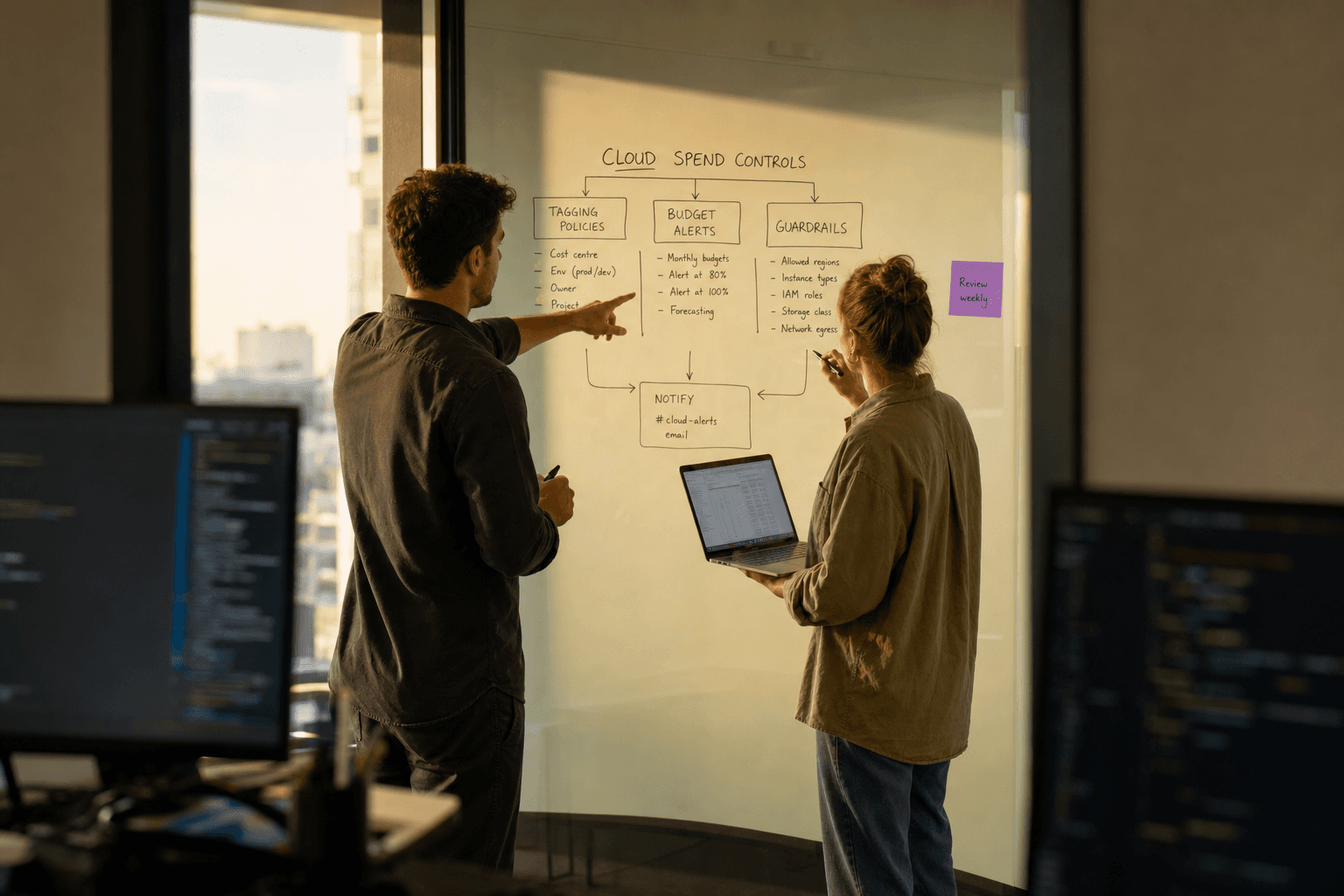
Each of these plays a distinct role:
- Multi-account architecture and landing zones give every team, environment or product its own account, provisioned through automated account vending rather than manual setup — so cost and access boundaries are clear from day one.
- Tagging policies ensure every resource is attributable to a team, project or cost centre, which is the prerequisite for any meaningful spend attribution.
- Budget alerts catch overspend early, before it compounds across a billing cycle.
- Reserved instance and committed-use management captures savings on predictable, steady-state workloads.
- Rightsizing recommendations flag over-provisioned compute and storage that quietly inflate the bill.
- Guardrails — blocking public storage buckets, enforcing encryption by default — protect against the security misconfigurations that tend to accompany uncontrolled growth, and which the Australian Cyber Security Centre consistently flags as a common cloud misconfiguration risk.
None of these work in isolation. Tagging without budget alerts gives you visibility with no trigger to act. Guardrails without account structure are hard to enforce consistently. The framework only holds together when it's designed as one system.
SaaS governance tools or an embedded partner — which fits your stage?
The right approach depends on how mature your cloud environment already is, not on which tool has the best feature list. This is a genuinely practical decision point, and it's worth being deliberate about it before buying anything.
| Situation | Better fit |
|---|---|
| Mature, existing multi-account AWS environment, standardised patterns | SaaS governance product (e.g. Stax) for automated, low-touch cost visibility and guardrail enforcement |
| Early-stage cloud maturity, non-standard requirements, no existing account structure | Embedded consultancy for strategic advisory, hands-on architecture design and knowledge transfer |
| Need predictable, self-serve tooling on top of an already-solid foundation | SaaS governance product |
| Need someone to design the governance architecture itself and hand it over to your team | Embedded consultancy |
SaaS governance products automate AWS governance — including cost visibility — for organisations that already have a mature, existing multi-account environment. They're strong where the problem is standardised and well understood: you know what good looks like, you just need predictable tooling to enforce and monitor it.
Embedded consultancies are the better fit earlier in the journey, when requirements are non-standard or the account structure, tagging discipline and guardrails don't exist yet. In that scenario, a self-serve product has nothing mature to sit on top of — the gap is in the underlying architecture and the strategic decisions about how it should be built, not in reporting.
Horizon Labs works in this second category. Our Infrastructure, Security & DevOps work addresses cloud governance — including cost controls — as part of broader modernisation engagements, embedding with client teams even where the AWS, Azure or GCP environment isn't yet mature, rather than dropping in a governance SaaS layer and leaving.
How do you attribute cloud spend to teams and products?
Attribution starts with tagging discipline enforced at the account or organisational-policy level, not left to individual engineers to remember. Without consistent tags for team, environment, product and cost centre, you can see the total bill but not who's driving it — which makes any conversation about accountability or trade-offs impossible.
Once tagging is consistent, budget alerts can be scoped per team or product rather than just globally, and rightsizing recommendations become actionable because someone specific owns the resource. This is the same underlying discipline that supports broader data work — the tagging and account structure that enables cost attribution is often built alongside the data infrastructure work needed to report on it reliably.
What should engineering leaders do first?
Start with an honest assessment of where your account structure and guardrails actually stand today, not where the invoice suggests they should be. If you're already running a mature multi-account setup and just need automated cost tooling and guardrail enforcement, a SaaS governance product is likely the fastest path.
If you're still building account structure, tagging discipline, or landing zones — or you need someone to design that governance architecture and transfer the knowledge to your team rather than hand you another dashboard — an embedded engagement will get you further, faster. Either way, the goal is the same: cost visibility that comes from how your cloud environment is built, not from chasing the bill after the fact.
It's worth noting that broader FinOps practice — multi-cloud chargeback and showback models, unit economics, and maturity frameworks like those from the FinOps Foundation — extends beyond AWS-specific account governance. Those are worth exploring as your practice matures; this article focuses on the structural foundation that makes any of them workable in the first place.
For more on the architecture decisions behind scaling infrastructure, browse our insights.
If you're exploring how to bring cost governance and account structure under control as your cloud footprint grows, we can help — starting with an honest look at where your environment stands today.
Chris Kerr
Partner at Horizon Labs, an AI product consultancy and venture studio. A commercially focused product and technology leader with 20+ years building and scaling digital platforms, teams, and businesses across SaaS, travel, eCommerce, logistics and transport, and digital marketing — operating at the intersection of product, engineering, and data. Writes about platform strategy, AI transformation, modern data ecosystems, and the operational discipline that separates AI demos from AI products.