AI-Assisted Rostering Optimisation for Logistics and Field Service
AI-assisted rostering optimisation uses mathematical modelling and machine learning to assign workers, vehicles, and shifts against real operational constraints — compliance, skills, travel, cost — rather than relying on spreadsheets or static rules. This piece breaks down what it takes to build it properly for Australian logistics and field-service operations.
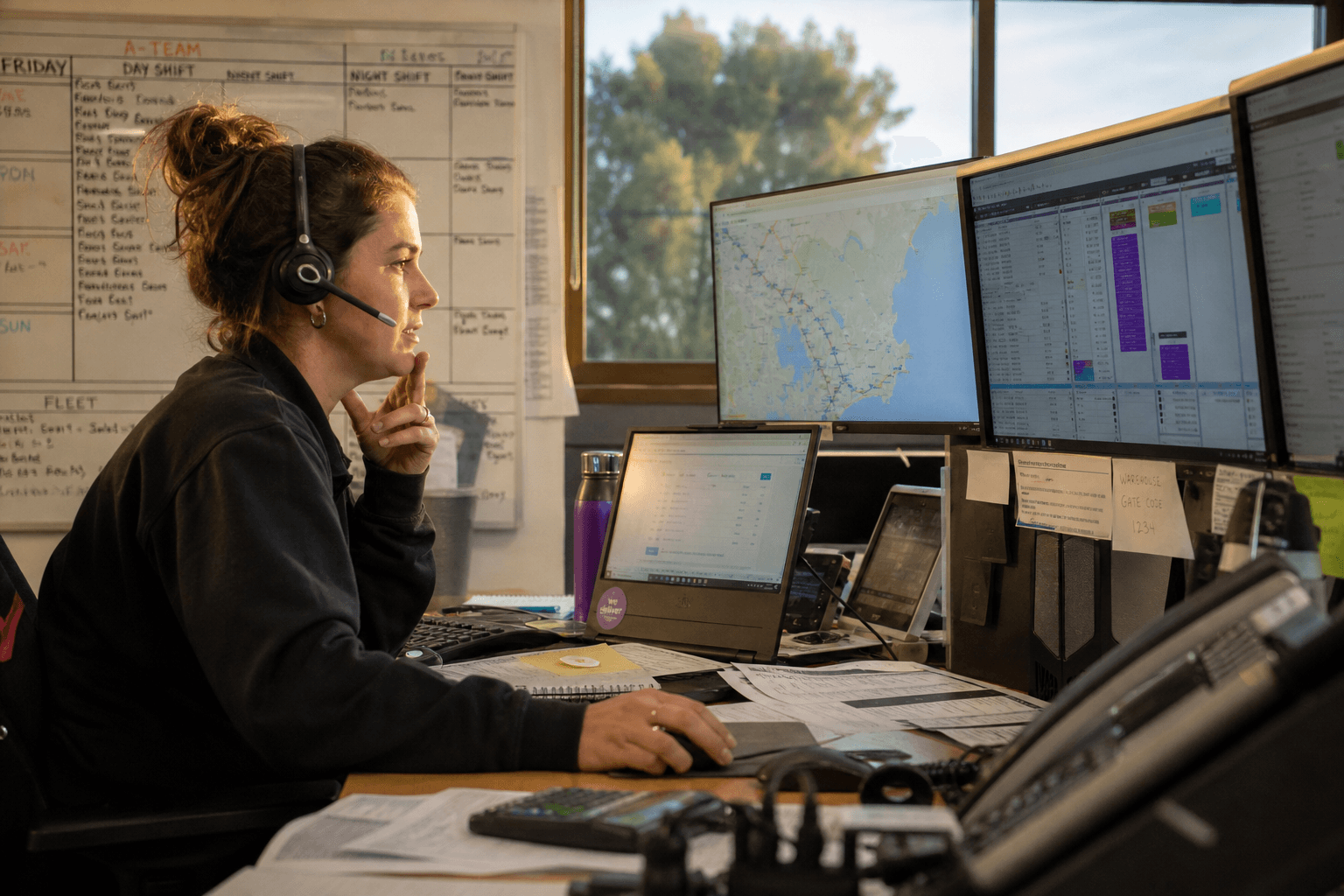
AI-assisted rostering optimisation uses mathematical modelling and machine learning to assign workers, vehicles, and shifts in a way that satisfies operational constraints — compliance, skills, travel, cost — while actively searching for the best feasible roster. That is the core distinction from a planner working through a spreadsheet or a rules engine applying fixed templates: optimisation software searches a solution space for the best outcome against defined objectives, rather than simply recording a roster someone has chosen manually.
For logistics and field-service operators, rostering looks simple from the outside — assign people to jobs, fill the roster, send out the dispatch sheet. In practice it is one of the hardest operational problems in the business, because the number of valid combinations of people, shifts, and jobs grows exponentially as a workforce scales. Most organisations are still solving it with spreadsheets, static rules, or scheduling software that was never designed for the constraints they actually face.
What is rostering optimisation?
Rostering optimisation is the practice of using mathematical modelling and, increasingly, machine learning to assign workers, vehicles, and shifts in a way that satisfies operational constraints while minimising cost, travel, idle time, or compliance risk. It differs from basic scheduling software in that it actively searches for the best feasible roster rather than simply recording one that a planner has chosen manually.
For logistics and field-service operators, the problem is rarely a single objective. You are usually balancing labour cost, service-level commitments, travel distance between jobs, skill and licensing requirements, award and enterprise-agreement conditions, and real-time disruptions like vehicle breakdowns or urgent call-outs — all at once, often across multiple depots or regions. Getting this right is a natural extension of ai product strategy: deciding where a model genuinely improves an operational outcome, and where a simpler rules-based fix is the better first step.
Why is manual and rule-based rostering inefficient?
Manual and rule-based rostering struggles because the number of valid combinations of people, shifts, and jobs grows exponentially as a workforce scales, far beyond what a planner or a simple rules engine can evaluate by hand. The result is rosters that are "good enough" rather than genuinely efficient, and that degrade quickly when conditions change.
Common symptoms we see in logistics and industrial operations include chronic overtime in some regions while other crews sit under-utilised, excessive dead-kilometre travel between field jobs, last-minute reshuffling that erodes trust in the roster, and compliance exposure around fatigue management, minimum break requirements, and award interpretation. None of these are solved by adding more spreadsheet tabs — they are solved by better modelling.
| Approach | How it handles constraints | Typical weakness |
|---|---|---|
| Manual / spreadsheet rostering | Planner applies rules from memory or a checklist | Slow to produce, inconsistent, hard to audit |
| Rule-based scheduling software | Hard-coded rules and templates | Brittle when exceptions or new constraints appear |
| AI-assisted optimisation | Constraints modelled explicitly, solved computationally | Requires good data and ongoing model maintenance |
What data do you need for AI-assisted rostering?
AI-assisted rostering needs clean, structured data on your workforce, your jobs, and your constraints — not a perfect data warehouse, but data that is consistent enough to model. The three core inputs are workforce data (skills, certifications, availability, award or enterprise-agreement rules), job or demand data (locations, time windows, duration, priority), and historical operational data (travel times, completion rates, no-shows, exceptions).
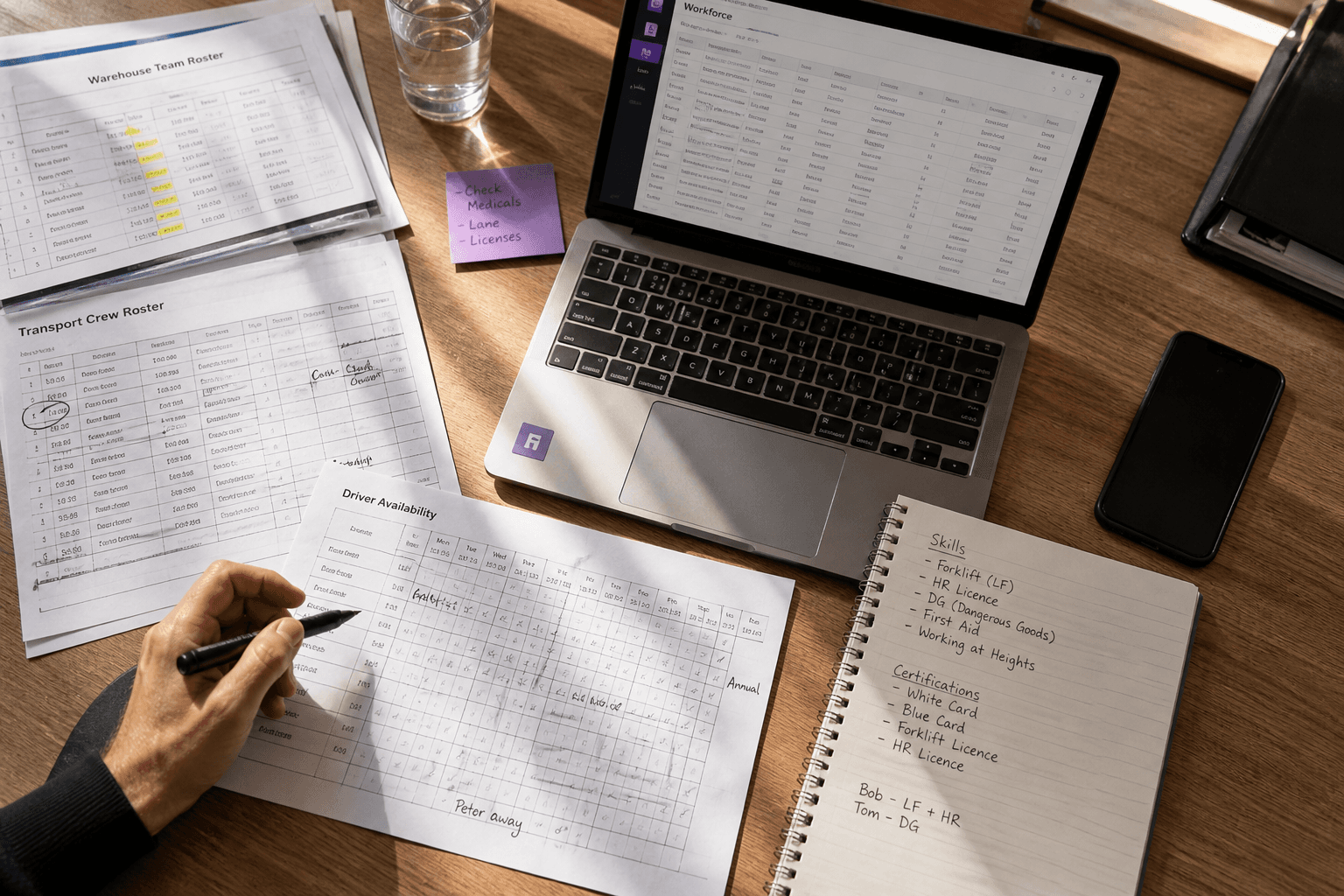
In our experience, the biggest blocker to starting an optimisation project is not the algorithm — it is that this data is scattered across a workforce management system, a dispatch tool, a payroll system, and several spreadsheets, with no single source of truth. Before any optimisation model can run reliably, that data needs to be consolidated and kept current. This is foundational data-infrastructure work, and it is usually the first real milestone in a project like this, well before any scheduling algorithm is written.
How does constraint modelling work in scheduling?
Constraint modelling means translating your operational rules — legal, contractual, and practical — into a form a solver can reason about, so it can search for rosters that satisfy every hard rule while optimising for soft preferences like cost or travel. Hard constraints are non-negotiable: a technician without the right licence cannot be assigned to a job requiring it, and minimum rest periods under applicable awards or enterprise agreements cannot be breached.

Soft constraints are preferences the model tries to optimise, such as minimising total travel distance, balancing overtime across the team, or favouring workers who have handled a particular client before. Getting this balance right matters: an over-constrained model becomes infeasible or produces rosters nobody can use, while an under-constrained one produces rosters that are mathematically optimal but operationally or legally unworkable.
Australian operators have a specific compliance layer to account for here. Rostering decisions need to respect the relevant modern award or enterprise agreement under the Fair Work Act 2009, and fatigue-related constraints in industries like transport and field services are shaped by guidance from Safe Work Australia. Any optimisation model built for an Australian logistics or industrial workforce needs these rules encoded as genuine hard constraints, not an afterthought layered on top. This is where careful ai engineering matters — building the solver, the constraint layer, and the monitoring that keeps it accurate as award interpretations or operational rules change.
How does this integrate with existing dispatch systems?
AI-assisted rostering optimisation needs to sit alongside your existing dispatch and workforce management tools, not replace them wholesale. The optimisation engine typically generates or re-optimises the roster — then hands it back to the dispatch system your planners and field staff already use day to day. This is a deliberate design choice: planners keep the interface they know, and the optimisation layer does the heavy computational work behind the scenes.
In practice this usually means building an integration layer that reads live data from your workforce management and dispatch systems, feeds it to the optimisation model, and writes the resulting roster back in a format those systems can consume. Where the underlying systems are older or poorly documented, this integration work can look a lot like application modernisation — exposing data and functionality that was never designed to be accessed programmatically, without disrupting the operational tools your team relies on every day.
It's also worth being direct about where this approach has limits. Optimisation models are only as good as the constraints and data behind them, and they need ongoing maintenance as award conditions, fleet composition, or service areas change. A model that isn't revisited after go-live will drift away from the rules it was built to respect. Treating rostering optimisation as a one-off project rather than an ongoing capability is the most common reason these systems lose trust with planners over time.
For logistics and field-service operators weighing this up, the right starting point is usually an honest assessment of your data and constraint landscape before any model gets built — not a vendor pitch promising a plug-and-play solution. If you want to read more on related problems, our more insights page covers data infrastructure, AI engineering, and application modernisation in more depth.
If rostering, dispatch, or workforce scheduling is becoming a bottleneck for your operation, get in touch and we can talk through where optimisation would genuinely help — and where it wouldn't.
Chris Kerr
Partner at Horizon Labs, an AI product consultancy and venture studio. A commercially focused product and technology leader with 20+ years building and scaling digital platforms, teams, and businesses across SaaS, travel, eCommerce, logistics and transport, and digital marketing — operating at the intersection of product, engineering, and data. Writes about platform strategy, AI transformation, modern data ecosystems, and the operational discipline that separates AI demos from AI products.