AI Governance Framework for Australian Mid-Market Companies
Most AI governance frameworks assume an enterprise compliance team the mid-market doesn't have. Here's a right-sized approach — a lean policy set, model inventory, human-in-the-loop rules and vendor due diligence — mapped to Privacy Act reform and the Voluntary AI Safety Standard.

Most AI governance frameworks are written for organisations with a Chief AI Officer, a model risk committee, and a compliance team of twenty. That's not the mid-market. If you're running a 200-person fintech or a 600-person logistics platform, you need something that actually gets used — a small set of policies, a model inventory, clear human-in-the-loop rules, and a vendor checklist — mapped to what Australian regulators are actually asking for.
This article sets out a right-sized approach: what to put in place, in what order, and how it maps to Australia's privacy reform agenda and the Voluntary AI Safety Standard.
What is an AI governance framework?
An AI governance framework is the set of policies, processes, and controls an organisation uses to decide which AI systems it builds or buys, how those systems are risk-assessed, who is accountable for their outputs, and how they are monitored once in production. It sits alongside — not instead of — your existing data governance and security controls.

For a mid-market company, the framework doesn't need to be a 60-page document. It needs four things that are genuinely maintained: a policy that states who can approve AI use cases, a live inventory of every model and AI vendor in use, defined human-in-the-loop checkpoints for consequential decisions, and a due diligence process for AI vendors before contracts are signed.
For related reading, explore our ai product strategy and ai engineering services, or browse more insights.
What's driving the need now in Australia?
Two regulatory developments are pushing AI governance from "nice to have" to "expected" for Australian businesses: the ongoing reform of the Privacy Act 1988, and the release of the Voluntary AI Safety Standard. Neither currently imposes AI-specific legal obligations on private mid-market companies outright, but both signal the direction of travel and give boards a reference point to be measured against.
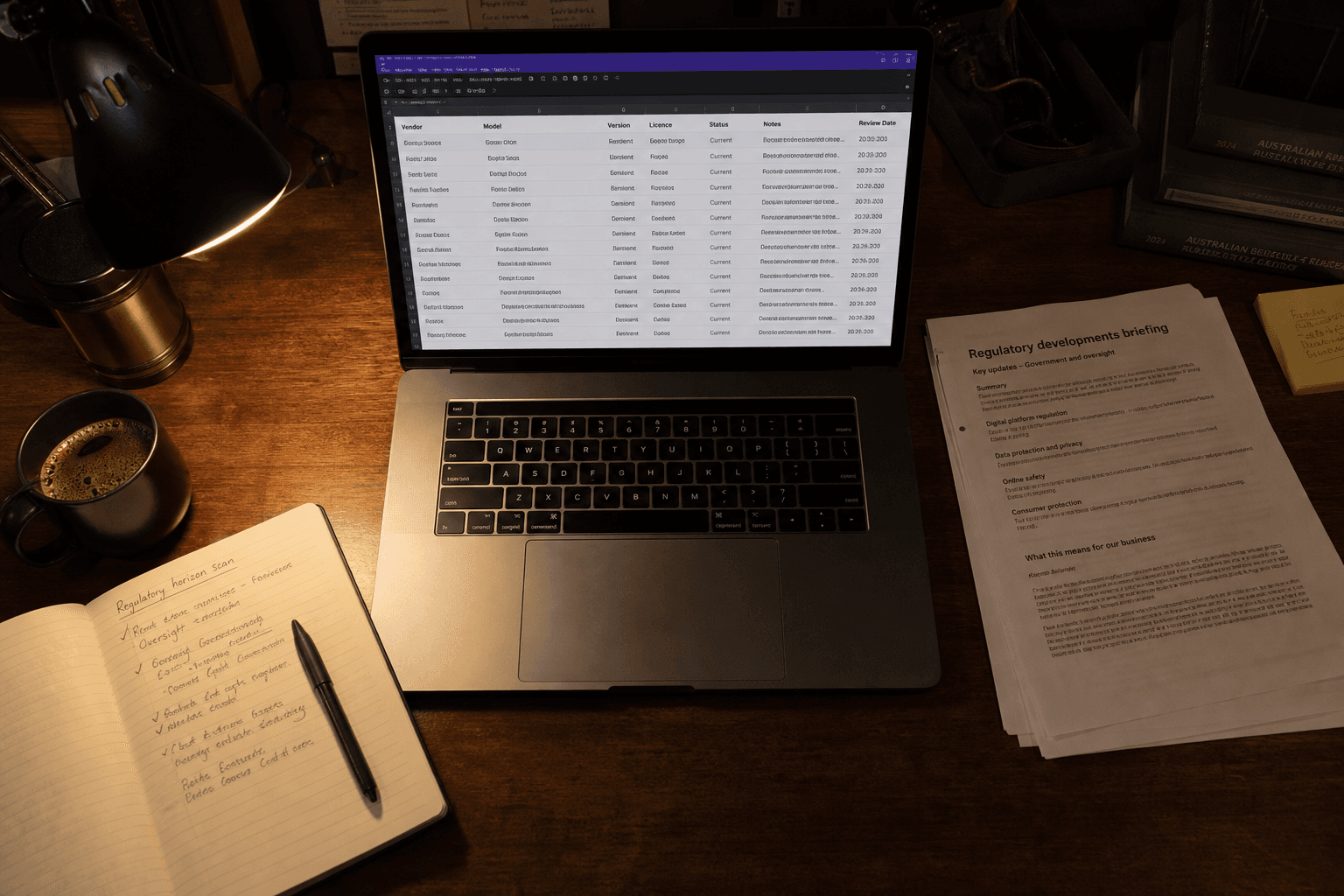
The Attorney-General's Department's Privacy Act review, and the government's 2024 response agreeing to a substantial number of the review's proposals, foreshadows stronger obligations around automated decision-making, including a right for individuals to request meaningful information about decisions made using personal information. If your AI systems touch personal data — credit decisions, claims triage, hiring screens, customer risk scoring — this is directly relevant, and the Office of the Australian Information Commissioner (OAIC) is the regulator to watch.
Separately, the National AI Centre (within the Department of Industry, Science and Resources) published the Voluntary AI Safety Standard in 2024, setting out ten guardrails covering accountability, risk management, data governance, testing, human oversight, and transparency. It is voluntary — there is no penalty for non-adoption — but it is fast becoming the reference model regulators, insurers, and enterprise customers point to when they ask how you manage AI risk.
If you're looking for guidance on this topic, get in touch — we're happy to help.
Chris Kerr
Partner at Horizon Labs, an AI product consultancy and venture studio. A commercially focused product and technology leader with 20+ years building and scaling digital platforms, teams, and businesses across SaaS, travel, eCommerce, logistics and transport, and digital marketing — operating at the intersection of product, engineering, and data. Writes about platform strategy, AI transformation, modern data ecosystems, and the operational discipline that separates AI demos from AI products.