MLOps Consulting Australia: A Practical Guide for Teams
MLOps consulting helps organisations move machine learning models from notebooks into reliable, governed production systems. This guide covers what MLOps consulting involves, how Australian regulation shapes it, and how to decide between building the capability in-house or bringing in outside expertise.
MLOps consulting helps organisations move machine learning models out of notebooks and into reliable, monitored production systems. For Australian technology leaders weighing up whether to build this capability internally or bring in outside expertise, understanding what MLOps consulting actually covers — and what good practice looks like — matters more than the label itself.
What is MLOps consulting?
MLOps consulting is advisory and hands-on engineering support that helps organisations design, build, and operate the infrastructure, processes, and governance needed to deploy and maintain machine learning models in production. MLOps itself — short for machine learning operations — is the discipline of applying software engineering practices like version control, continuous integration, automated testing, and monitoring to the machine learning lifecycle. Google Cloud's widely referenced framework describes MLOps maturity across three levels: manual, largely notebook-driven processes (Level 0); automated ML pipelines that retrain models on new data (Level 1); and full CI/CD pipeline automation for rapid, reliable iteration (Level 2). Most Australian organisations we encounter sit at Level 0, with a handful of models deployed manually and no repeatable path to production.
Why do Australian organisations need MLOps consulting?
Organisations typically seek MLOps consulting when a model has proven valuable in a proof-of-concept but stalls before reaching customers — usually because no one owns the deployment pipeline, there's no monitoring for data or model drift, or the data infrastructure underneath can't support reliable retraining. These are common triggers: a data science team with strong model-building skills but no production engineering discipline, a recent funding round that raises expectations for AI-powered features, or a compliance requirement that demands auditable model governance.

In regulated sectors — financial services, insurance, healthtech — this gets sharper. The Office of the Australian Information Commissioner enforces the Privacy Act 1988 obligations around automated decision-making and data handling, and APRA's CPS 234 prudential standard sets information security expectations that extend to ML systems processing sensitive data. The Australian Government's AI Ethics Principles, published via the Department of Industry, Science and Resources, also set out expectations around transparency, accountability, and human oversight that increasingly shape how boards ask about AI governance — including for ML systems already in production.
What does MLOps consulting actually involve?
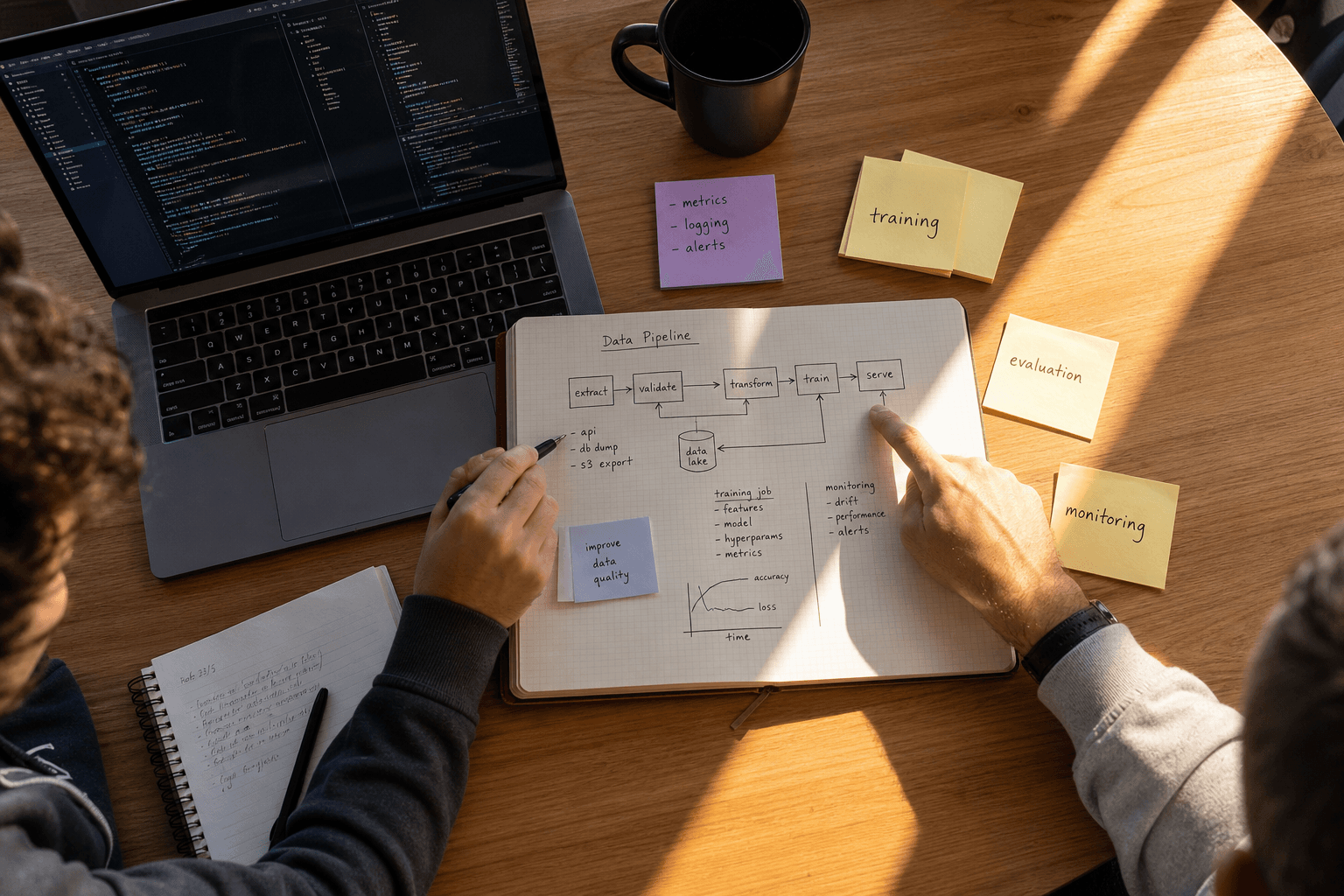
MLOps consulting work generally spans four areas: pipeline automation (turning ad hoc training scripts into repeatable, versioned pipelines), deployment infrastructure (serving models reliably at the latency and scale the product needs), monitoring and observability (tracking prediction quality, data drift, and model performance over time), and governance (documentation, approval workflows, and audit trails for regulated use cases). The table below maps common maturity stages to what typically needs to change.
| Maturity stage | What's happening | Typical gap |
|---|---|---|
| Notebook-only | Models trained and evaluated in Jupyter notebooks, deployed manually if at all | No repeatable deployment path |
| Manual deployment | Models deployed to production but retraining and monitoring are manual | No drift detection, slow iteration |
| Automated pipelines | Training and validation automated, triggered by new data | Deployment and rollback still manual |
| CI/CD for ML | Full pipeline from code commit to monitored production deployment | Governance and documentation often lag |
Build vs buy: how should you approach MLOps capability?
The right answer depends on how central ML is to your product and how much internal capacity you have, not on a fixed rule. A useful way to frame the decision is comparing the likely trade-offs rather than assuming one path is universally better.
| Approach | Speed to production | Internal capability uplift | Ongoing cost profile |
|---|---|---|---|
| Build in-house from scratch | Slower initially | High, but requires hiring specialist roles | Fixed headcount cost regardless of ML workload |
| Engage MLOps consulting | Faster for first production deployment | Moderate, depends on knowledge transfer | Scales with engagement scope |
| Hybrid (consulting + internal team) | Faster, with capability retained | Highest, if transfer is deliberate | Declining external spend over time |
Our own view, covered in more depth in our insights, is that the hybrid model tends to work best for organisations without a dedicated MLOps function yet: bring in practitioners to ship the first production pipeline while building the internal team's confidence to own it afterwards.
How does MLOps consulting fit with data infrastructure and AI engineering?
MLOps consulting rarely succeeds in isolation — it depends on the data infrastructure underneath it and the engineering discipline around it. A model can only be monitored reliably if the data pipelines feeding it are observable and well-governed, which is why we treat data infrastructure as a prerequisite rather than a parallel workstream. Equally, taking a model from a notebook to a dependable production service is fundamentally a software engineering problem, which is why this work sits closely with our AI engineering capability rather than being treated as a bolt-on specialty.
For organisations still deciding whether AI is the right investment at all, it's worth stepping back further — our AI product strategy work often precedes any MLOps conversation, because there's no point automating a deployment pipeline for a model that hasn't proven its value yet.
How much does MLOps consulting cost in Australia?
Pricing varies considerably with scope, but an honest starting point is an assessment engagement — reviewing your current model deployment practices, data pipelines, and governance gaps — before committing to a larger build. This lets you see concretely what a production-grade pipeline requires before signing up for it. We don't publish fixed packages here because the right scope depends entirely on how many models you're running, how regulated your sector is, and how much of the work your internal team can absorb.
Is MLOps consulting right for your organisation?
If you have models that work in testing but have never reached customers reliably, or if your data science team spends more time firefighting broken pipelines than building new models, that's a reasonable signal to bring in outside MLOps expertise. If you're earlier than that — still validating whether a model is worth building — strategy work comes first.
If you're exploring MLOps consulting for your organisation, we can help — starting with an honest conversation about where your models and data infrastructure actually stand today.
Chris Kerr
Partner at Horizon Labs, an AI product consultancy and venture studio. A commercially focused product and technology leader with 20+ years building and scaling digital platforms, teams, and businesses across SaaS, travel, eCommerce, logistics and transport, and digital marketing — operating at the intersection of product, engineering, and data. Writes about platform strategy, AI transformation, modern data ecosystems, and the operational discipline that separates AI demos from AI products.