How to Choose an AI Consultancy in Australia: 8 Key Questions
Choosing an AI consultancy is fundamentally different from hiring traditional software developers. Here are eight critical questions to evaluate AI consultancies before you sign, covering IP ownership, production metrics, data infrastructure, and Australian compliance requirements.

How to Choose an AI Consultancy in Australia: 8 Questions to Ask Before You Sign
Choosing an AI consultancy is fundamentally different from hiring traditional software developers. AI projects require specialised expertise in data infrastructure, model selection, production deployment, and measurable business outcomes. With Australia's AI consulting market growing rapidly, CTOs face dozens of vendors making bold claims — but not all can deliver production-ready systems that create real value.
The right AI consultancy becomes a strategic partner who understands your business context, builds systems you can maintain, and measures success with data. The wrong choice leads to expensive proof-of-concepts that never reach production, vendor lock-in, and AI initiatives that consume budget without delivering ROI.
Here are eight critical questions to evaluate AI consultancies before you sign any contract.
1. What Will We Actually Own When the Project Ends?
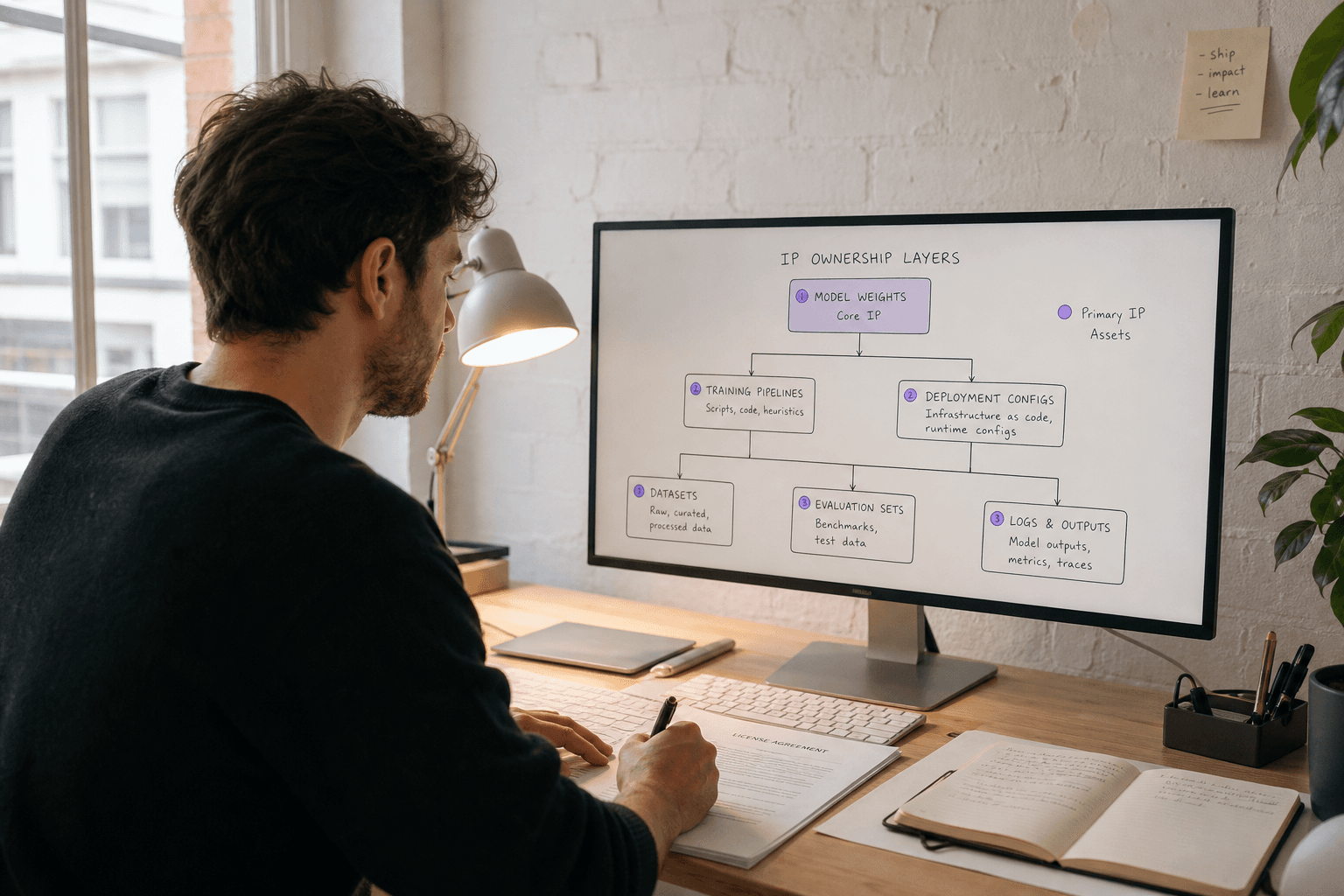
Intellectual property ownership determines whether you're building strategic capability or creating expensive dependency. Many AI consultancies retain ownership of core models, training pipelines, or deployment infrastructure — leaving you with a system you cannot modify, scale, or maintain independently.
What to ask specifically:
- "Do we own the trained models, fine-tuning data, and training scripts?"
- "Can we export our models to run on different infrastructure?"
- "What happens to our data if we terminate the contract?"
- "Which components require ongoing licensing from your firm?"
Look for consultancies that transfer complete IP ownership including model weights, training code, evaluation datasets, and deployment configurations. Avoid any arrangement where core AI functionality remains proprietary to the vendor.
Under Australian Consumer Law, you have rights to goods and services that are fit for purpose. This includes AI systems that you can actually use and maintain after the consultancy ends.
2. How Do You Measure Success in Production?
AI projects fail most often not during development, but after deployment when models degrade, edge cases emerge, or business metrics don't improve. Production-ready AI requires continuous monitoring of model performance, data drift, and business outcomes.

What to ask specifically:
- "How do you monitor model accuracy over time?"
- "What metrics do you track beyond technical performance?"
- "How quickly can you detect and respond to model degradation?"
- "Can you show us examples of business metrics that improved for similar clients?"
Strong AI consultancies implement comprehensive monitoring from day one, including model performance metrics, data quality checks, and business KPI tracking. They should provide dashboards that your team can understand and use.
Be wary of consultancies that focus only on development metrics (accuracy, F1 score) without connecting to business outcomes (cost reduction, revenue increase, efficiency gains).
3. How Will You Assess Our Data Infrastructure Readiness?
Successful AI depends on clean, accessible, well-governed data. Many AI projects fail because consultancies skip the unglamorous work of data assessment, assuming your existing infrastructure can support AI workloads.
What to ask specifically:
- "What's your process for evaluating our current data quality and accessibility?"
- "How do you identify gaps in our data infrastructure?"
- "What data governance requirements does AI add to our existing processes?"
- "Can you integrate with our current data systems, or do we need new infrastructure?"
Experienced AI consultancies conduct thorough data audits before proposing solutions. They should assess data quality, identify integration points, evaluate privacy and security controls, and map data lineage.
Consultancies that promise quick wins without understanding your data landscape are setting both parties up for failure.
4. Are You Model-Agnostic or Tied to Specific Vendors?
The AI landscape evolves rapidly. Model-agnostic consultancies can adapt to new technologies and choose the best tool for each use case. Vendor-tied consultancies may push solutions that benefit their partnerships rather than your business.
What to ask specifically:
- "Do you work with multiple LLM providers (OpenAI, Anthropic, Cohere, open-source models)?"
- "How do you select the right model architecture for each use case?"
- "Can you migrate our AI systems to different models as technology improves?"
- "Do you receive commissions or incentives from specific AI vendors?"
Look for consultancies that evaluate multiple options and choose based on technical fit, cost, and performance requirements. They should explain their selection criteria and be transparent about any vendor relationships.
Model lock-in can become expensive quickly, especially with rapidly changing pricing models from major AI providers.
5. What's Your Approach to AI Model Selection and Evaluation?
Choosing the wrong AI model wastes time and budget while potentially creating ongoing operational challenges. Professional AI consultancies follow rigorous evaluation processes that consider multiple factors beyond initial performance metrics.
What to ask specifically:
- "How do you benchmark different models for our specific use case?"
- "What factors do you consider beyond accuracy (cost, latency, maintainability)?"
- "Do you test models with our actual data before recommending solutions?"
- "How do you evaluate trade-offs between model performance and operational costs?"
Strong consultancies run systematic comparisons using your data, not generic benchmarks. They consider total cost of ownership, including inference costs, fine-tuning requirements, and operational complexity.
They should provide clear documentation of their evaluation process and explain why they recommend specific approaches.
6. How Do You Handle Data Privacy and Security?
AI systems often process sensitive business data, creating new privacy and security challenges. Australian businesses must comply with the Privacy Act 1988, and many industries have additional requirements like the Corporations Act or healthcare regulations.
What to ask specifically:
- "How do you ensure our data doesn't leak into training datasets for other clients?"
- "What security controls do you implement for AI development and deployment?"
- "How do you handle data residency requirements for Australian businesses?"
- "Are your AI systems compliant with relevant Australian regulations?"
Look for consultancies that implement data isolation, encryption at rest and in transit, access controls, and audit logging. They should understand Australian data sovereignty requirements and industry-specific compliance needs.
Be particularly cautious about consultancies that want to use your data to improve their general models or services.
7. What Happens When AI Models Make Mistakes?
AI systems will make mistakes — the question is how quickly you can detect, understand, and correct them. Production AI requires robust error handling, human oversight mechanisms, and clear escalation procedures.
What to ask specifically:
- "How do you build human oversight into AI systems?"
- "What happens when users report incorrect AI outputs?"
- "How do you continuously improve model performance based on real-world feedback?"
- "Can you implement confidence scoring and uncertainty quantification?"
Professional consultancies design AI systems with appropriate guardrails, confidence thresholds, and human-in-the-loop processes. They should provide mechanisms for continuous learning and improvement.
Avoid consultancies that treat AI as "set and forget" technology without ongoing monitoring and improvement processes.
8. Can You Show Examples of Similar Australian Projects?
Australian businesses face unique challenges including data sovereignty requirements, specific regulatory environments, and integration with existing enterprise systems common in the local market.
What to ask specifically:
- "Can you share case studies of similar AI implementations for Australian mid-market businesses?"
- "What results did those clients achieve, and how do you measure ongoing success?"
- "How do you adapt global AI practices for Australian business contexts?"
- "What challenges do you commonly see with Australian enterprises adopting AI?"
Look for consultancies with proven Australian experience, not just international case studies. They should understand local business practices, regulatory requirements, and common integration challenges.
Strong consultancies can provide specific metrics and outcomes from similar engagements, not just generic success stories.
Red Flags to Avoid
Several warning signs indicate AI consultancies that may not deliver production-ready results:
- Guaranteed ROI promises without understanding your business context
- Proprietary AI models they won't let you inspect or own
- Demo-driven sales without technical deep-dives into your specific challenges
- Resistance to discussing data requirements or infrastructure needs
- Vague timelines or reluctance to commit to specific deliverables
- No monitoring strategy for production AI systems
- Over-reliance on single vendors or closed-source solutions
Making Your Decision
Choosing an AI consultancy is choosing a strategic partner for long-term capability building. The right partner helps you build AI systems that create measurable business value, that your team can maintain and evolve, and that position you for future AI adoption.
Focus on consultancies that:
- Transfer complete IP ownership
- Implement comprehensive production monitoring
- Assess and address data infrastructure gaps
- Remain model-agnostic and vendor-neutral
- Follow rigorous evaluation methodologies
- Understand Australian compliance requirements
- Design systems with appropriate human oversight
- Have proven experience with similar Australian businesses
Ready to Evaluate AI Consulting Partners?
At Horizon Labs, we believe AI consulting should be transparent, practical, and focused on building capabilities you own. We embed with your team, implement production-ready AI systems, and measure success with business outcomes — not just technical metrics.
Explore our AI capabilities or start a conversation about your specific AI challenges. We're happy to discuss your project and answer these eight questions in detail.
Aisha Reddy
Head of AI Strategy at Horizon Labs. Runs the AI Readiness Assessments and advises mid-market boards on where AI investment actually pays back. Former management consultant who got tired of slide decks; now ships AI that delivers measurable outcomes. Writes about strategy, governance, and how to evaluate AI consultancies without being sold to.