Data Clean Rooms for Regulated Australian Industries
Data clean rooms let regulated Australian organisations run joint analysis with partners without exposing raw records. Here's how the architecture works, and when it's worth the investment over a simpler data-sharing agreement.

What is a data clean room?
A data clean room is a secure computing environment where two or more parties can run joint analysis on their combined data without either party seeing the other's raw, row-level records. Instead of exporting a spreadsheet or a data extract to a partner, each organisation keeps its data in place, and only aggregated, permissioned query results leave the environment. This matters most where the data itself — customer identifiers, health records, transaction histories — is too sensitive or too regulated to move.
Why do fintech, healthtech, and insurance need this?
These sectors sit under some of the heaviest data obligations in Australia — the Privacy Act 1988, APRA's CPS 234 information security standard for regulated financial entities, and health-specific rules around clinical and My Health Record data. Partnerships that would otherwise create real value — a fintech and a bank co-developing a fraud model, an insurer and a hospital network studying claims patterns, a health app and a pathology provider matching outcomes — routinely stall because no one wants to be the party that exported identifiable records to another company's systems.
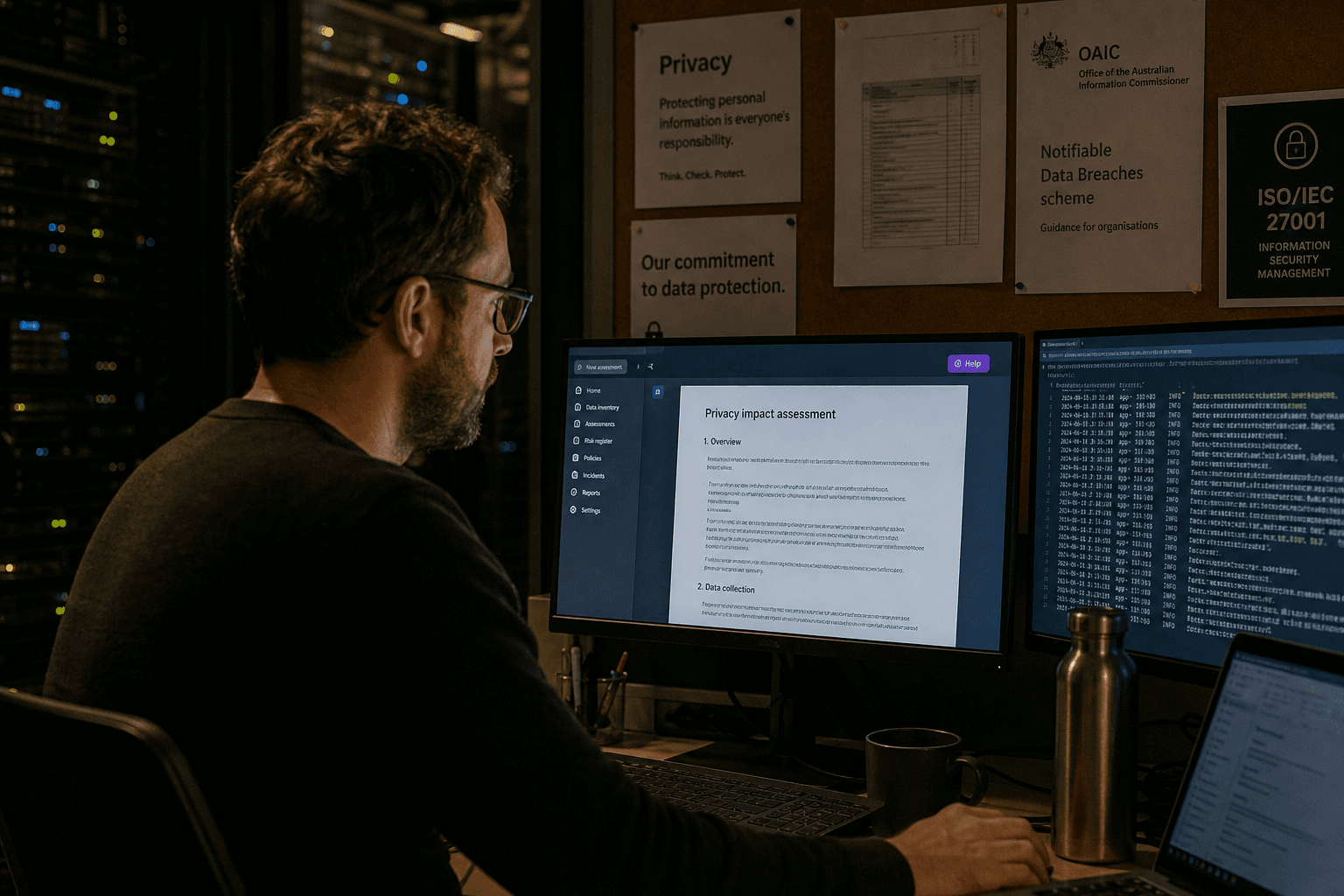
A clean room reframes the problem. Instead of asking "how do we share this data safely," the question becomes "how do we get a useful answer without sharing the data at all." That reframing is why clean rooms have become a serious architectural option rather than a niche technique, particularly for organisations already investing in stronger data-infrastructure foundations.
How does a data clean room actually work?
In practice, a clean room combines four elements: isolated compute (each party's data stays in its own environment or a jointly governed neutral one), a restricted query interface (only approved, pre-vetted queries or aggregation types can run — no arbitrary SELECT-style access to raw rows), output controls (results below a minimum group size, or that could re-identify an individual, are suppressed), and an audit trail (every query, requester, and result is logged for compliance review).

Some implementations add privacy-enhancing techniques on top — differential privacy noise, hashed or tokenised join keys, or secure multi-party computation — depending on how sensitive the join fields are and how much statistical protection regulators or partners require. The right combination depends on the specific data and the specific regulatory obligations in play, and it's a decision worth making deliberately rather than defaulting to the vendor's out-of-the-box setting.
Clean rooms vs simpler data-sharing approaches — how do you choose?
Most organisations already have a simpler option available: a data-sharing agreement (a legal contract governing what data moves, how, and for what purpose) paired with de-identification or aggregation before transfer. That approach is faster to stand up and lower cost, and for many partnerships it's entirely sufficient. Clean rooms earn their cost when the join itself is the sensitive part — when even aggregated, de-identified extracts risk re-identification, or when the relationship needs to support many recurring queries rather than a single one-off extract.
| Approach | Data movement | Re-identification risk | Setup effort | Best fit |
|---|---|---|---|---|
| Data-sharing agreement + de-identified extract | Data physically leaves each party's environment | Higher — depends entirely on quality of de-identification | Lower | One-off or infrequent analysis, lower-sensitivity fields |
| Aggregated reporting only | No row-level data leaves either party | Lower, but limited analytical flexibility | Lower | Simple metrics, dashboards, KPI sharing |
| Data clean room | Raw data never leaves originating environment | Lowest, when configured with output controls | Higher — governance, tooling, query design | Ongoing joint analysis, regulated or highly sensitive data, multi-partner collaboration |
This is a qualitative comparison, not a scored benchmark — the right choice depends on your specific data sensitivity, partner count, and query frequency, and should be assessed case by case rather than assumed.
When is the investment actually worth it?
A clean room is worth building when three conditions are present together: the collaboration is ongoing rather than one-off, the joined data is sensitive enough that legal and compliance teams would otherwise block or heavily slow the project, and the value of the joint analysis (fraud detection across institutions, population health insights across providers, risk pooling across insurers) is high enough to justify the governance overhead. If any one of those is missing — a single ad hoc analysis, low-sensitivity fields, or low business value — a well-drafted data-sharing agreement with proper de-identification is usually the more sensible starting point.
It's also worth being honest about the trade-off: clean rooms add real engineering and governance overhead. Query design has to be restricted deliberately, output thresholds need tuning to avoid both over-suppression (results too coarse to be useful) and under-suppression (results that leak individual-level information), and someone needs to own the ongoing audit and access review process. This isn't a set-and-forget architecture — it's infrastructure that needs the same operational rigour as any other production system, which is where a structured ai-product-strategy engagement can help scope the problem before committing to a platform.
What should you check before committing to a platform or architecture?
Before selecting a clean room platform or building a custom one, confirm three things: what regulatory obligations actually apply to the specific data fields involved (the Office of the Australian Information Commissioner publishes guidance on data sharing and de-identification at oaic.gov.au, and APRA-regulated entities have specific obligations under CPS 234), what your partner's technical and governance capability actually is (a clean room only works if both sides can operate it correctly), and whether the query patterns you need are actually supported by the platform's restriction model. Vendors differ significantly in how flexible their permitted-query frameworks are, and a mismatch here is one of the most common reasons these projects stall after the initial build.
Where clean rooms fit into a broader data strategy
For most regulated Australian companies, a clean room isn't a first project — it sits downstream of decent data infrastructure, clear data governance, and a specific, high-value collaboration use case already identified. If your data estate is still fragmented or your partner data-sharing needs are still one-off and infrequent, it's worth solving those foundational problems first. For more on building that foundation, see our insights on data infrastructure and modernisation.
If you're exploring whether a data clean room — or a simpler data-sharing model — is the right fit for a partnership you're planning, we can help you assess the regulatory, technical, and cost trade-offs before you commit to a platform.
Chris Kerr
Partner at Horizon Labs, an AI product consultancy and venture studio. A commercially focused product and technology leader with 20+ years building and scaling digital platforms, teams, and businesses across SaaS, travel, eCommerce, logistics and transport, and digital marketing — operating at the intersection of product, engineering, and data. Writes about platform strategy, AI transformation, modern data ecosystems, and the operational discipline that separates AI demos from AI products.