AI Consulting vs In-House: When to Outsource vs Build Your Team
Choosing between AI consulting and building an in-house team depends on your timeline, budget, and strategic priorities. Most successful AI adoptions use a hybrid approach: consultants for initial development and knowledge transfer, followed by internal teams for ongoing evolution.
AI Consulting vs In-House: When to Outsource and When to Build Your Own Team
Choosing between AI consulting and building an in-house team is one of the most critical decisions technology leaders face today. The wrong choice can cost millions in failed projects, delayed time-to-market, or technical debt that haunts you for years.
This decision isn't binary. The best approach often combines both strategies at different stages of your AI journey. Here's how to make the right choice for your organisation.
When AI Consulting Makes Strategic Sense
AI consulting delivers value when you need specialised expertise quickly, want to validate concepts before committing resources, or lack the budget for full-time AI talent. External consultants bring battle-tested frameworks, cross-industry insights, and the ability to ship production code without the overhead of permanent hires.

Speed to Market Scenarios
When market timing matters, consulting accelerates delivery. A Melbourne fintech we worked with needed fraud detection live within 90 days for regulatory compliance. Building an internal team would have taken 6-12 months just for hiring. We delivered a production system in 10 weeks using pre-built ML frameworks and established MLOps practices.
Consulting also works well for proof-of-concept projects. Before committing $2M+ to internal AI capabilities, smart leaders validate assumptions with a $50-100K consulting engagement. This de-risks the larger investment and provides clarity on technical feasibility.
Specialised AI Expertise Requirements
Certain AI applications require deep, narrow expertise that's hard to justify full-time. Computer vision for quality control, natural language processing for regulatory documents, or reinforcement learning for supply chain optimisation — these domains need specialists who've solved similar problems before.
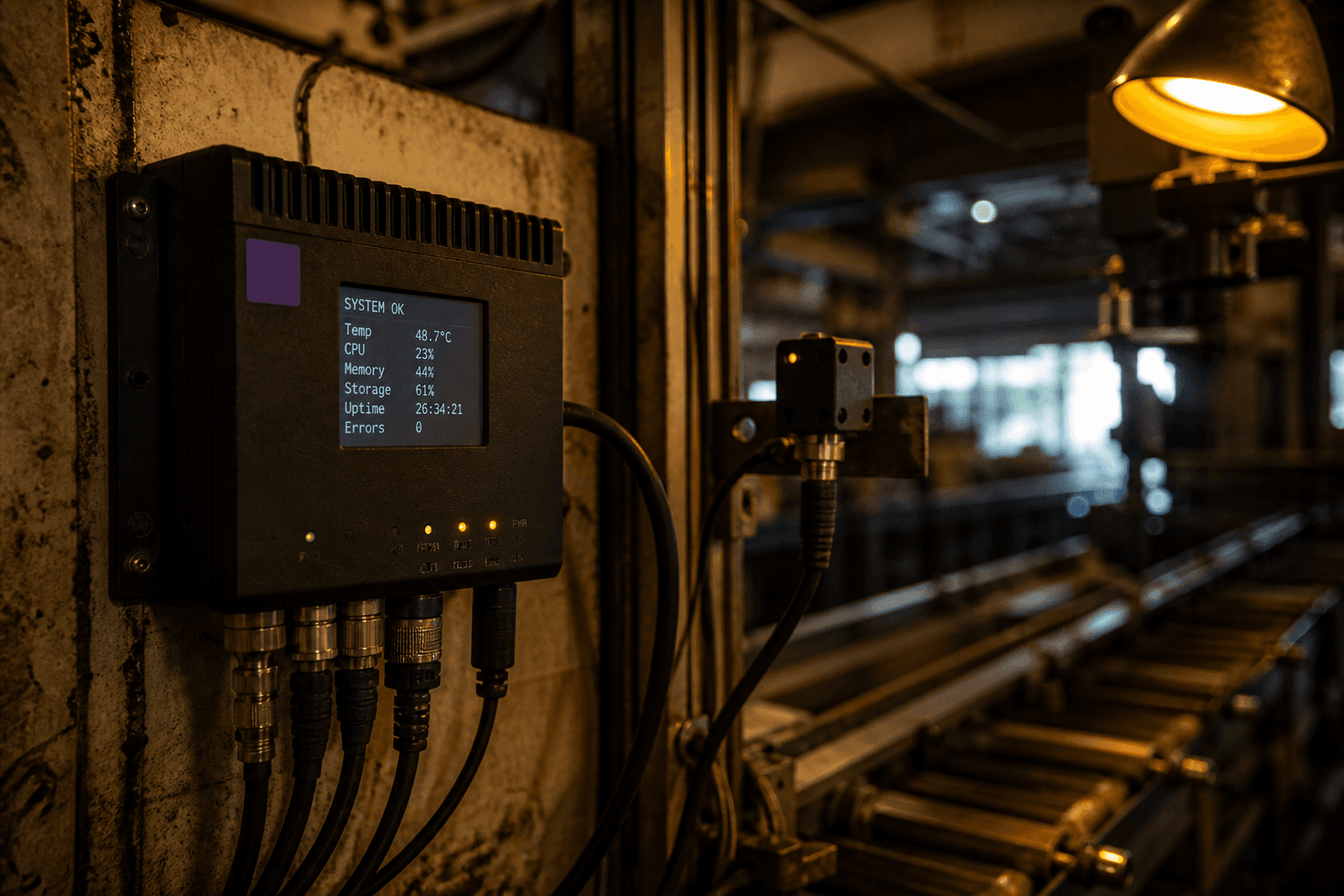
A manufacturing client needed predictive maintenance for industrial equipment. Rather than hire specialists in time-series analysis, sensor data processing, and industrial IoT, they engaged consultants who'd built similar systems across multiple industries. The result: faster implementation, fewer false starts, and knowledge transfer to their operations team.
When Building In-House Teams is the Right Choice
In-house teams excel when AI becomes core to your competitive advantage, you need continuous iteration, or you're handling sensitive data that can't leave your infrastructure. The upfront investment pays off through deeper domain knowledge, faster iteration cycles, and complete control over your AI roadmap.

AI as Core Competitive Advantage
When AI directly drives revenue or creates defensible moats, you need internal ownership. A logistics company using AI for route optimisation, a retailer with ML-powered personalisation, or a healthcare provider with diagnostic AI — these applications are too strategic to outsource completely.
Internal teams understand your business context, customer needs, and operational constraints better than any consultant. They can make rapid adjustments, A/B test variations, and evolve models based on real user feedback.
Long-term AI Capabilities
If your 3-5 year strategy includes multiple AI initiatives, building internal capabilities makes financial sense. The fully-loaded cost of a senior AI engineer in Australia ranges from $180,000-$250,000 annually. Compare this to consulting rates of $200-$400 per hour, and internal teams become cost-effective for sustained AI development.
| Approach | Year 1 Cost | Year 3 Cost | Best For |
|---|---|---|---|
| Consulting | $150-300K | $450-900K | Single projects, specialised needs |
| In-house | $200-500K | $600-1.5M | Multiple projects, core capabilities |
| Hybrid | $100-200K | $400-800K | Most mid-market companies |
The Hybrid Approach: Best of Both Worlds
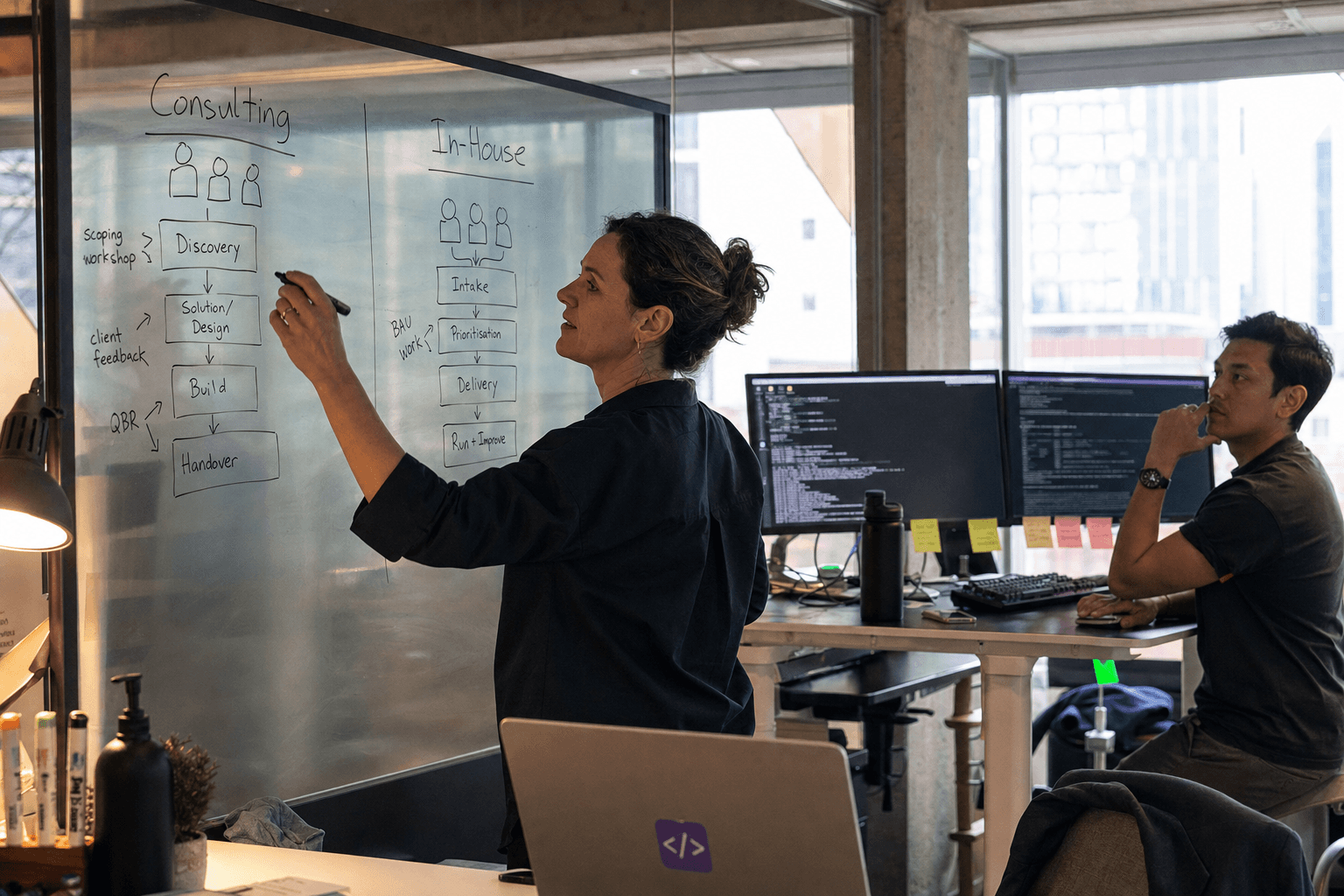
Most successful AI adoptions use a hybrid model: consultants for initial development and knowledge transfer, followed by internal teams for ongoing evolution. This approach captures external expertise while building internal capabilities.
Phase 1: Foundation with Consultants
Start with consultants to establish AI infrastructure, develop initial models, and train your team. A well-structured engagement includes:
- Technical architecture: MLOps pipelines, model deployment infrastructure, monitoring systems
- Initial model development: Production-ready AI applications with documented processes
- Knowledge transfer: Code walkthroughs, documentation, training sessions for your team
- Hiring support: Help recruiting permanent AI talent with relevant skills
This phase typically runs 3-6 months and costs $100-300K, depending on complexity.
Phase 2: Internal Team Takeover
Once foundations are established, internal teams take ownership. They understand the codebase, can iterate on models, and handle day-to-day operations. Consultants remain available for complex technical challenges or major platform upgrades.
A retail client followed this model for personalisation AI. Six months of consulting delivered production recommender systems and trained their data team. Eighteen months later, their internal team had improved model accuracy by 30% and launched three additional AI features.
Cost Analysis: The Real Numbers
AI talent costs vary significantly based on experience, location, and specialisation. Here's the breakdown for Australian organisations:
Consulting Costs
- Junior AI consultants: $150-250/hour
- Senior AI consultants: $250-400/hour
- AI specialists (computer vision, NLP): $300-500/hour
- Typical project: $50-300K for initial development
Internal Team Costs (Fully Loaded)
- AI Engineer: $120-180K base + 40-60% on-costs = $180-290K total
- Senior AI Engineer/Scientist: $150-220K base + 40-60% on-costs = $240-350K total
- Head of AI: $200-300K base + 40-60% on-costs = $320-480K total
Don't forget infrastructure costs: cloud computing ($1-10K/month), AI tools and platforms ($5-50K annually), and training/conference attendance ($5-15K per person annually).
Knowledge Transfer and IP Considerations
Intellectual property ownership and knowledge transfer are critical factors often overlooked in the consulting vs in-house decision.
IP Ownership Models
With consulting, negotiate IP ownership upfront. Standard models include:
- Client owns all IP: Higher costs, but you control everything
- Consultant retains framework IP: Lower costs, but dependencies on external code
- Shared IP: Balanced approach for innovative projects
In-house development gives complete IP control but may duplicate existing solutions. A hybrid approach often works best: license proven frameworks through consulting, then build proprietary applications internally.
Knowledge Transfer Success Factors
Effective knowledge transfer requires structured planning:
- Documentation: Comprehensive technical documentation, not just code comments
- Pair programming: Internal developers work alongside consultants
- Gradual handover: Consultants reduce involvement over 2-3 months
- Support period: 3-6 months of ongoing technical support
Team Structure Recommendations
Successful AI teams, whether internal or hybrid, need specific roles and skills.
Minimum Viable AI Team
For most mid-market companies, start with:
- AI Product Owner: Defines requirements, manages stakeholders (can be existing role)
- AI Engineer: Develops and deploys models (hire or contract)
- Data Engineer: Manages data pipelines (often existing role, upskilled)
- DevOps Engineer: Handles AI infrastructure (existing role, with AI training)
Scaling the Team
As AI maturity grows, add specialised roles:
- AI Scientists: For research-heavy applications
- AI Operations (AIOps): For model monitoring and governance
- AI Ethics/Governance: For regulated industries
Industry-Specific Considerations
Different industries favour different approaches based on regulatory requirements, competitive dynamics, and risk tolerance.
Financial Services
Heavily regulated industries often prefer hybrid models. External consultants provide expertise while internal teams ensure compliance. APRA's guidance on model risk management requires internal model validation capabilities, making pure outsourcing risky.
Manufacturing and Logistics
Operational AI applications benefit from internal teams who understand equipment, processes, and safety requirements. However, specialised algorithms (computer vision, optimisation) often start with consulting.
Healthcare
Privacy regulations and patient safety requirements favour internal development for core applications. Consulting works well for infrastructure and non-clinical AI applications.
Whether you choose consulting or in-house development, success starts with clear AI product strategy that aligns technology decisions with business outcomes. Most organizations benefit from expert AI engineering to establish robust foundations, while CTO advisory services help navigate the strategic trade-offs between building internal capabilities and leveraging external expertise.
Making Your Decision: A Framework
Use this decision framework to choose your approach:
Choose Consulting When:
- You need AI expertise within 3-6 months
- Budget for full-time AI talent isn't available ($300K+ annually)
- AI requirements are project-based, not ongoing
- You need specialised expertise (computer vision, NLP, etc.)
- Risk tolerance is low — you want proven solutions
Choose In-House When:
- AI is core to your competitive strategy
- You have sustained AI development needs (multiple projects)
- Data sensitivity prevents external access
- You can invest $500K+ annually in AI capabilities
- Speed of iteration matters more than initial time-to-market
Choose Hybrid When:
- You want to build long-term AI capabilities
- Budget allows for both consulting and hiring
- You need knowledge transfer from external experts
- Risk tolerance supports gradual capability building
The AI landscape moves quickly, but the fundamentals of building vs buying remain constant. Choose the approach that aligns with your business strategy, risk tolerance, and long-term vision. Most importantly, be honest about your organisation's readiness for AI — both technically and culturally.
The best AI strategy isn't about choosing between consulting and in-house teams. It's about orchestrating the right combination of talent, timing, and technical approach to achieve your business objectives.
Ready to determine the right AI approach for your organization? Our team has helped dozens of companies navigate the consulting vs in-house decision, from initial strategy through full-scale implementation. Contact us to discuss your specific situation and build a roadmap that maximizes your AI investment while minimizing risk.
Aisha Reddy
Head of AI Strategy at Horizon Labs. Runs the AI Readiness Assessments and advises mid-market boards on where AI investment actually pays back. Former management consultant who got tired of slide decks; now ships AI that delivers measurable outcomes. Writes about strategy, governance, and how to evaluate AI consultancies without being sold to.